Manulife Philippines is selling its fourth edition of Wealth Guarantee in 22 months, now with a 5% guaranteed payout. The rate is higher than before. Measured against where Philippine interest rates went this year, the offer got thinner, not richer.
| Wealth Guarantee Plus is a competitive and channel defense presented as a customer upgrade: Manulife lifted its guaranteed payout by half a point in a year when the policy rate rose three quarters of a point and its biggest rival launched a near copy. 1. The “higher” rate is lower in market terms. The top payout rose from 4.5% in the March 2026 edition to 5% in September, while the Bangko Sentral ng Pilipinas lifted its policy rate from 4.25% to 5.0% and the 10-year government bond yield stood at 7.57% on September 28, 2026. 2. The real pressure is a rival and a shrinking agency book. Sun Life announced its 4.50% seven-year Wealth Prosper 7 days before the launch, and Manulife Philippines’ own premium income fell 9.1% in 2025 while the life industry grew 14.5%. 3. The design fixes this quarter, not the channel. A single-premium, limited-time plan counts at only 10% in Manulife’s own sales metric and is now on its fourth run since November 2024, so it adds premium volume without building the recurring book the agency channel is losing. The gap between those three facts is easiest to see from one retiree’s kitchen table. |
A 60-year-old retired public-school teacher in Iloilo City had ₱1 million sitting in a savings account after her lump-sum retirement pay cleared. In March 2026 her Manulife advisor showed her Wealth Guarantee, then on its third limited run. The math was simple. The minimum was ₱500,000. At her ticket size the guaranteed payout rate was 4.1%, so she would get ₱41,000 a year for six years, ₱246,000 in all, and her ₱1 million back at the end of year seven. If she died during the term, her family would receive 125% of her premium. She hesitated. Seven years felt long, and she liked having her money within reach.
In September the advisor called again. The product had a new name, Wealth Guarantee Plus, and a better table. Below ₱3 million, the payout rate was now 4.75%. She would receive ₱47,500 a year for seven years instead of six, ₱332,500 in total, with the same full return of premium and the same 125% life cover. The minimum had dropped to ₱300,000. Same lock-up, ₱86,500 more. That felt like a clear upgrade, and the advisor said the offer would close once Manulife’s allocation ran out.
Her nephew, a bank teller, saw it differently. The government’s Retail Treasury Bond 32 was opening for orders on September 29 with a ₱5,000 minimum, quarterly coupons and a 2.5-year term, sold through bank apps and GCash. Inflation had hit 6.2% in July. The central bank had raised rates three times since April. His question was not whether 4.75% beat 4.1%. It was whether 4.75% for seven years was a good price for her money in September 2026. That is the question this product actually has to answer.
The number that went up, and the numbers that went up faster
Manulife’s launch materials frame Wealth Guarantee Plus around what customers want. President and CEO Rahul Hora said Filipino customers want “solutions that offer both certainty and confidence.” The company leaned on its own Asia Care Survey 2026: 88% of Filipinos surveyed said their own financial freedom is the legacy they most hope to pass on, and nine in ten said they want to support themselves for as long as they can. The pitch is straightforward on paper: a single premium, a guaranteed annual payout of 5% for tickets of ₱3 million and above or 4.75% below that, payouts for all seven years, the premium returned at maturity, and life cover of 125% of the premium.
The product history tells a different story. Wealth Guarantee first launched in November 2024, sold through Manulife advisors and through Manulife China Bank Life at Chinabank branches, with payouts of up to 4.5% for six years inside a seven-year term. It came back in April 2025 and again in March 2026 on the same terms: 4.5% at ₱3 million and above, 4.1% below, a ₱500,000 minimum. The rate did not move for 16 months. Then, in September 2026, it jumped.
| Edition opened | Name | Payout rate (≥₱3M / below) | Payouts | Minimum | BSP policy rate |
| Nov 11, 2024 | Wealth Guarantee | Up to 4.5% | 6 of 7 years | Not stated | 6.00% |
| Apr 21, 2025 | Wealth Guarantee | 4.5% / 4.1% | 6 of 7 years | ₱500,000 | 5.50% |
| Mar 16, 2026 | Wealth Guarantee | 4.5% / 4.1% | 6 of 7 years | ₱500,000 | 4.25% |
| Sep 7, 2026 | Wealth Guarantee Plus | 5.0% / 4.75% | 7 of 7 years | ₱300,000 | 5.00% |
Sources: Manulife Philippines product pages and press releases (Nov. 2024, Apr. 2025, Mar. 2026, Sep. 2026); Manila Bulletin, Inquirer and Metrobank Wealth Insights reports of BSP decisions. Policy rate is the rate in force on the opening date.
What changed between March and September was not Filipino attitudes to certainty. It was the price of money. When the March edition opened, the Bangko Sentral ng Pilipinas policy rate was 4.25%, after a cut on February 19. Then the Middle East conflict pushed up oil and fertilizer prices, the government declared a national energy emergency, and the BSP raised rates on April 23, again in June, and again in late August, to 5.0%. July headline inflation was 6.2%, and the BSP’s own forecast for 2026 was 6.1%. The 10-year government bond yield reached 7.57% on September 28, according to Trading Economics, about 1.5 points higher than a year earlier.
Against that backdrop the 5% headline looks different. In November 2024, the 4.5% top rate sat 1.5 points below the policy rate. In March 2026, it sat a quarter point above it, the most generous the product has been in market terms. In September, the 5% top rate is exactly level with the policy rate. The payout went up by 0.50 points. The policy rate went up by 0.75 points. The smaller-ticket rate rose 0.65 points, from 4.1% to 4.75%, which is closer but still short. By this measure the March edition, not the Plus, was the better deal relative to the market.
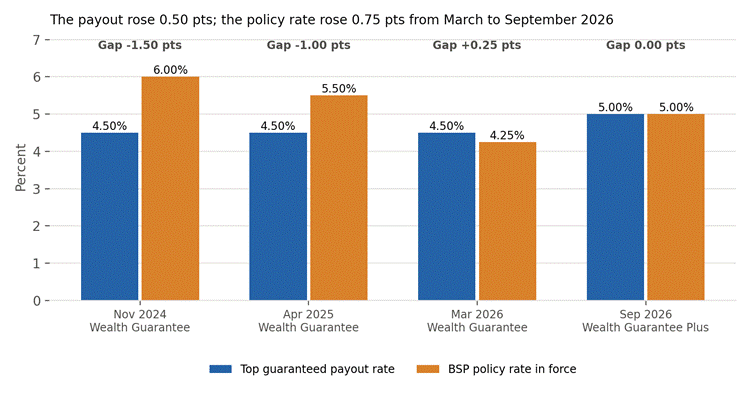
Figure 1. Wealth Guarantee top payout rate vs. the BSP policy rate on each edition’s opening date.
Sources: Manulife Philippines product pages and press releases; BSP decisions as reported by Manila Bulletin (Oct. 16, 2024), Inquirer (Apr. 2025; Apr. 23 and Aug. 2026) and Metrobank Wealth Insights (Feb. 19, 2026). Rates are as published; no interpolation between dates.
So the real problem is not that Filipinos suddenly wanted guarantees. They already bought three editions of this one. The real problem is that a 4.5% guarantee had become unsellable in a 5% rate world, a rival was about to put a new number on the table, and Manulife’s own advisor-sold business had been shrinking. The pressure map below scores each source of pressure against the evidence.
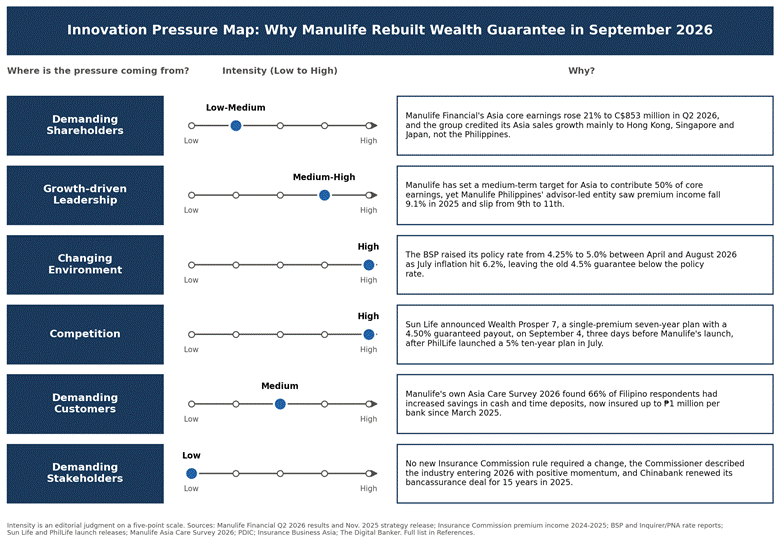
Figure. Innovation Pressure Map for Wealth Guarantee Plus.
Intensity ratings are editorial judgments on a five-point scale; each marker sits on one of five discrete positions. Each Why? statement is sourced in the References list.
Two rows score High and they point in the same direction: the rate environment and a competitor moving at the same moment. Leadership pressure sits just below them. The two Low-end rows matter as much as the High ones. Nothing in the regulator’s posture or Manulife’s group results forced this launch.
These ratings carry real uncertainty. The Demanding Customers row is the hardest to call. If Manulife ever discloses that earlier editions sold out fast, or that surrender requests rose as deposit rates climbed, it should move up to Medium-High. The Shareholders row could move up if Manulife’s next results name the Philippines among its weaker Asian markets. The Competition row could fall to Medium-High if Sun Life’s product turns out to be sold only in small volumes, since its minimum premium is not published.
Three ways to read one launch
Three explanations fit the press release. Each one predicts a different row should be highest on the map, which makes them testable.
The first reading is the customer story. Filipinos want certainty, Manulife listened, and the product got better. If this were the main driver, Demanding Customers would be the top pressure. The evidence supports demand but not urgency. Manulife’s own survey found that 66% of Filipino respondents had increased their savings in cash and time deposits. That is a sign customers are choosing alternatives, not waiting for a better insurance plan. Deposit insurance coverage doubled to ₱1 million per depositor per bank in March 2025, which made the bank option safer too. The customer story explains why guaranteed products sell. It does not explain why the rate had to rise in September rather than March, or why the minimum had to fall.
The second reading is the rate story. Rates rose, so Manulife repriced. This predicts Changing Environment at the top, and the evidence agrees. A 4.5% guarantee sitting half a point under the policy rate would have been hard for any advisor to defend. But the rate story alone predicts a raise at least as large as the market move. Manulife raised the top rate by less. The rate story explains why the product changed. It does not explain the extra payout year, the lower minimum, or the timing down to the week.
Get the next SEA banking case study in your inbox
Free. Unsubscribe anytime.
The third reading is the competitive and channel story. Manulife needed to beat a rival’s number and give its advisors something to sell. This predicts Competition and Growth-driven Leadership near the top. The timing fits it best. Sun Life Philippines announced Sun Life Wealth Prosper 7 on September 4, another limited offer: a one-time premium, a 4.50% guaranteed annual payout, seven years of life cover and full return of premium. Wealth Guarantee Plus went out on September 7 at 5% and 4.75%, a clear 0.25 to 0.50 point edge over Sun Life’s published rate. Sun Life has built for the new-business scoreboard before: its EasyLink Protect launch, covered in Sun Life Skipped the Checkup. It Kept the Sales Call., was built to win new business, not to reach new customers. Smaller insurers were already there too. PhilLife launched Certi5 in July: a ten-year, single-pay plan from ₱100,000 that pays 5% a year starting at the end of year two.
The channel evidence is sharper still. The September announcements name Manulife advisors as the channel. Unlike the 2024 and 2025 editions, they do not mention Chinabank branches or Manulife China Bank Life. And the Insurance Commission’s numbers show why the advisor side needed help. The Manufacturers Life Insurance Co. (Phils.), the company behind Manulife’s more than 10,000 financial advisors and agency leaders, booked ₱15.83 billion in premium income in 2024 and ranked ninth. In 2025 it booked ₱14.39 billion, down 9.1%, and slipped to eleventh. Over the same year Manulife China Bank Life, the bancassurance joint venture, grew 39.5% to ₱14.44 billion and overtook its sister company. Life industry premiums rose 14.5% to ₱403.2 billion.
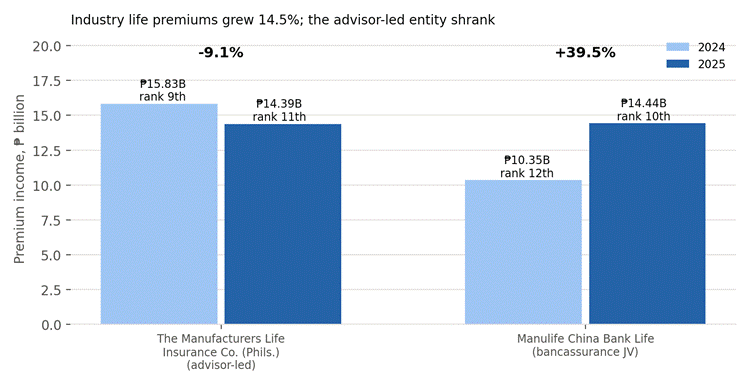
Figure 2. Premium income, 2024 vs. 2025, Manulife’s two Philippine life companies.
Source: Insurance Commission of the Philippines, Performance of Life Insurance Companies, Premium Income as of 31 December 2024 and 2025 (unaudited EQRSFS). Life industry grew 14.5% over the same period.
The rate story and the competitive story are not rivals. The rate environment made a higher guarantee possible and necessary. The competitor and the channel decided its exact shape. The customer story is real but is the least useful for explaining this particular launch. It is the one the press release leads with.
What the half point buys, and what it cannot
Start with the product mechanics. A single premium of ₱3 million earns ₱150,000 a year for seven years, ₱1.05 million in all, plus the ₱3 million back. Under the old terms the same premium earned ₱135,000 a year for six years, or ₱810,000. That is ₱240,000 more, a 30% increase in total payouts. Moving from six payouts to seven inside the same seven-year term is the bigger change. It is worth more than the rate increase itself, and it is what the word “longer” in the launch headline really means. The guarantees hold only while the insured is alive. If the insured dies, the 125% life benefit applies instead. The product page describes a maximum allocation but does not publish an end date, an issue-age range, or what a policyholder gets back if they surrender early.
Now the balance sheet. Guaranteeing 5% for seven years is not a large risk for an insurer when the 10-year government bond yields 7.57%. The gap between what Manulife can earn on long government paper and what it promises the customer pays for the 125% life cover, the advisor’s commission, capital and profit. The more rates rose this year, the wider that gap got. Top-tier buyers in March 2026 locked in 4.5% when the policy rate was 4.25%. Customers buying the Plus lock in 5% when it is 5.0%. Manulife is sharing less of the rate rise with the customer than it did six months ago. That is a rational pricing choice. It is not the same thing as a better deal.
The group can easily afford this. Manulife Financial reported Asia core earnings of C$853 million in the second quarter of 2026, up 21%, and a LICAT capital ratio of 136%. Its Asia sales growth came mainly from Hong Kong, Singapore and Japan. The Philippines was not named. Insurance Commission data put Manulife Philippines’ net worth at ₱14.30 billion at the end of 2025, sixth among life insurers. Capital is not the constraint. Distribution is.
That is where the design starts to look fragile. Wealth Guarantee Plus answers the Competition row directly. It beats Sun Life’s rate and it answers the Environment row well enough. But the Leadership pressure is really about the agency book, and the product answers that one weakly. Manulife measures sales with annual premium equivalent, which counts 100% of regular premiums but only 10% of single premiums. A ₱3 million Wealth Guarantee Plus sale shows up as ₱300,000 in that metric. In the Insurance Commission’s premium income table, by contrast, the full ₱3 million counts in the year it is paid. The product flatters the ranking that makes headlines more than the metric the parent company manages to.
Repetition is the second weak point. Four editions in 22 months turn a “limited-time offer” into a sales calendar. Advisors and customers learn to wait for the next run. And each edition renews only when rates and rivals allow. The BSP’s June projections put inflation back inside its 2% to 4% target by 2028. If rates follow it down, a 5% guarantee may be too rich to relaunch, and the agency channel will need a different product to sell. The bancassurance side shows what steadier growth looks like. Manulife China Bank Life grew 39.5% in 2025 through Chinabank’s branch network, a partnership renewed for 15 years in June 2025. Chinabank itself has always sold to a specific, relationship-driven customer base, as Chinabank Was a Niche Bank Before “Niche Banking” Had a Name describes. That base is exactly the saver a guaranteed single-premium plan suits. Leaving the bank channel out of the September announcements may be a choice about who needs the win most.
A skeptical reader should still doubt three things. First, whether the 125% life cover is worth much to a buyer who already has protection. For many retirees it is not. Second, the absence of a published surrender schedule, which matters for anyone who might need cash before year seven. Third, the real return. With 2026 inflation forecast at 6.1% and 2027 at 5.4% in the BSP’s August projections, a 5% nominal payout loses purchasing power in the near term, and the returned premium in year seven will buy less than it does today.
One product, three honest verdicts
For the customer, the verdict is fair value for a narrow need, not a bargain. The Demanding Customers row is the one that matters here. If you want a fixed peso income, full principal back and some life cover in one contract, and you will not need the money for seven years, Wealth Guarantee Plus is better than the March edition in pesos and better than Sun Life’s 4.50% on paper. But it does not beat the market. Compare it with a Retail Treasury Bond or a time deposit after taxes, ask for the surrender value at years two, four and six in writing, and remember that the guarantee is set in nominal pesos while inflation is above 6%.
For Manulife’s strategy, the verdict is a sensible tactical move with a structural hole. The Competition and Leadership rows drive this verdict. The product wins the headline against Sun Life and gives advisors a reason to call every client with idle cash before year-end. It will probably lift 2026 premium income for the advisor-led entity. It will not, on its own, reverse a 9.1% decline in that entity’s premium, because single premiums do not renew. Watch whether the next results show recurring-premium growth in the agency channel, or only another spike.
For a regulator or analyst, the verdict is low risk now, with a disclosure question. The Demanding Stakeholders row is Low for good reason. The Insurance Commission described the industry as entering 2026 with positive momentum, and a 5% guarantee backed by government yields above 7% is not a solvency threat. The question is how the product is described. Launch coverage called the payouts “returns” and “higher,” which is accurate against earlier editions and misleading against the rate environment. The more useful disclosure would show the guaranteed rate next to the policy rate on the date of sale.
Workshop: test your own “upgrade” before you announce it
Wealth Guarantee Plus shows a pattern that repeats across financial products. A number goes up, and the announcement calls it an improvement, even when the market it competes in moved further. Use the questions below on your own product, pricing change or initiative, then fill in the blank map.
| # | Question | Your answer |
| 1 | Against what did it really go up? Put your new number next to the benchmark your customer can buy instead on the same day, not next to your own previous version. | |
| 2 | Which pressure does the design answer? Name the row on your map that scored highest. Then check whether your change answers that row or a weaker one that is easier to fix. | |
| 3 | Does it repeat or does it build? If the change only works as a one-off offer, write down what you will sell when the offer ends and conditions change. |
Fill in the map for your own product. Rate each row honestly on the five-point scale and write one sourced fact in each Why? cell. If every row reads High, you have not found the real problem yet.
| Where is the pressure coming from? | Intensity (Low to High) | Why? |
| Demanding Shareholders | Low ○ ○ ○ ○ ○ High | |
| Growth-driven Leadership | Low ○ ○ ○ ○ ○ High | |
| Changing Environment | Low ○ ○ ○ ○ ○ High | |
| Competition | Low ○ ○ ○ ○ ○ High | |
| Demanding Customers | Low ○ ○ ○ ○ ○ High | |
| Demanding Stakeholders | Low ○ ○ ○ ○ ○ High |
Tags
Manulife Philippines · Wealth Guarantee Plus · Manulife China Bank Life · Sun Life Wealth Prosper 7 · Guaranteed Payout Plans · BSP Policy Rate · Philippine Insurance 2026 · Insurance · Insurtech · Southeast Asia Fintech
IdeyaHub newsletter
Enjoyed this case study?
Get the next deep dive on Southeast Asian banks, fintechs and insurers in your inbox. One email a week.
Free. Unsubscribe anytime.
References
- Manulife Philippines Launches Wealth Guarantee Plus with Higher, Longer Guaranteed Returns, Mindanao Times (Manulife Philippines press release)
- Manulife launches Wealth Guarantee Plus with seven-year cash payouts, Gadgets Magazine Philippines
- Manulife unveils Wealth Guarantee Plus: guaranteed income, capital safety and life coverage, Context.ph
- Wealth Guarantee Plus, Manulife Philippines
- Wealth Guarantee is Back!, Manulife Philippines
- Manulife and MCBL Launch Limited-offer Wealth Management Product Wealth Guarantee, Manulife Philippines
- Manulife Philippines and MCBL Bring Back Limited-Offer Wealth Management Product Wealth Guarantee, Manulife Philippines
- Asia Care Survey 2026, Manulife Philippines
- Performance of Life Insurance Companies, Premium Income as of 31 December 2025, Insurance Commission of the Philippines
- Performance of Life Insurance Companies, Premium Income as of 31 December 2024, Insurance Commission of the Philippines
- Performance of Life Insurance Companies, Net Worth as of 31 December 2025, Insurance Commission of the Philippines
- Philippine insurance premiums exceed PHP 500 billion, Insurance Business Asia
- Sun Life Responds to Demand for Financial Stability With New Insurance Plan With Guaranteed Payouts, LionhearTV (Sun Life Philippines press release)
- Sun Life responds to demand for financial stability, The Manila Times
- Investors shift to capital safety with PhilLife’s new zero-volatility wealth tool, Context.ph
- BSP cuts policy rates by 25 bps, Manila Bulletin
- BSP cuts policy rate by 25 bps to 5.5%, Inquirer.net
- BSP Update: Giving a subtle nod to growth, Metrobank Wealth Insights
- BSP delivers first rate hike in over 2 years to fight inflation surge, Inquirer.net
- BSP hikes policy rates by another 25 basis points, Philippine News Agency
- BSP raises policy rate to 5%; peso sinks to new low, Inquirer.net
- Philippines 10-Year Government Bond Yield, Trading Economics
- Retail Treasury Bonds Tranche 32, Notice of Offering, Bureau of the Treasury
- Retail Treasury Bonds Tranche 32 FAQs, Bureau of the Treasury
- Maximum Deposit Insurance Coverage, Philippine Deposit Insurance Corporation
- Manulife Reports Second Quarter 2026 Results, PR Newswire
- Manulife Announces Refreshed Enterprise Strategy to Deliver Sustainable, Long-Term Growth, PR Newswire
- Manulife Hong Kong reports double-digit APE sales growth in first quarter of 2021 (APE definition), Manulife
- Manulife Philippines and Chinabank sign 15-year renewal of bancassurance agreement, The Digital Banker