Its unsecured Business Express Loan beats paying a compliance penalty. It isn’t the product that closes the ₱971.5-billion gap the penalty exists to fix — and nothing about it stops BPI or RCBC from running the identical play next quarter.
| Security Bank’s Business Express Loan is a rational, profitable answer to a compliance penalty most Philippine banks just pay instead of solving — which makes it a smart balance-sheet decision, a weak dent in the national MSME financing gap, and not much of a competitive moat on its own. 1. It pays for itself faster than the fine does. Since piloting in 2022, the loan’s portfolio has grown 2.7 times over and its ceiling has risen from ₱5 million to ₱7.5 million, the behavior of a business line generating real income, not a compliance box being quietly checked. 2. It barely moves the number regulators are actually measuring. The eligibility rules require three years in operation with the most recent one profitable, plus a six-month, ₱50,000 banking relationship, which is why universal and commercial banks as a class still lend just 1.5% of their portfolios to micro and small enterprises against an 8% legal mandate. 3. Nothing about the product stops a rival from copying it by Friday. BPI already runs its own unsecured, collateral-free small-business loan through Ka-Negosyo Ready Loan, proof that trading a mortgage for an existing track record isn’t proprietary, so whatever edge Security Bank has here has to come from its balance sheet, not from the loan terms themselves. The rest of this issue works through each of those three claims in the order they actually matter to a bank’s P&L, which is not the order Security Bank’s own press release puts them in. |
Picture the same business owner across two different years. Before 2023, a small wholesaler in Iloilo needing ₱3 million to restock ahead of the school-opening rush had one real option at a universal bank: a collateralized loan, a property appraisal, and a three-to-four-week wait while the paperwork moved between branch and head office, long enough that the inventory window sometimes closed before the money did. Apply for the Business Express Loan today, and the same owner, provided she already banks with Security Bank and can show three years in business with the latest one profitable, submits the application through the same DigiBanker platform she already uses to run payroll, gets a credit decision without producing a single property document, and has funds in five to seven banking days instead of the fifteen to twenty a mortgaged loan still takes. The paperwork didn’t get thinner because a law asked it to. It got thinner because Security Bank swapped a property appraisal for something it already had on file: her own transaction history. That’s a real gain in speed and friction for the businesses this product reaches, and it’s worth seeing clearly before turning to the number that complicates it.
What Security Bank was actually solving for
Any fair verdict on this loan has to start by setting the actual goal it’s being measured against, not the one implied by the press coverage around it. Here are two numbers that were both true in the Philippines at the same moment this year. Security Bank told the public that its new Business Express Loan serves the 99.5% of Philippine businesses classified as MSMEs. The Bangko Sentral ng Pilipinas, through the banking data it publishes quarterly, showed that the country’s banks were collectively ₱971.5 billion short of the minimum they’re legally required to lend those same businesses. Both statements are accurate. Only one of them is about to change because of this product, and figuring out which one requires ignoring the press release entirely and doing the arithmetic yourself.
That arithmetic starts with a law most bank customers have never heard of and most banks would rather not discuss in a launch announcement: the Magna Carta for MSMEs, which sets a floor of 8% of every bank’s loan portfolio for micro and small enterprises and 2% for medium ones. Miss the floor, and a bank doesn’t lose its license or make headlines. It pays a penalty and moves on. By the end of 2025, the country’s banks had lent just ₱575 billion of the ₱12.14-trillion loan book sitting on their collective books to MSMEs of every size, 4.7% against a 10% combined target, with almost the entire shortfall concentrated in the micro-and-small category: ₱238.5 billion actually lent against a required minimum north of ₱971.5 billion. Universal and commercial banks, the tier Security Bank sits in, lend only about 1.5% of their own portfolios to micro and small enterprises. Reporting on the sector has been blunt about what most banks do instead of closing that gap: they simply absorb the noncompliance penalty and move on.
Notice, too, where the shortfall actually sits, because it sets the real target this issue keeps checking BEL against. Medium-sized enterprises, the larger half of the MSME category, already receive more than their 2% quota nationally, roughly ₱336.4 billion against it. The entire ₱971.5-billion gap is concentrated at the smaller end: newly formed businesses, sole proprietorships, family operations without an audited financial history. That’s the goal a genuine solution to the mandate would need to hit. A bank facing an 8% requirement it’s nowhere close to reaching has, roughly, three choices: pay the fine indefinitely, lend indiscriminately to close the gap and eat the resulting bad debt, or build a lending product narrow and profitable enough to make business sense on its own terms, whether or not it fully closes the regulatory gap. Which of those three Security Bank actually picked is the question the rest of this issue answers, one thread at a time.
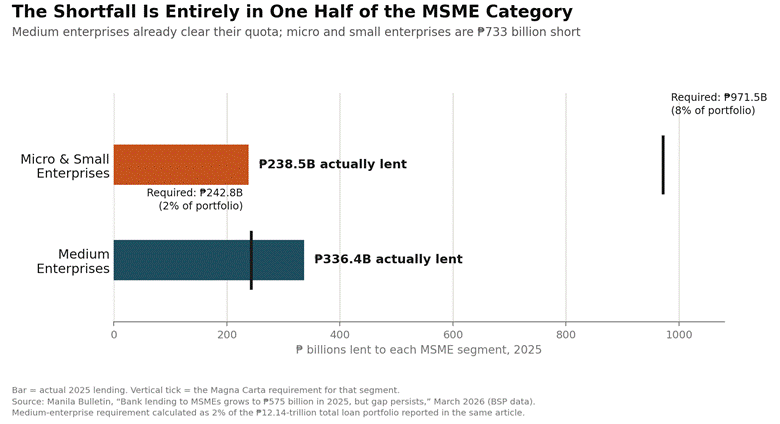
Figure 1. Medium enterprises already clear their quota; the entire ₱971.5-billion shortfall sits with micro and small enterprises, the population BEL’s eligibility rules screen out.
Three ways to respond, and the one Security Bank chose to build
Which of those three paths Security Bank actually took becomes visible only by holding open three different readings of the same facts, because they don’t all survive contact with the numbers.
The first reading is the one the marketing copy invites: a genuine financial-inclusion move, a bank finally building the credit access its “99.5% of Philippine businesses” framing implies. The second is the more cynical read plenty of coverage defaults to for any bank’s compliance-adjacent product launch: a box-ticking gesture, built to generate a press cycle and quietly wound down once the news moment passes. The third reading is narrower than either: a rational, profit-seeking business decision, built because unsecured small-business lending is a genuinely good line of business for a well-capitalized bank, independent of what it does or doesn’t do for the Magna Carta shortfall.
The growth data rules out the second reading almost immediately. Security Bank launched the Business Banking Segment on April 18, 2023, with a four-product ladder: a Business Plus checking account bundled with the DigiBanker cash-management platform, a Revolving Credit Line for short working-capital gaps, a collateralized Business Mortgage Loan, and the Business Express Loan (BEL) itself. A box-ticking product gets built once and left alone. This one didn’t. BEL’s ceiling rose from ₱5 million to ₱7.5 million; its collateralized sibling rose from ₱30 million to ₱50 million, now approved at up to 80% of appraised value inside 15 to 20 working days, against BEL’s five-to-seven-banking-day turnaround for the unsecured version. The segment’s loan portfolio grew 2.7 times over from its 2022 pilot base by the time The Digital Banker named Security Bank Best SME Bank in the Philippines in March 2025, with a single quarter in 2024 alone contributing 60% growth. Security Bank backed that growth with fifty new branches, deliberately weighted toward northern and southern Luzon, the Visayas, and Mindanao rather than an already branch-saturated Metro Manila, and set a public target of capturing 20% of the Philippine MSME lending market within three to five years of the 2023 launch. None of that, the rising ceilings, the branch expansion, a 2025 and early-2026 infrastructure rebuild with ACI Worldwide that pushed InstaPay volume past 10 million transactions a month and lifted domestic payment-rail transactions 35% year-on-year, looks like a compliance gesture nobody expects to matter in three years.
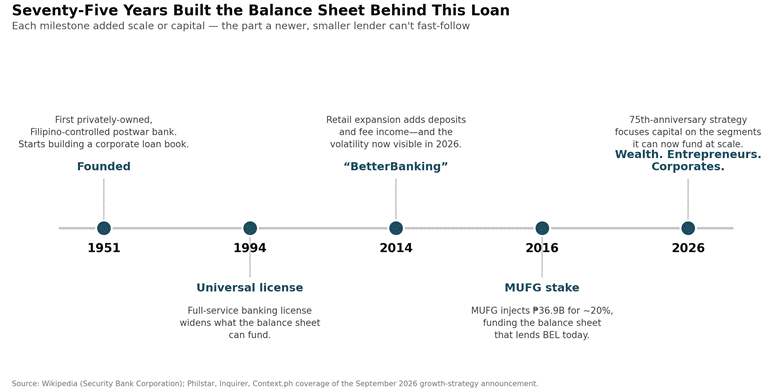
Figure 2. Seventy-five years of scale and capital, not a single new invention, are what let Security Bank keep raising this loan’s ceiling.
That leaves the inclusion reading and the profit reading standing, and 2026’s earnings data tips the scale toward the second. The bank’s first-quarter net income actually fell 3.6% year-on-year to ₱2.7 billion, not because lending slowed, net interest income grew to ₱15.2 billion from ₱11.9 billion, but because non-interest income nearly halved, from ₱3.5 billion to ₱1.9 billion, while credit-loss provisions climbed to ₱3.9 billion in a quarter management itself described as facing “challenging operating conditions.” The first half as a whole recovered to ₱6.1 billion in net income, a 4% year-on-year gain, on ₱34.9 billion in revenue and ₱15.4 billion in pre-provision operating profit. A bank whose fee income just proved it can swing by nearly half in a single quarter has an obvious, self-interested reason to want a dependable, growing lending line sitting next to it, independent of any inclusion mandate. On pure economics, building BEL instead of simply absorbing the noncompliance penalty was the rational call, and the growth numbers are the proof.
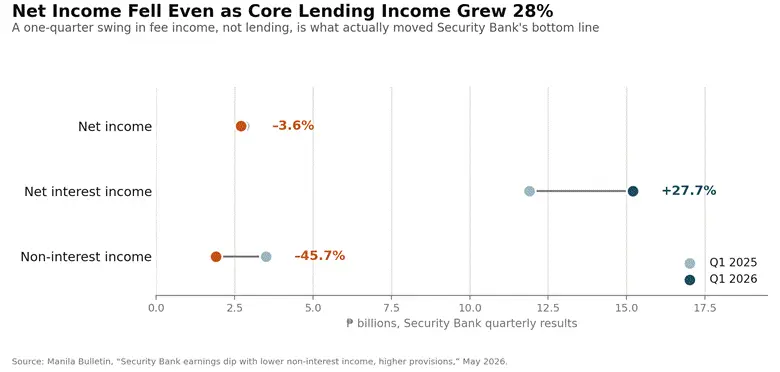
Figure 3. A one-quarter swing in fee income, not a slowdown in lending, is what actually pulled net income down.
What the growth data can’t settle is whether the inclusion reading is also true, whether the product that makes such good business sense also happens to reach the underserved businesses its own marketing invokes. That question doesn’t get answered by looking at Security Bank’s numbers in isolation. It gets answered by connecting them to what the loan actually requires and what everyone else in the industry is already doing.
How a banking relationship became the collateral
To borrow up to ₱7.5 million from BEL with no collateral, a business needs at least three years of operation and profitability in the most recent one. Total outstanding debt can’t exceed 40% of monthly income. And the primary owner needs to already hold a Security Bank deposit account at least six months old with a minimum average daily balance of ₱50,000, or already carry a Security Bank credit card. Connect that list to an underwriter’s logic and the pattern is unmistakable: collateral didn’t disappear from this loan. It moved. Instead of a mortgaged property, the collateral is a proven operating history and an existing balance the bank can already see on its own books. That’s a sound way to price unsecured risk quickly. It is also, by construction, a filter that admits businesses that were already profitable and already banked before they applied, and excludes almost everyone the Magna Carta’s 8% floor exists to reach: first-time borrowers, newly formed micro-enterprises, sari-sari stores and small manufacturers with no prior banking relationship at all.
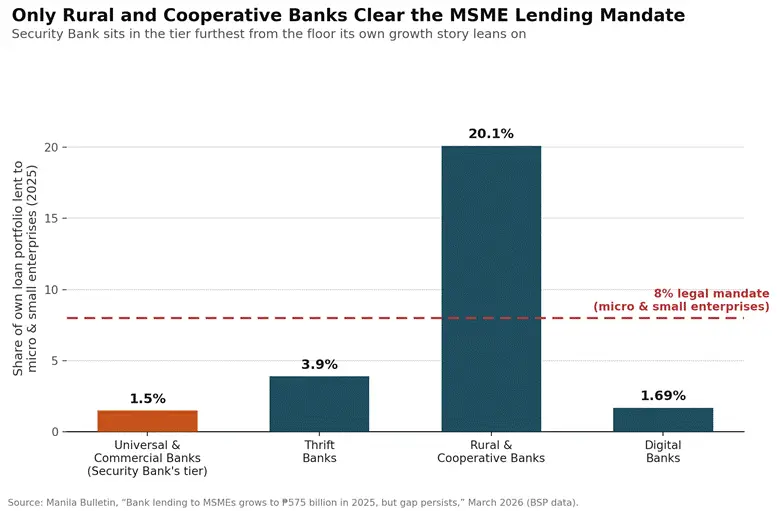
Figure 4. Universal and commercial banks — Security Bank’s own tier — sit furthest below the mandate.
Connect that filter to the system-wide chart and the inclusion reading from the previous section collapses further. Universal and commercial banks, Security Bank’s own tier, allocate roughly 1.5% of their portfolios to micro and small enterprises against an 8% requirement. Thrift banks manage 3.9%. Only rural and cooperative banks, an entirely different tier of institution with an entirely different cost base, actually clear the mandate, lending close to 20% of their portfolios to the smallest businesses. Digital banks, despite marketing themselves around inclusion, sit even lower than the universal banks, under 2%. The businesses failing to qualify for BEL and the businesses driving that system-wide shortfall are, to a first approximation, the same population. A loan that requires three years in operation, a profitable latest year, and an existing six-month banking relationship was never going to be the instrument that moves a number built almost entirely out of businesses that have neither.
Connect the product to its competitors and a third thread appears. BPI already runs its own unsecured, collateral-free small-business loan through Ka-Negosyo Ready Loan, smaller-ticket and shorter-tenor than BEL today, but built on the identical substitution of an existing track record for a mortgage. RCBC, UnionBank, and a widening field of digital banks are chasing the identical slice of the market, established businesses with clean financials and an existing account relationship, because it’s provably the safest place to lend inside an underserved category. None of BEL’s eligibility criteria requires a technology or data source unique to Security Bank. A well-capitalized rival could copy the entire rule set and the turnaround time inside a single product cycle.
The one thread that doesn’t connect as easily for a competitor is capital. Security Bank’s gross non-performing loan ratio stood at 3.08% in the first quarter of 2026, with provisions for credit losses already climbing before that quarter closed. Layering more unsecured lending onto a book where provisioning is rising is a bet a bank can only keep making at scale if its pre-provision earnings can absorb the losses without flinching, and Security Bank’s ₱15.4 billion in first-half pre-provision operating profit is exactly the kind of cushion a smaller thrift bank or a still-unprofitable digital challenger doesn’t have. That’s where the bank’s history actually matters, not as a brand story but as capital: seventy-five years of corporate and commercial lending, a universal banking license since 1994, and a ₱36.9 billion capital injection from MUFG in 2016 built a balance sheet large enough to keep widening an unsecured loan ceiling through a rough earnings quarter. A newer competitor can copy Security Bank’s eligibility criteria over a weekend. Matching the capital base that lets it absorb the downside of those same criteria takes considerably longer.
Connect all four threads, the eligibility filter, the system-wide chart, the competitor doing the same thing, and the capital cushion, and one coherent picture emerges: a narrow, profitable, easily-copied loan sitting on top of a balance sheet that isn’t easily copied at all. That’s a genuinely different picture from either of the two readings this issue started with, and it’s only visible once the four threads are connected rather than read one at a time.
What the finished product proves, and what it doesn’t
Everything connected in the previous section still leaves three different people asking three different questions, and they deserve three different, narrowed answers rather than one blended verdict.
If you’re an entrepreneur deciding whether to apply for this loan, the verdict is straightforwardly positive: BEL is fast, transparently priced, and genuinely faster than the collateralized alternative sitting next to it on the same product page, provided you already clear the eligibility bar. If you don’t clear it yet, three years in business with the latest one profitable and an existing banking relationship, the honest advice is to build toward qualifying rather than expect this specific product to meet you earlier in that journey.
If you’re evaluating Security Bank’s strategy rather than its loan terms, the verdict has to be more qualified. The bank made a genuinely rational choice to build a profitable lending business instead of quietly paying a compliance fine, and the growth numbers show the choice paying off on its own terms. But the marketing language around “99.5% of Philippine businesses” borrows the scale of a national financing crisis to describe a product engineered, by its own eligibility rules, to avoid almost all of the risk that crisis actually represents. That isn’t dishonest so much as it’s a category error worth correcting: BEL is a strong relationship-deepening product for Security Bank’s existing and adjacent customers. It is not, and was never underwritten to be, the product that closes the ₱971.5-billion gap it keeps getting mentioned alongside.
If you’re a regulator or a policy analyst watching this from the outside, the useful signal isn’t Security Bank’s growth rate at all. It’s that a bank can now report a 2.7-times portfolio expansion, a rising loan ceiling, and an industry award for MSME lending, while the system-wide micro-and-small number it’s supposedly helping move barely budges. That gap between one bank’s press-release metric and the sector-wide compliance metric is exactly the kind of thing a mandate review should be measuring directly, rather than inferring from award citations and growth percentages that were never designed to answer the question.
Three tests for the next “we solved it” claim
None of the arithmetic above is useful unless it produces something you can actually act on next time a similar claim crosses your desk. Before you take any company’s claim that a new product solves an underserved-market problem at face value, whether it’s a bank’s MSME loan, a fintech’s inclusion pitch, or your own team’s proposal, run it through the same three tests this issue just applied to Security Bank.
| # | Test | Your answer |
| 1 | The economics. Does this product pay for itself faster than the cost of doing nothing — a fine, a lost customer, a missed deadline? If the growth data shows it does, that’s a real business decision, not proof it solves the underlying problem. | |
| 2 | The target. Does the product’s actual eligibility or access requirements match the population the stated problem is measured by, or does it quietly select for people already close to qualifying anyway? Write down the real filter, not the marketing description. | |
| 3 | The copy test. If a well-funded competitor matched the product’s terms tomorrow, what’s still defensible a year from now: the product itself, or something underneath it — a balance sheet, a dataset, a relationship — that takes years to build? |
If your answers to questions 1 and 3 are strong but question 2 is weak, you’re looking at a good business decision wearing a social-impact headline, which is exactly what a skeptical reader should assume by default until the company discloses the numbers that prove otherwise.
Tags: Security Bank · Philippine Niche Banking · MSME Lending Philippines · Business Banking · Magna Carta MSMEs · Philippine Banking 2026 · Financial Inclusion · Regulatory Compliance
References
- Security Bank unveils 3-year growth strategy, Philstar
- Security Bank maps out 3-year growth push, Inquirer
- Security Bank targets wealth, entrepreneurs for growth, Context.ph
- Security Bank H1 net income rises 4% to P6.1 billion, Tribune
- Security Bank earnings dip with lower non-interest income, higher provisions, Manila Bulletin
- Security Bank enables Filipino MSMEs through new Business Banking Segment, Security Bank
- Security Bank sets ambitious goal for small business loans, Inquirer
- Security Bank targeting boost in MSME lending, The Digital Banker
- Security Bank named Best SME Bank in the Philippines by The Digital Banker, Security Bank
- Business Express Loan – Up to ₱7.5M Unsecured, Security Bank
- Business Mortgage Loan – Up to ₱50M With Collateral, Security Bank
- ACI Worldwide and Security Bank Philippines Set New Benchmark for Enterprise-wide Payments Modernization, Business Wire
- Bank lending to MSMEs grows to ₱575 billion in 2025, but gap persists, Manila Bulletin
- PHL banks fail to meet MSME lending quota in Q1, BusinessWorld
- Security Bank, Wikipedia