A record profit year at the Philippines’ 17th-largest bank was won at the branch counter and the corporate lending desk, not inside the digital wallet it spent five years building.
| PBCOM’s 2025 turnaround is real. But it is a branch-and-balance-sheet story, not the “digital-first” story the bank has been telling since 2021. 1. The core numbers are genuinely strong. Net income hit a record ₱2.5 billion in 2025, up 15.3% from ₱2.2 billion in 2024, while total assets grew 18.1% to ₱185.3 billion. 2. The digital front door is thin and split in two. PBCOM runs separate apps for opening an account (PBCOMobile) and for banking day to day (POP), and POP’s 3.3-star rating and roughly 100,000 downloads trail Security Bank’s app (4.0 stars, over a million downloads) and UnionBank Online (4.8 stars, over ten million). 3. The growth is getting pricier to fund, and thin digital engagement is part of the reason. PBCOM’s low-cost CASA deposit ratio slid from 50% at the end of 2024 to 43.2% by September 2025, pushing the bank toward time deposits that grew 35.5% and cost more to carry. None of that shows up as clearly on a balance sheet as it shows up in the ten minutes a banking app just ate out of somebody’s lunch break. |
“Lose[s] its state completely” is how one PBCOM customer summed up the POP app in a Google Play review this year, describing what happened when she switched away to check a text message mid-transfer and came back to a blank login screen. Read on its own, it sounds like an ordinary one-star complaint. Run it through an actual payment with a deadline attached, and it is eight wasted minutes and a second OTP request, for something that is supposed to post in under a minute.
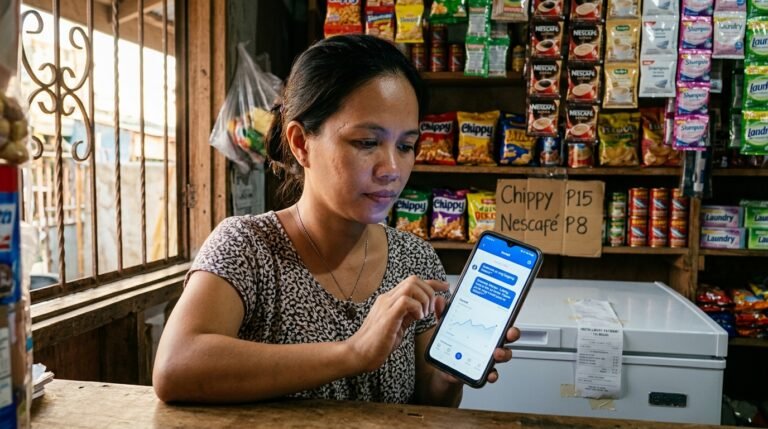
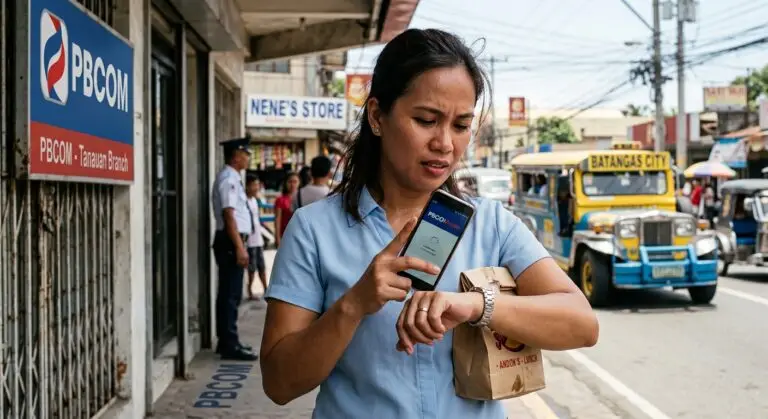
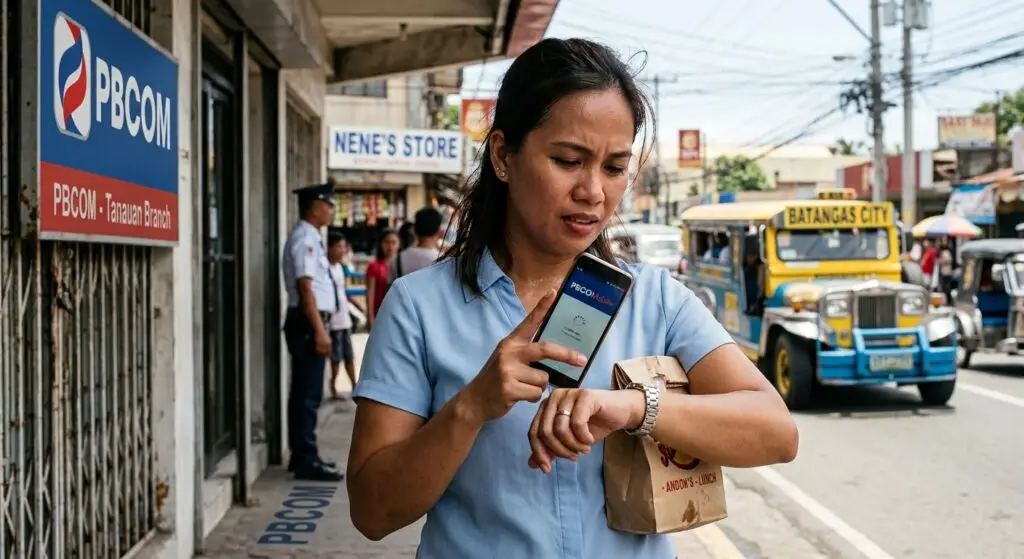
Here is what that failure looks like when it lands on someone with a deadline. It is tuition week at a private school outside Cabanatuan, and a mother on her lunch break opens POP’s bill-payment screen to settle her son’s second installment, ₱7,500, before the school’s 5 p.m. cutoff. She keys in the student number and the amount, confirms, and waits for the OTP. It does not arrive in the window the app allows. She checks her messages, the app drops to the background, and when she comes back, POP has logged her out completely, the same reset a reviewer flagged months earlier. She logs back in, requests a new code, and this time it lands: the payment posts and a reference number appears within seconds, which is genuinely how fast digital bill payment is supposed to work. But she has burned nearly ten minutes of a thirty-minute lunch break paying a bill that should have taken one, and she still has not eaten.
This scene is reconstructed, not a single verified transaction, but every point of friction in it, the missing OTP, the app losing its session, the second login, is a pattern documented across PBCOM’s own user reviews on Google Play through 2025 and 2026, not an isolated bad week. That gap, between rails that genuinely work in under a minute and an app wrapped around them that keeps losing the plot, is the story underneath PBCOM’s headline numbers this year. The bank’s balance sheet says one thing. Its app store page says another. Both are true at once, and a niche-fintech reader should care about why.
A Turnaround Built the Old-Fashioned Way
Start with what actually happened at PBCOM in 2025, because it is a genuinely good year and deserves to be read as one before anything else.
Net income reached a record ₱2.5 billion, up 15.3% from ₱2.2 billion in 2024, and earnings per share climbed the same 15.3%, to ₱5.30. Interest income was up 11.3% year over year at ₱10.8 billion, and the bank held its net interest margin at 3.9%. The balance sheet grew even faster: PBCOM finished the year with ₱185.3 billion in total assets, 18.1% more than the ₱156.9 billion it carried at the end of 2024. Underneath that, the loan book barely budged, closing at ₱101.7 billion, while investment securities added 7.6% to reach ₱31.1 billion and overall deposits ended the year 18% higher. Deposit growth is the quiet lever mid-sized Philippine banks compete on, and RCBC’s ₱100,000 Door Into Priority Banking shows a rival pulling it through a priority-banking threshold instead of new branches.
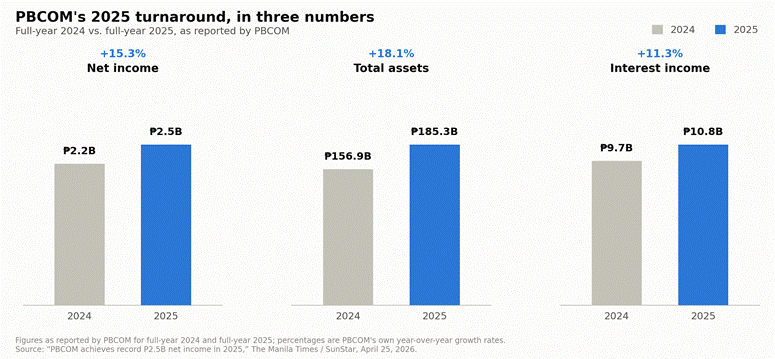
Figure 1. PBCOM’s 2025 results against 2024, the year-over-year jump in the three numbers that carried the bank’s turnaround headlines.
None of that came from a viral app or a fintech partnership. It came from the oldest playbook in Philippine banking: open more branches, sign more corporate and commercial loans, and let a controlling shareholder’s retail footprint do some of the customer-acquisition work. PBCOM is majority owned by retail tycoon Lucio Co, who also controls the Puregold supermarket chain, and the bank has leaned on that relationship directly, placing branch-lite counters inside Puregold stores. As of that September 2025 count, PBCOM’s physical footprint stood at 96 branches, four of them tucked inside Puregold stores, backed by a network of 174 ATMs and 144 cash deposit machines. In July 2026 it marked its 100th branch, in Santiago City, Isabela, a milestone the bank’s own newsroom framed as evidence of “strengthening presence nationwide.” It is the opposite of the pattern IdeyaHub traced in Philippine Banks Aren’t Inventing New Products. They’re Reconnecting Old Ones., where the growth came from wiring existing pieces together rather than adding footprint.
The credit story backs this up. Philippine Rating Services Corporation, the country’s main local rating agency, last published an issuer rating for PBCOM in September 2024: PRS Aa minus with a stable outlook, citing the bank’s earnings growth, improving asset quality, and the “enhanced growth potential” it gained after regulators approved its universal banking license in February 2022, a license that lets PBCOM move into investment banking, underwriting, and trust services it could not previously offer. Size-wise, PhilRatings had PBCOM sitting around the middle of the industry pack as of mid-2024: 17th nationally on assets and deposits, 15th on capital. That standing has almost certainly moved up given 2025’s 18% asset growth, though the agency had not published a refreshed rating as of this writing.
In June 2026, PBCOM added a leadership change that fits the same pattern: it named John Cary L. Ong, a roughly 30-year banking veteran and former head of wholesale banking at Security Bank, as its incoming president and CEO, succeeding Patricia May T. Siy, who led the bank for over a decade and will move to the board. Ong’s background, corporate and commercial banking at Security Bank, UnionBank, Citibank, and Deutsche Bank, signals where the bank expects its next leg of growth to come from: bigger corporate clients, not a mass-market app.
That is the part of the PBCOM story that gets the press releases. The part that does not is what happens when an actual retail customer opens the bank’s phone app.
Two Apps, One Bank, Neither One Loved
PBCOM’s digital story starts further back than most readers would guess. In May 2021, PBCOM went live on Temenos Transact, a cloud-hosted, software-as-a-service core banking platform, becoming one of the first commercial banks in the Philippines approved to host its core banking system in the cloud. At the time, PBCOM’s chief operating officer, John Howard D. Medina, said the bank was “building ‘digital-first’ banking services” that customers could reach entirely from a mobile device, and described the new system as flexible and API-ready enough to support faster product launches and future open-banking services.
Five years on, that infrastructure is real, but the consumer product built on top of it is thin, and split across two separate apps that do not talk to each other in any way a customer would notice. A new customer who wants to open a PBCOM account without visiting a branch downloads PBCOMobile, which handles selfie-and-ID verification, account opening, and basic transfers. It carries a 3.6-star rating from 144 reviews on Apple’s App Store. Once that account exists, the same customer has to download an entirely different app, POP (PBCOM Online Platform), to actually manage it day to day: check balances, pay bills, send InstaPay transfers, request e-statements, or update contact details. POP carries a 3.3-star rating on both Android (744 reviews, over 100,000 downloads, most recently updated September 4, 2026) and iOS (172 ratings). A customer’s very first interaction with PBCOM’s digital bank, in other words, happens in an app she will then abandon the moment her account is live.
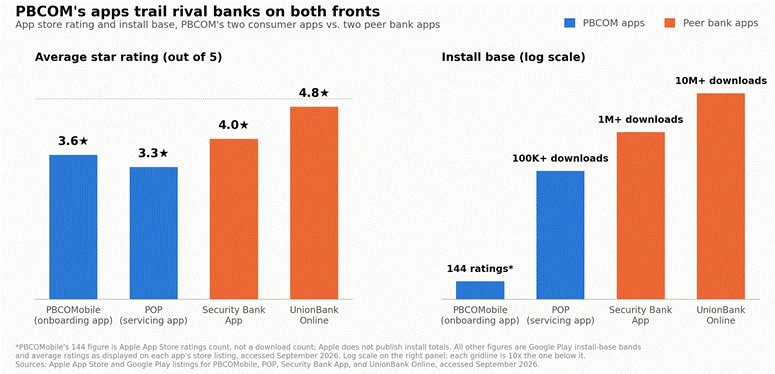
Figure 2. Star ratings and install base for PBCOM’s two consumer apps against two peer bank apps, log scale on the right panel because the gap spans two orders of magnitude.
The reviews on both apps describe the same handful of problems, repeated across years rather than isolated to one bad release. Users report OTPs that never arrive, forcing a fresh login before they can retry a transfer. Others describe the app losing its session entirely if they switch to another app mid-transaction, the exact failure in the tuition-payment scene above. Some report being locked out of their accounts after a failed password reset, with one calling the recovery process simply “POOR,” and several complain that PBCOM’s customer service, by phone and by social media, is slow or unhelpful when these issues come up. On the positive side, users do credit the app for fingerprint login and a “Quick Balance” feature that shows account balances without a full login, and PBCOM has kept shipping incremental fixes: a July 2026 update (version 1.1.76) was billed as strengthening account security, and an earlier update raised the app’s displayed PDIC deposit insurance coverage to reflect the current ₱1 million limit.
It would be easy to write this off as a general truth about Philippine bank apps, that ratings in this category always run low because reviewers only show up to complain. That explanation does not survive a direct comparison. Security Bank’s consumer app carries a 4.0-star rating across nearly 12,000 reviews and has passed a million downloads. UnionBank Online, the largest traditional bank’s retail app, carries a 4.8-star rating across 372,000 reviews and has passed ten million downloads, two orders of magnitude beyond POP’s reach. Both of those banks are, like PBCOM, universal banks operating under the same Bangko Sentral ng Pilipinas rules, competing for the same deposit base. The gap is not that Filipino bank-app reviewers are harsh. It is that PBCOM’s specific app, across two separate installs, keeps failing at the two things a banking app cannot fail at: authenticating a login and holding onto a session. For a different take on the same digital catch-up problem, Chinabank Was a Niche Bank Before “Niche Banking” Had a Name looks at how a 106-year-old bank rebuilt its business platform on vendor software.
Get the next SEA banking case study in your inbox
Free. Unsubscribe anytime.
Same Rails, Worse Wrapper
Strip away the marketing language and POP is not actually a differentiated product. Almost everything it does, InstaPay transfers, PESONet, bill payment, QR PH, Smart Padala, runs on national payment rails that Bangko Sentral ng Pilipinas requires every universal and commercial bank to connect to. A Filipino bank app in 2026 does not build its own real-time transfer network the way a fintech might; it plugs into infrastructure the whole industry shares. Security Bank’s app, UnionBank Online, and POP all move money through the same InstaPay switch, at the same speed, under the same BSP rules. Even the transfer-into-GCash feature is not a PBCOM exclusive: any InstaPay-participating bank can send funds into a GCash or Maya wallet, because GCash and Maya are themselves InstaPay participants. That is commodity plumbing, not a moat, and it means the honest comparison between POP and its rivals is not “different products” so much as the same product, executed with different reliability.
Where PBCOM does have something genuinely distinct, none of it lives inside the app. The Puregold branch placements are a real structural asset: four branches physically inside Puregold stores as of September 2025, with more branch-lite formats planned, giving PBCOM a distribution channel that Security Bank and UnionBank cannot simply out-code their way past. The universal banking license the bank regained in 2022 opens investment banking, underwriting, and trust services well beyond what a savings-and-checking app does, but that differentiation sits on the corporate and wholesale side of the balance sheet, the side new CEO John Cary Ong’s entire career has been built around, not in a retail customer’s pocket. And the Temenos cloud core, PBCOM’s most publicized “digital-first” credential, is a genuine technical edge over banks still running on legacy on-premise systems, except that five years after go-live it has not produced an app that ships faster or works better than competitors running less modern infrastructure. UnionBank Online, built on less newsworthy technology, is still the one with the 4.8-star rating.
The one place PBCOM’s app is actually distinct from its rivals is the two-app split itself, and that distinction cuts the wrong way. Splitting onboarding and servicing into PBCOMobile and POP is not a feature competitors lack; it is friction competitors chose not to impose. Which leaves an uncomfortable but clarifying way to state the whole case: PBCOM isn’t selling a differentiated digital product. It’s selling the same shared national rails as everyone else, wrapped in a worse app, while the things that would actually set it apart, the branch network, the license, the balance sheet, never show up on the login screen.
Why the Fragmentation Shows Up in the Funding Line, Too
Here is where the app story and the balance sheet story actually connect, and it is not a coincidence.
Between the end of 2024 and September 2025, PBCOM’s CASA ratio (the share of its deposits sitting in current and savings accounts, which pay little or no interest) fell from 50% to 43.2%. Over the same stretch, time deposits, which pay a fixed and generally higher rate, jumped 35.5%, to ₱74.8 billion. PBCOM itself has said publicly that rebuilding its low-cost CASA base is now a priority for sustaining growth into 2026, which is a polite way of saying the bank spent 2025 buying deposit growth with a more expensive funding mix than it would like.
CASA money is sticky money. It stays in an account because a customer uses that account for everyday spending, bill payments, and payroll, the exact behaviors a good banking app is built to capture and keep captured. A customer who can reliably move money, pay bills, and check balances from her phone has very little reason to pull funds out into a term deposit at a different bank, or into an e-wallet, for convenience. A customer who cannot reliably do those things inside her banking app has much less reason to leave her money sitting idle in a low-yield account when a fixed-term deposit, or a rival’s better app, is one branch visit or one download away. PBCOM’s own numbers suggest this is exactly what happened: CASA eroded at the same time the bank’s flagship retail app was shipping “enhanced security” patches for problems reviewers had already been describing for years.
This matters more in the Philippines in 2026 than it would have five years ago, because the country’s payments infrastructure has caught up to make digital engagement genuinely decisive. The Bangko Sentral ng Pilipinas reported that digital channels accounted for 64.7% of the total volume of retail payments in 2025, up from 57.4% in 2024, landing comfortably inside, and just past the midpoint of, the 60%-to-70% digital payment penetration range the government set out in its Philippine Development Plan. QR PH, the central bank’s interoperable QR standard, processed 2.47 billion transactions worth ₱1.16 trillion in 2025, the first year it overtook debit and credit cards combined, and PESONet, the batch electronic fund transfer system, overtook paper checks for the first time in the same year. BSP Governor Eli M. Remolona, Jr. has credited much of that growth to regulatory design rather than any single product: “a lot of the growth is due to our insistence on interoperability, ensuring that a growing number of businesses and service providers are on one system,” he said.
The scale of PBCOM’s digital-native competitors makes the point sharper still. GCash, the e-wallet operated by Mynt, a joint venture of Globe Telecom, the Ayala Group, and Ant Financial, says on its own website that more than 94 million Filipinos have used the app, and Mynt was preparing, as of September 2026, to list on the Philippine Stock Exchange on October 20, 2026, at a targeted valuation of at least $8 billion. Maya, GCash’s closest rival, had already passed 50 million registered wallet users by mid-2022 and has kept adding users since, and, unlike GCash’s e-money license, it holds one of only six full BSP digital bank licenses in the country, letting it offer PDIC-insured deposit accounts directly inside its wallet app. PBCOM is not trying to out-build GCash or Maya, and it does not need to: POP already lets a PBCOM customer send a real-time InstaPay transfer directly into a GCash account, which is arguably the more realistic strategy for a bank PBCOM’s size, plug into the national rails rather than build a rival superapp. But that strategy only works if the plumbing on PBCOM’s own side of the connection is reliable enough that a customer trusts it with a tuition payment on her lunch break, without a second login attempt.
Three Verdicts, Because One Reader’s Answer Isn’t Another’s
A retail customer, a PBCOM strategist, and an outside analyst would each walk away from this story with a different, honest answer, and it is worth separating them rather than collapsing them into one grade.
For the retail customer, POP is workable for a PBCOM account holder who already banks there for a savings account, a payroll deposit, or a small business loan, and who mainly needs occasional transfers and bill payments. The core rails, InstaPay, PDIC coverage now correctly shown at ₱1 million, fingerprint login, genuinely work once a login succeeds. But this is not, in 2026, a primary digital wallet in the way GCash or Maya are for most Filipinos, and a customer who expects app-store-reviewed reliability for everyday spending should keep a second, more digitally mature account or e-wallet alongside it rather than depend on POP alone.
For PBCOM’s own strategy, the Temenos migration was the right long-term infrastructure bet, and the bank deserves credit for making it in 2021, well ahead of many peers its size. But five years later, the consumer product built on top of that infrastructure has not caught up to the ambition of the “digital-first” language the bank used to announce it. The 2025 turnaround PBCOM can genuinely celebrate, record profit, record assets, a 100th branch, was won through branches, Puregold placement, and corporate lending under a new CEO whose entire background is wholesale banking, not through the app. That is a coherent strategy. It is just a different strategy than the one PBCOM’s own marketing has implied since 2021, and the bank would do its shareholders a service by being plainer about which growth engine is actually running.
For an outside analyst or regulator, the fundamentals are sound: rising profit, rising assets, a stable investment-grade local rating as of its last published review, and a universal banking license that opens new fee-generating business lines. The thing worth watching is the funding mix. A bank that finances asset growth increasingly through costlier time deposits, while its digital retail channel struggles to hold onto low-cost CASA balances, is more exposed to rate swings and refinancing pressure than a bank with a genuinely sticky, digitally engaged deposit base. PBCOM already leans on capital markets alongside deposits to fund growth: its maiden ₱2 billion bond offering in October 2024, whose proceeds PBCOM earmarked for general corporate purposes including refinancing existing debt and supporting loan growth, drew almost four times its target and closed at ₱7.7 billion, and by mid-2026 the bank was preparing to redeem that issue and return to the bond market for fresh funding. A stronger retail app would not replace that need for market funding, but a stickier, better-used one would give PBCOM more cheap deposit funding to lean on instead.
Turn This Into a Worksheet for Your Own Product
The PBCOM story is not really about one Philippine bank. It is about a mismatch that shows up constantly in fintech and banking: solid infrastructure paired with a customer-facing product that never gets the same investment, and a growth story that gets told through whichever channel happens to be working, even if that is not the channel the company is publicly betting on.
If you are building, evaluating, or investing in a financial product, borrow these three questions from the PBCOM case and run them against your own.
| Question | Why it matters |
| When your team upgrades core infrastructure, does a customer ever feel the difference, or does the improvement stay invisible behind the same login screen? | PBCOM’s cloud core banking migration was real engineering progress in 2021, but by 2026 it still has not translated into an app customers rate above three and a half stars. Infrastructure wins only count commercially once a customer can feel them. |
| If a new customer needs one app to join you and a different app to actually use you, what is that costing you in reviews, downloads, and abandoned sign-ups? | PBCOM splits onboarding and servicing across PBCOMobile and POP. Competitors that kept it to one app, like UnionBank Online, are collecting ratings and installs an order of magnitude larger. |
| Is your growth funded by cheap, sticky money that your product keeps engaged, or by chasing expensive deposits and debt because the product isn’t sticky enough to hold cheap money on its own? | PBCOM’s CASA ratio fell from 50% to 43.2% in nine months while time deposits climbed 35.5%. A reliable, well-used app is a funding strategy, not just a convenience feature. |
Tags: PBCOM, Philippine banking, digital banking, core banking modernization, Temenos, mobile banking UX, deposit funding costs, GCash, Bangko Sentral ng Pilipinas, neobank competition
IdeyaHub newsletter
Enjoyed this case study?
Get the next deep dive on Southeast Asian banks, fintechs and insurers in your inbox. One email a week.
Free. Unsubscribe anytime.
References
- PBCOM achieves record P2.5B net income in 2025, sustains strong growth momentum, The Manila Times, April 25, 2026
- PBCOM net income hits record P2.5B in 2025, SunStar, April 2026
- PBCOM targets high-cost deposit rebalance to sustain 2025 growth, Manila Bulletin, December 26, 2025
- PBCom gets double-A credit rating, Manila Bulletin, September 22, 2024
- PBCom celebrates 100th-branch milestone in Santiago City, The Manila Times, July 6, 2026
- Former Security Bank Veteran John Cary L. Ong Named PBCOM CEO, Fintech News Philippines, June 2026
- PBCom names former Security Bank EVP Ong as incoming president and CEO, BusinessWorld, June 25, 2026
- PBCom looks to raise at least P2 billion from maiden bond issuance, BusinessWorld, October 15, 2024
- PBCOM Secures PhP7.7 Billion in Oversubscribed Maiden Peso Bond Offering, press release via PDS, November 2024
- PBCom to redeem P7.7B in corporate bonds, BusinessWorld, May 6, 2026
- Philippines’ PBCOM Goes Live with Temenos SaaS to Offer “Digital-First” Banking Services, Temenos press release, May 2021
- PBCOM goes live on cloud-based Temenos core banking system, FinTech Futures, May 2021
- PBCom Receives High Credit Rating (PRS Aa minus, stable outlook), Philippine Rating Services Corporation, September 20, 2024
- POP (PBCOM Online Platform), Google Play Store listing, accessed September 2026
- POP (PBCOM Online Platform), Apple App Store listing, accessed September 2026
- PBCOMobile, Apple App Store listing, accessed September 2026
- PBCOM Online Platform product page, PBCOM
- Security Bank App, Google Play Store listing, accessed September 2026
- UnionBank Online, Google Play Store listing, accessed September 2026
- Digital payments accounted for 64.7% of total retail payments in 2025, says BSP, GMA News Online, August 2026
- About Us (94 million users figure), GCash, accessed September 2026
- Maya (mobile payments), Wikipedia, registered-user figures with citations
- Digital payments now make up 64.7% of Philippines retail transactions, Philstar.com, August 18, 2026
- GCash parent Mynt targets October 20, 2026 PSE listing in major IPO, GMA News Online, September 2026
- Maya is 1 of the 6 BSP-Licensed Digital Banks in the Philippines Today, Maya, 2026
- PBCOM Obtains Universal Bank License Approval, PBCOM press release, February 2022