A close read of how Vietnam’s first EBITDA-profitable digital bank built a genuinely differentiated lending business around a credit gap most banks ignored, and why its capital structure, its profit claim, and its original distribution partner each carry a real, unresolved risk the awards don’t mention.
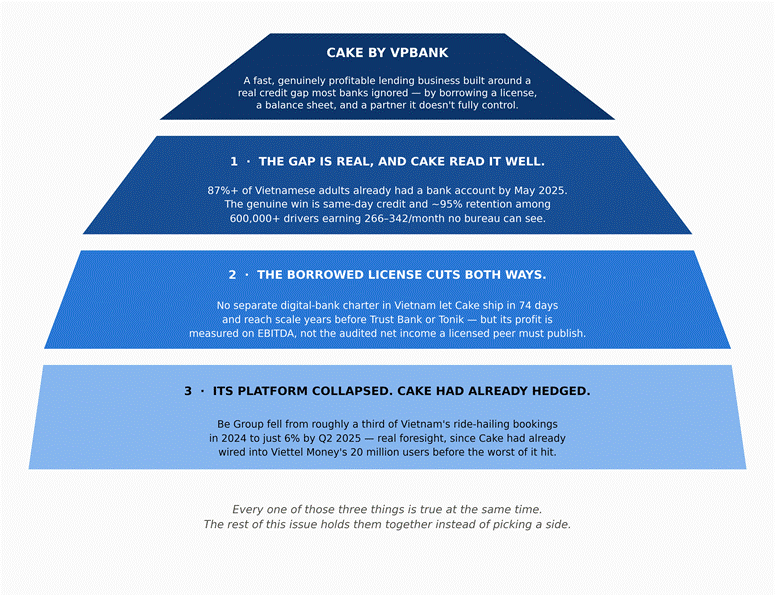
The takeaway, structured as a pyramid: one governing idea, three supporting arguments.
A Be driver in Ho Chi Minh City finishes a shift a little short. Rent is due, the motorbike needs a chain, and the next payout from the app is still two days out. He doesn’t visit a branch or fill out a loan application. He opens Cake, the digital bank stitched into the same app he uses to accept rides, and asks for an advance against the earnings the app can already see: how many trips, how consistently, how long he’s been driving. The money lands the same day, sometimes within the hour. Nobody checked a credit bureau, because for most of Vietnam’s gig workforce there’s nothing there to check.
That single transaction is the whole business case for Cake by VPBank, and it’s also the reason almost every write-up of the bank gets the story half right. The standard version says Cake brought banking to Vietnam’s unbanked, the same headline written about GXS Bank in Singapore, Bank Jago in Indonesia, and Tonik in the Philippines. It’s a clean story. It’s also the wrong one for this particular country. Vietnam isn’t an unbanked market. As of May 2025, the State Bank of Vietnam put account ownership among adults at more than 87%, a figure closer to the developed markets Southeast Asia’s neobanks are usually compared against than to the roughly half of Filipino adults or the 61.7% of Indonesians who still sit outside formal banking. If Cake were only in the business of opening accounts, it would be fighting over table scraps in an already-saturated market. It isn’t. It’s in the business of underwriting people the 87% figure quietly hides, drivers, delivery riders, and gig workers whose income is real and steady but invisible to the credit infrastructure a bank statement or a bureau file is built to read.
That’s a narrower business than “financial inclusion,” and a more interesting one, because it means Cake’s five years of growth, its profit claims, and its risk all trace back to one specific bet: that a ride-hailing app’s own transaction data is a better underwriting signal than anything a traditional bank can pull from a government database or a payslip. Whether that bet has actually paid off, and what could still unwind it, is a different question than the one most coverage of Cake bothers to ask.
The account was never the problem. The paycheck was.
Start with what Cake actually built, because the products give away who they’re for. Cake Super, its flagship savings account, automatically splits a deposit into VND 200,000 (about $8.50) sub-accounts and pays interest described as up to 18 times the market average, a structure that only makes sense for someone managing income in small, frequent, unpredictable amounts rather than a single monthly paycheck. Its consumer loans for drivers promise one-business-day disbursement, underwritten against the trip, tenure, and earnings data Be’s app already logs. Its salary-advance product with telecom partners lends over terms shorter than a month, a maturity no traditional bank bothers offering because the fixed cost of underwriting a loan that small rarely clears the interest earned on it. And its micro-investment product with Dragon Capital lets someone put as little as VND 10,000, roughly 50 cents, into the stock market. None of these are designed for someone who lacks a bank account. They’re designed for someone who has one, or could easily get one, but whose income doesn’t look like income to the systems that decide who gets credit.
That distinction matters because it changes what “success” should even mean for Cake, and by that measure the numbers are genuinely strong. Cake reached 2 million customers within 20 months of its January 2021 launch, crossed 5 million by 2024, the largest customer base of any Vietnamese digital bank, and had grown to 6.2 million by the third quarter of 2025, processing more than a million credit applications a month against $12.8 billion in cumulative transaction value. Total income surged 225% in the first nine months of 2025 against the same period a year earlier, with profit roughly quadrupling in the third quarter alone even as operating expenses rose 83%, the kind of spread between revenue growth and cost growth that’s supposed to be the entire point of a digital-only balance sheet. Revenue per user reportedly tripled year-on-year to around $12, and Cake has been named Vietnam’s Best Digital Bank by both The Asian Banker and Euromoney, alongside a spot on TAB Global’s World’s Top 100 Digital Banks list for two years running. Retention sits at roughly 80% among customers who transact frequently and climbs to about 95% among those who’ve adopted an actual financial product like a loan or a savings account, which is the number that should matter more to a bank than raw user counts: it says the lending and savings products, not just the payments layer, are what’s keeping people around.
The credit-not-access framing also explains something that would otherwise look like an odd choice: Cake didn’t try to become the biggest wallet in Vietnam, a fight GCash-style super-apps and Viettel’s own MoMo are already having. It built a comparatively narrow lending and savings product and pointed it at a segment defined by income pattern rather than geography or age. Vietnam’s roughly 600,000 ride-hailing and delivery drivers are still classified as “business partners” rather than employees, a designation platforms have held onto since 2014 despite a 2019 labor code that arguably should have changed it, which means they carry no employer-sponsored social insurance, health insurance, or unemployment protection. A 2021 survey by Vietnam’s General Confederation of Labor and Oxfam put their take-home pay at VND 7 to 9 million a month, $266 to $342, for shifts running 8 to 13 hours. That’s a workforce with real, recurring cash flow and close to nothing a conventional underwriter can point to as proof of it. Cake’s actual innovation was deciding that Be’s own trip logs were proof enough.
A bank that never had to become one
Here’s the part of the Cake story that gets skipped in almost every writeup, and it cuts in Cake’s favor as much as it raises questions. Singapore’s MAS, the Philippines’ BSP, and Malaysia’s BNM all created a specific legal category for this kind of company: a standalone digital bank license, its own capital requirements, its own board, its own regulatory reporting separate from any parent institution. GXS Bank, Trust Bank, Tonik, GoTyme, and GXBank all operate under exactly that kind of charter. Vietnam has no equivalent. As of this writing, the State Bank of Vietnam and the Ministry of Planning and Investment are still arguing over when, not whether, to introduce a digital bank framework tied to a planned international financial centre, with the SBV pushing for a 2027 start and the MPI wanting 2026. Until that framework exists, there is no such thing as a separately licensed Vietnamese digital bank.
Cake isn’t one. It’s a product, branded and marketed as a bank, sitting entirely inside VPBank’s own commercial banking license, one of four segmented digital brands VPBank runs alongside NEO for the mass and emerging-affluent market, YOLO for younger digital-first customers, and UBank for the financially underserved. Be Group supplies the distribution and, through its BeFinancial arm, co-built the product; VPBank supplies the license, the balance sheet, and the capital adequacy that lets the whole thing lend money at all. That structure is why Cake could go from MVP to launch in 74 days running on Mambu’s cloud banking platform, a timeline no separately capitalized, separately licensed neobank in the region has come close to matching. Trust Bank in Singapore took roughly three and a half years after its 2022 launch just to reach profitability, in large part because it had to build out lending, insurance, and investment infrastructure from something close to zero as its own regulated entity. Cake never had to build that infrastructure. It borrowed VPBank’s.
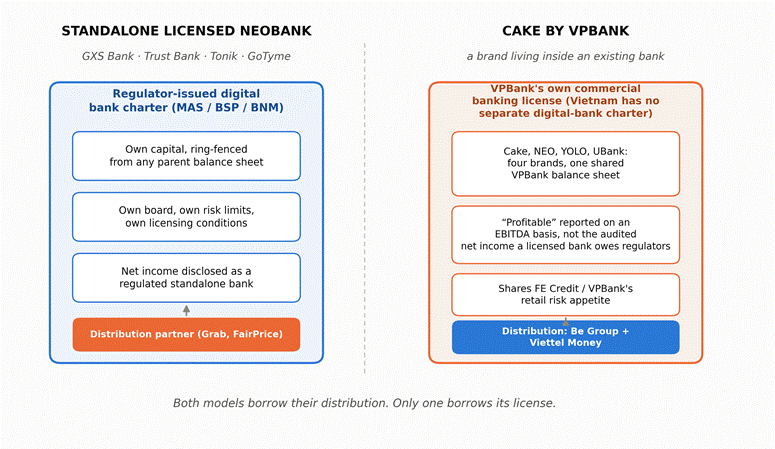
Figure 1. Cake’s structure versus Southeast Asia’s separately licensed digital banks.
| Cake by VPBank | GXS Bank / Trust Bank (Singapore) | Tonik / GoTyme (Philippines) | |
| License | None of its own; operates under VPBank’s existing commercial banking charter | Separate MAS digital full bank license | Separate BSP digital bank license |
| Capital | Shares VPBank’s balance sheet and capital adequacy ratios | Independently capitalized and ring-fenced | Independently capitalized and ring-fenced |
| Reported profit | Framed publicly as EBITDA-profitable; not separately audited or disclosed under banking-sector reporting rules | Net profit disclosed as a regulated standalone entity (Trust: profitable March 2026) | Net profit disclosed as a regulated standalone entity (Tonik: profitable Q1 2026) |
| Time to launch | 74 days, MVP to live product | Multi-year build under a new banking license | Multi-year build under a new banking license |
That borrowed structure cuts two ways, and a fair read has to hold both at once. It’s genuinely why Cake could move faster and cheaper than any of its regionally licensed peers, and why it could plausibly claim a form of profitability years before Trust Bank or Tonik got there. It’s also why “Vietnam’s first profitable digital bank” deserves a raised eyebrow rather than a headline repeated without context. The claim is consistently framed on an EBITDA basis, a metric that strips out interest expense and loan-loss provisioning, which for any lender are not accounting technicalities sitting off to the side. They are the two line items that actually decide whether a loan book against 600,000 informal-income drivers is healthy or quietly rotting. Tonik and Trust Bank have to publish net income as regulated standalone banks, provisioning and all. Cake does not, because Cake isn’t one.
It’s also worth sitting with what Cake is riding on. VPBank’s consumer-finance arm, FE Credit, has cut its non-performing loan ratio to 14.4% from close to 20% during the pandemic and is targeting 11 to 12%, still multiples above what a conservative bank would tolerate. VPBank’s own chief executive has said the bank is willing to accept a higher bad-debt ratio as the price of growth, with the rise concentrated specifically in retail and small-business lending, the exact segment Cake sits inside. VPBank’s consolidated numbers for 2025 look excellent on their face: profit before tax of roughly VND 30.6 trillion, about $1.2 billion, up 53% year-on-year and 121% ahead of its own target, with total assets crossing roughly $48 billion and VPBank ranking first among Vietnam’s private banks in the Forbes Global 2000. But a bank that says out loud it will tolerate more bad debt to keep growing its retail book is not an unusual place to house a lending product built for gig workers with no credit file and no employer safety net. It might be exactly the right home for that kind of risk. It’s also the reason Cake’s real underwriting performance, not the EBITDA headline, is the number worth actually seeing before taking “profitable” at face value.
The app it was built for nearly didn’t survive. Cake had already moved on.
The third piece of this story cuts both ways, and it’s largely absent from the award citations either way it cuts. Cake wasn’t just partnered with Be Group. It was purpose-built around Be’s app, its driver base, and its transaction data, the same dependency GXS Bank has on Grab in Singapore. That kind of bet is only as strong as the platform underneath it, and Be’s platform has had a genuinely brutal few years. What’s less widely noticed is that Cake seems to have clocked the danger early and started hedging against it well before the numbers below made the threat obvious.
Grab entered Vietnam years ago and built a durable lead. Gojek came in as the credible second challenger, then watched its share fall from roughly 30% to 7% over two years before shutting down its Vietnam operations entirely in September 2024 after six years in the market. Be spent that period as one of the stronger homegrown alternatives. Then Xanh SM arrived. Launched in April 2023 by VinFast, Vingroup’s electric-vehicle arm, running an all-electric fleet, Xanh SM captured more than 32% of the market within seven months and reached 6 million customers in five. By the second quarter of 2025, according to data cited from Rakuten and Decision Lab, the market looked like this: Xanh SM at 40%, Grab at 36%, Mai Linh at 5%, everyone else including Vinasun and Maxim at 13% combined, and Be Group at just 6%. A platform Cake was designed around, sitting inside a roughly $1.6 billion ride-hailing market that barely existed a decade ago, went from serious contender to afterthought in under two years.
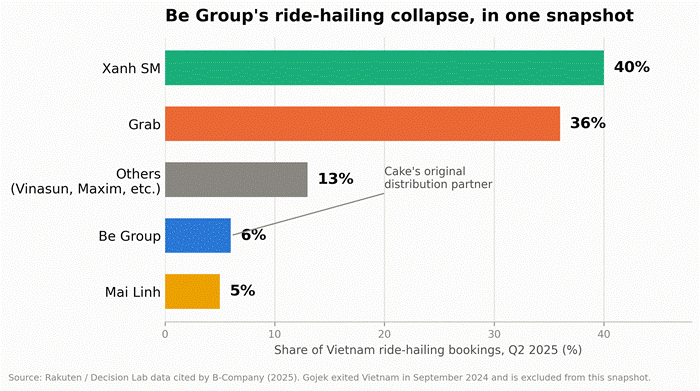
Figure 2. Vietnam’s ride-hailing market, Q2 2025.
If Cake’s growth engine had stayed single-threaded through Be, that collapse should have shown up directly in new-customer numbers and loan originations by 2025. It’s worth being precise about why it apparently didn’t hit as hard as the market-share chart alone would suggest: Cake had already started wiring itself into other distribution rails before the worst of Be’s decline. A 2023 partnership brought Viettel Money’s roughly 20 million users into reach, with four months of integration data showing a 20-fold increase in Be users linking Viettel Money accounts and a 50-fold jump in transactions between the platforms. That same year, Cake, Be, and Viettel Money struck a financing deal with VinFast itself, offering installment loans for VinFast electric motorcycles at preferential rates. There’s a specific irony worth sitting with here: VinFast is the same corporate family, under Vingroup, that owns Xanh SM, the ride-hailing app that gutted Be’s market share. Cake ended up financing purchases of the very manufacturer whose ride-hailing arm was simultaneously dismantling the app Cake was originally built to live inside. That’s either a coincidence of Vietnam’s concentrated conglomerate landscape, or a sign that Cake’s product team read the competitive writing on the wall earlier than the market-share numbers made obvious, and started building a second and third distribution leg before the first one buckled.
That’s the generous read, and there’s real evidence for it: continued customer growth through 2025, income up 225% in the same period Be’s share was collapsing, and a genuine diversification into Viettel’s much larger user base rather than a defensive scramble after the fact. The less generous read is that Be’s collapse still leaves Cake more exposed than its growth numbers admit. Viettel Money and VinFast financing extend Cake’s reach, but neither replaces what a ride-hailing app uniquely offered: a live, granular, daily feed of exactly the transaction and tenure data Cake’s underwriting model was built to read. A telecom wallet’s top-up history is a weaker credit signal than a driver’s shift log. If Be keeps shrinking, or exits the market the way Gojek did, Cake’s underwriting engine loses its richest and most purpose-built data source, even if its customer count keeps climbing on the back of everything else it’s since bolted on.
What actually holds up, and what a skeptical reader should still want to see
Weigh all three pieces together and Cake comes out as a real, working business, not a press-release fiction, but a narrower and more fragile one than the “profitable digital bank” headline implies on its own. The underwriting insight is sound and reasonably differentiated: using a ride-hailing app’s own data to lend to workers a bureau can’t see is a genuinely better idea than anything a traditional Vietnamese bank was offering this segment before 2021, and the retention numbers, especially the roughly 95% figure among financial-product users, suggest people who try the lending and savings products are actually sticking with them rather than churning after a signup bonus. The speed and capital efficiency are real advantages of the borrowed-license structure, not just an accounting trick, and building a second and third distribution channel before the platform it was built around collapsed shows a level of foresight that the standard “Cake is Be’s bank” narrative doesn’t give it credit for.
Against that: the profitability claim is doing more rhetorical work than its EBITDA basis can actually support, especially sitting inside a parent bank that has openly said it will tolerate rising bad debt in exactly the retail segment Cake occupies. There is no publicly disclosed, Cake-specific non-performing loan ratio anywhere in the reporting on this bank, which is a real gap for a lender whose entire customer base earns informal, unprotected income with no unemployment cushion if a downturn or a fuel-price shock, the kind Vietnam’s gig workers have already lived through once, hits the country’s roughly 600,000 drivers at once. And the distribution story, while more resilient than it first appears, still leans on a platform that lost 80% of its relative market position in under two years. A reader deciding whether Cake’s model is worth copying, investing behind, or simply believing the press coverage of, should want three things that aren’t yet public: Cake’s actual loan-loss provisioning, a breakdown of how much of its 6.2 million customers and $12.8 billion in transaction value now flows through Be versus Viettel Money versus its own direct app, and a straight answer on whether “EBITDA-profitable” would still be true if measured the way a licensed, standalone neobank like Tonik is required to report.
Workshop: stress-test the “digital bank” you’re looking at
Whether you’re evaluating your own fintech idea, a company you’re investing behind, or a partnership your organization is being pitched, run it through the same two questions this issue just walked through before you take a “profitable digital bank” headline at face value.
| # | Question | Your answer |
| 1 | The real gap. Are you actually solving an access problem (no account exists) or an underwriting problem (an account could exist, but nothing proves this person’s income to a lender)? Check the real banking-penetration number for your market before you answer; guessing “unbanked” when the real figure is closer to Vietnam’s 87% than Indonesia’s 62% changes what you should be building. | |
| 2 | The borrowed piece. Is there a license, a balance sheet, or a distribution channel your product depends on that you don’t actually own? Name it specifically, and then name what happens to your numbers if that piece is taken away, downgraded, or, like Be Group, loses most of its relative position within two years. |
If you can only answer the first question with something as vague as “the unbanked” or “underserved SMEs,” you haven’t found your gap yet. If you can answer both, and the thing you’re borrowing in question two is something you’ve actually stress-tested rather than just assumed will hold, you’re looking at what Cake by VPBank actually built, not the highlight-reel version of it.
Hit reply with your two answers. A future issue will feature one submission, anonymized on request, with a real breakdown of where the model holds and where it doesn’t.
Tags: Vietnam Digital Banking, Cake by VPBank, Niche Banking Southeast Asia, Be Group, Xanh SM, Viettel Money, Embedded Finance, Fintech Risk
References
- Cake by VPBank: Vietnam’s first profitable digital only bank, Mambu
- Cake by VPBank: A typical success of digital bank in Vietnam, Global Business Review Magazine
- Cake by VPBank posts strong gains in scale and efficiency leveraging AI focus, Vietnam Investment Review
- Cake leads Vietnam’s digital banking landscape with innovation and profitability, The Asian Banker
- VPBank’s Giang Pham: “We run our business by segments”, The Asian Banker
- Be Group partnering up with VPBank to launch Cake digital bank, Vietnam Investment Review
- Cake by VPBanK sub-branding case study, Brandcoat / Rice Studios
- SBV suggests delaying the establishment of digital banks in financial centre, Vietnam News
- More than 87% of Vietnamese adults have a bank account, State Bank of Vietnam press briefing, via Vietnam.vn
- VPBank CEO defends higher bad debt as trade-off for growth, The Investor
- VPBank sets record PBT of VND 30.6 trillion, up 53%, VPBank
- VPBank ranks first among Vietnam’s private banks in Forbes Global 2000, VPBank
- Over a decade later, Vietnam’s 600,000 gig drivers remain uninsured workers, VnExpress International
- Vietnam ride-hailing market 2025: Competition between Xanh SM, Grab, and Be, B-Company
- Market share in Vietnam’s ride-hailing market, VIRAC Research
- Digital Bank Cake & Consumer Platform Be signs cooperation agreement with Viettel Money, VietNamNet
- Cake by VPBank, Be, Viettel Money sign cooperation deal, VnExpress International
- VinFast, Cake by VPBank, and Viettel Money join forces to promote electric mobility and digital financial inclusion, VnEconomy