Bank Jago’s deposits and loans grew 38% last year. It got there by hiding inside GoTo’s app instead of building its own — a smart move. But it also let partners make almost all its lending decisions, and that bill is starting to come due.
| Bank Jago won the distribution game by hiding inside GoTo’s app instead of building its own. But it let partners make almost all its lending decisions, and the cushion covering that bet is shrinking fast. 1. The hiding-inside-GoTo bet worked. Bank Jago hit 19.4 million customers and Rp26.4 trillion in deposits by March 2026, mostly through GoPay savings pockets and partner apps, not its own ads or branches. 2. Its loan growth isn’t mostly its own work. As of September 2025, Bank Jago’s own app lent only 4 to 5% of its Rp23.5 trillion loan book. Partners handled the other 96% — they scored the borrower and collected the money; Jago supplied the funding. 3. Its safety cushion is shrinking as that risk builds. Bad loans went from 0.2% to 0.8% in about a year. Capital reserves fell from 44.4% to 29.9% over the same stretch. Management says fixing the imbalance will take four to five more years. None of this sinks the bank on its own. But Bank Jago hit a version of this exact problem before, in 2022. Put the three facts together and “Indonesia’s best digital bank” looks like a real title — and an unfinished one. |
A woman in Jakarta opens GoPay to save for a motorbike repair. She taps “Kantong,” a savings pocket that splits her balance and pays interest on it. She never leaves the Gojek app. She never downloads a banking app. She probably doesn’t know that pocket sits inside a real, licensed, publicly listed bank. That’s not an accident. It’s the whole strategy. And it’s the reason you have to look past the growth numbers to see what Bank Jago actually is.
This matters beyond one savings pocket. Bank Jago is now one of the most talked-about digital banks in Southeast Asia, and its growth numbers get repeated in headline after headline. Read closely, those numbers say two very different things about two very different parts of the bank. One part is strong on its own merits. The other is borrowed, and the bill for borrowing it is starting to arrive.
The bank built to be invisible
Every other digital bank in this series fought for attention. Cake by VPBank and Ryt Bank both built their own apps. Both ran giveaways to get downloads. Both wanted you to open a new banking app and stick around.
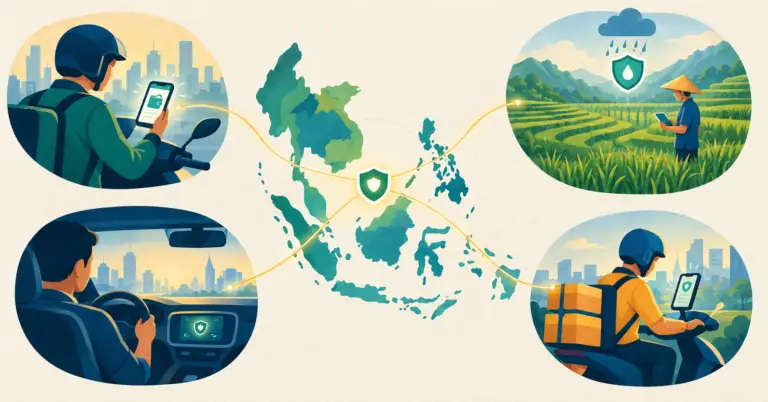
Bank Jago did the opposite. Don’t fight for the home screen — become the pipes behind someone else’s home screen. GoTo owns 21.4% of Bank Jago, through GoPay’s parent company, Dompet Karya Anak Bangsa. That stake wired Jago’s ledger straight into the GoPay wallet. A GoPay top-up can sit in a Jago savings pocket. A GoPay balance can earn Jago’s interest rate. A Gojek driver can cash out through Jago’s rails and never be told they now have a bank account.
Bank Jago runs no branch network of its own. It doesn’t need one. Every account opens through a phone, and a large share of those phones already have GoPay installed. That’s the whole point of the bet: skip the cost of winning a customer’s attention, and skip the cost of a physical branch network, by sitting inside an app tens of millions of people already use for rides, food, and shopping.
The results back up the bet. By March 2026, Bank Jago had 19.4 million customers, up from 16.3 million a year earlier. Deposits hit Rp26.4 trillion, up 23% year-on-year. More than half of that, Rp13.9 trillion, sits in cheap current and savings accounts, not fixed deposits. That’s a 53% CASA ratio, a number most Indonesian banks would kill for. It means Jago funds itself with cheap, sticky money instead of expensive term deposits it has to keep re-pricing.
For full-year 2025, deposits grew 38% to Rp25.9 trillion. Net profit rose 115% to Rp276 billion, up from Rp129 billion in 2024. On the funding side, this bank is doing exactly what it was built to do.
That’s a real edge, and it deserves credit before this gets more critical. GXS Bank in Singapore built its edge on Grab’s transaction data. Ryt Bank in Malaysia built its launch on giveaways and app-store rankings. Bank Jago built its funding base on being invisible. A savings pocket inside an app people already open every day costs almost nothing to distribute. That’s a deliberate choice, not luck: don’t fight for attention, fight for placement.
But there’s a difference worth flagging early. GXS Bank uses its ecosystem data for more than distribution. It built its own scoring model, called an ecosystem risk score, out of years of Grab and Singtel data, and uses that model to underwrite loans itself. Bank Jago has not built anything like that yet, at least not for the part of its loan book that runs through partners. It borrowed the distribution. It has not yet built the underwriting to match.
What’s actually inside the loan book
The deposit side of Bank Jago earns its praise. The lending side is where most coverage stops looking too closely. And lending is the real test of a bank, because a bank’s whole job is deciding who gets paid back.
By the third quarter of 2025, Bank Jago’s loan book had grown 36% year-on-year, to Rp23.5 trillion. Kontan, an Indonesian financial paper, broke down what’s actually in that number. Bank Jago’s own app-based lending, a product called Jago Dana Cepat, made up only 4 to 5% of it. The other 95 to 96% ran through partnerships with more than thirty fintech and financing companies, including Easycash. Each partner runs its own credit scoring, its own customer acquisition, its own collections. Bank Jago supplies the money.
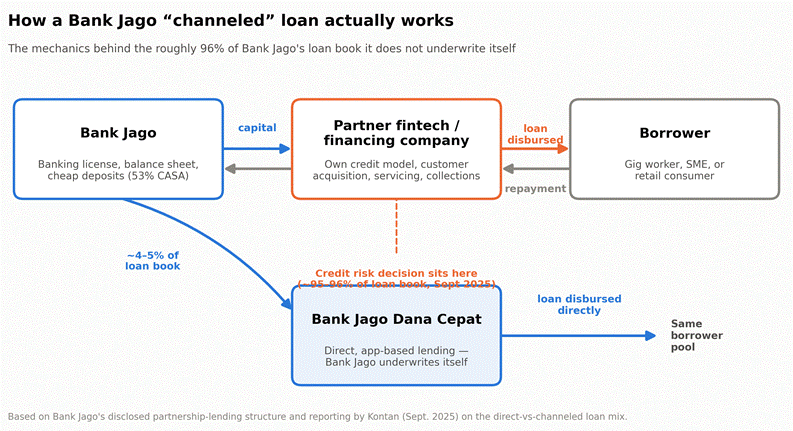
How a Bank Jago “channeled” loan actually works — Bank Jago supplies the capital and the license; the partner supplies the underwriting.
| Direct lending (Jago Dana Cepat) | Ecosystem / partner channeling | |
| Share of loan portfolio (Sept. 2025) | ~4–5% | ~95–96% |
| Who underwrites the borrower | Bank Jago | The partner’s own credit model |
| Who acquires & services the customer | Bank Jago’s own app | The partner fintech / financing company |
| Bank Jago’s role | Full-stack lender | Capital provider & balance-sheet partner |
| Growth trajectory | Newly launched; management calls it a multi-year build | Primary driver of the 36% YoY loan growth reported through Q3 2025 |
So when Bank Jago reports 36% loan growth and calls it proof of a thriving bank, that growth is mostly a scorecard of decisions made by thirty other companies’ risk teams. Not Bank Jago’s own. The bank’s compliance team calls this a deliberate choice: let partners handle origination and collections, since they’re already good at it, and keep Bank Jago’s own exposure inside strict prudential limits. That’s a fair argument. But it means “Bank Jago’s loan book grew 36%” and “Bank Jago got better at judging credit risk” are two different claims. Only one of them is actually true.
Indonesia’s financial regulator, OJK, allows this kind of arrangement, and plenty of banks besides Bank Jago use it. That’s worth remembering before treating channeling itself as a red flag. The red flag isn’t that Bank Jago channels credit. It’s how much of its book depends on it, and for how long that dependence has lasted without much of a direct-lending counterweight.
Channeling is a real business — up to a point
It would be easy to call loan channeling a shortcut. It isn’t. It’s a real, licensed function. A fintech with good underwriting but no banking license needs a funding partner. A bank with cheap deposits but no scoring model for gig workers needs that fintech’s technology. Put the two together and both sides do what they’re good at.
Superbank runs a similar model in Indonesia, backed by Grab, Singtel, Emtek, and South Korea’s KB Kookmin Bank. It posted a pre-tax profit of Rp142 billion through April 2026. In 2026, Singtel agreed to transfer its stake to Grab, and Grab moved to take fuller ownership and consolidate Superbank onto its own books, rather than walk away from the structure. If channeling were just a workaround, serious banks wouldn’t keep doubling down on it.
The real problem isn’t the model. It’s the concentration. A bank that channels 96% of its loans for years builds a great partner network. It does not build its own muscle for pricing and watching credit risk, because it barely uses that muscle. That gap doesn’t show up on an earnings slide. It shows up the day a partner’s model is wrong at scale, or the partner itself runs into trouble.
2022 already tested this
Bank Jago doesn’t have to guess what a bad quarter looks like under this model. It already had one. In the year before the third quarter of 2022, as channeled lending scaled up fast on the new GoTo partnership, bad loans jumped from 0.59% to 2.10%. That’s more than triple, in one year, while the loan book was still small enough that few people noticed outside banking trade press. One credit expert quoted at the time made the obvious point: fast lending needs fast oversight, or the bad-loan number moves before anyone catches the trend.
Bank Jago brought that spike back down, and the ratio has stayed low since, well below the industry average. That’s a fair, positive fact. It shows management can act when a number moves in the wrong direction, and that the bank has real tools for pulling back from a partner or a segment that starts underperforming.
But the real lesson from 2022 isn’t “Bank Jago fixed it.” It’s that this exact model can triple its bad-loan ratio in a year when partner lending outruns oversight. That history matters more than today’s low number when you’re deciding how much comfort a 0.8% ratio should actually give you.
A four-to-five-year fix for a today problem
That’s why the current trend is worth watching closely instead of shrugging off. Bank Jago’s bad-loan ratio has moved one way for five straight periods: 0.2% at the end of 2024, 0.4% at Q3 2025, 0.6% at the end of 2025, 0.8% by Q1 2026. Every one of those numbers is still low. But it has doubled in about a year, right alongside the fastest stretch of loan growth the bank has seen.
At the same time, capital reserves have fallen. Bank Jago’s capital ratio was 44.4% at the end of 2024, unusually high. It dropped to 31.6% by the end of 2025, and 29.9% by March 2026. On its own, that’s healthy: a bank finally putting idle capital to work. Jago’s ratio is still far above the regulatory minimum. But put the two trends side by side and the pattern is a bank whose cushion is shrinking exactly as the risk it doesn’t directly control is growing.
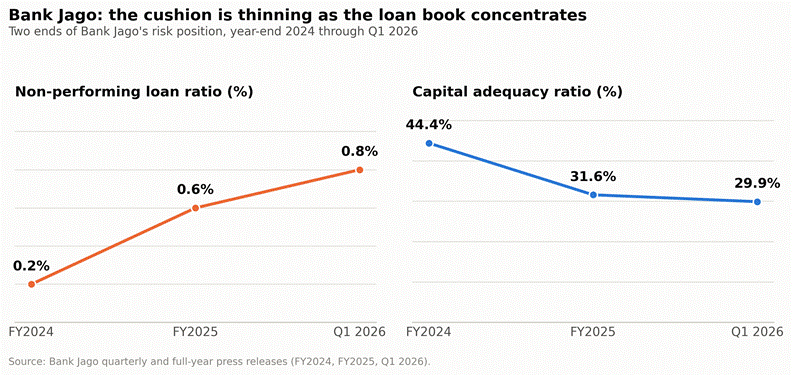
Bank Jago’s risk trend, year-end 2024 through Q1 2026: rising NPL, falling capital cushion.
Management isn’t hiding this. Asked about the future mix of direct versus partner lending, Bank Jago’s leadership has said partnerships will stay the main growth driver for now, and that direct lending will grow, over four to five years. That’s an honest answer. It’s also an admission: the fix for concentration risk is running on a multi-year clock, while the concentration itself grows every quarter in the meantime.
Four to five years from now is 2030 or 2031. That’s a long runway for a bank whose bad-loan number has already doubled once this year, and tripled once before, in 2022. And Bank Jago’s stock still moves on GoTo’s news, not its own. In November 2025, GoTo changed CEOs, Patrick Walujo out, Hans Patuwo in. Bank Jago’s shares moved on that news. Analysts said why, plainly: Bank Jago sits inside the GoTo ecosystem.
The stock market’s bet, and the parent propping it up
There’s another piece of this story that sits outside Bank Jago’s own financial statements: the price investors pay for its shares, and the health of the company sitting behind its growth engine.
Start with the stock. Bank Jago trades at roughly 43 times trailing earnings, and at close to 24 times next year’s expected earnings. Its price-to-book ratio sits around 1.6. Most banks, even fast-growing ones, trade far below that. A bank’s earnings are mostly loan interest, and the market usually treats loan interest as slow, cyclical, and easy to disrupt with one bad credit cycle. A multiple over 40 isn’t a bank multiple. It’s a growth-stock multiple, the kind usually reserved for a company the market expects to compound earnings for years, or a platform business rather than a lender.
That premium only makes sense if investors are pricing Bank Jago’s distribution network, not its current loan book. They’re betting on what GoPay’s reach could become inside Bank Jago’s balance sheet, not on the 4 to 5% of that balance sheet Bank Jago actually underwrites today. Analyst price targets for the stock run well above where it trades now, and the consensus call is still “buy.” That’s a bet on the same story this issue has been laying out: distribution first, underwriting later. If the underwriting gap never closes, that premium has less to stand on than the growth headlines suggest.
Now look at what’s propping up the distribution side of that bet. GoTo, the company whose app carries most of Bank Jago’s customer growth, only turned its first-ever quarterly profit in the first quarter of 2026: Rp171 billion, against a loss of Rp367 billion in the same quarter a year earlier. That swing came from real improvement. GoTo’s fintech unit, the part of the business that includes GoPay, grew transaction volume 72% and pushed its user count up 33% to 27.5 million. That unit did most of the work behind GoTo’s turnaround. But it’s still one quarter of profit after years of losses. Bank Jago built its entire growth story on being invisible inside an app whose owner has been unprofitable for most of the time Jago has existed as a public company.
It’s worth sitting with what that overlap means. The same GoTo fintech growth that finally pushed GoTo into profit is the same growth engine Bank Jago’s deposit numbers ride on. If that unit’s growth slows, for regulatory reasons, competition, or a slower Indonesian consumer, both stories soften at once, GoTo’s freshly-won profitability and Bank Jago’s funding pipeline. They aren’t two separate risks. They’re the same risk, counted twice, once on each company’s books.
None of this means GoTo is about to falter, or that Bank Jago’s stock is mispriced. It means two things Bank Jago doesn’t control, how much investors are willing to pay for its story, and how healthy its host app actually is, are both doing real work to hold up the numbers this issue has already questioned. A bank whose funding engine depends on another company’s app, and whose valuation depends on the market believing that engine will keep compounding, is carrying two more variables outside its own hands, on top of the underwriting it has already handed to thirty-plus partners.
What holds up, and what a skeptical reader should still doubt
Put it all together, and Bank Jago is a well-run bank that hasn’t finished becoming what its growth numbers suggest it already is. It’s easy to read a 38% deposit number and a 36% loan number as the same kind of achievement. They aren’t. One is a distribution win. The other is mostly someone else’s underwriting, wearing Bank Jago’s name.
The good part is real. Building the invisible plumbing behind GoTo’s huge user base, instead of fighting for space on a crowded home screen, was the smarter move. The cheap, sticky deposit base it built as a result is a real edge over banks still buying deposits with rate promotions. And channeling itself is a legitimate model, not a shortcut dressed up as strategy.
The problem is what that model has cost the bank. Letting partners originate 95%-plus of your loans for years means your own underwriting muscle barely develops. The bad-loan trend since 2024, however low in absolute terms, is the first hard sign that not every partner’s risk model is as solid as the growth numbers suggest. And 2022 already proved this exact setup can move fast when it breaks.
A reader should want three things Bank Jago hasn’t published: a partner-by-partner breakdown of exposure, clear terms on who eats the loss when a channeled borrower defaults, and an update on whether the direct-lending build-out is ahead of, on, or behind that four-to-five-year target. A reader should also watch two things entirely outside Bank Jago’s control: how long GoTo’s newly-found profit holds up, and how long the market keeps paying a growth-stock multiple for a loan book it barely underwrites itself.
This is the same tension this series keeps finding in Southeast Asia’s digital banks. Cake by VPBank borrowed a banking license. Ryt Bank borrowed a story about its own AI. Bank Jago borrowed underwriting. Each one moved fast by skipping a piece of the business a normal bank has to build itself. Each one still has to pay that cost back, on its own timeline, whether or not the growth headlines mention it.
Workshop: pressure-test the growth number you’re being shown
Whether you’re looking at your own product’s growth metrics, a company you’re assessing as an investor or partner, or a “we grew X%” line in a pitch deck, run it through the same two questions this issue just applied to Bank Jago.
| # | Question | Your answer |
| 1 | Whose decision is the growth number actually measuring? Strip out anything a partner, vendor, or platform decided instead of you. If more than half the number traces back to someone else’s call, name what you’d need to see before trusting it the way you trust your own work. | |
| 2 | What capability have you put off building, and what’s your real timeline for it? Name the shortcut standing in for it right now. Give an honest timeframe, in years, not quarters, and check whether your risk is growing faster than that timeline allows. |
Hit reply with what you found. A future issue will feature one answer, anonymized on request, with an honest look at where growth and capability actually line up.
Tags: Bank Jago, Indonesia Digital Banking, GoTo Ecosystem, Niche Banking Southeast Asia, Loan Channeling, GoPay, Superbank, Embedded Finance, Non-Performing Loans, Banking as a Service
References
1. Bank Jago Consistently Grows in Early 2026 — Bank Jago press release (jago.com)
2. Bank Jago Maintains Growth Momentum in Q3-2025 — Bank Jago press release (jago.com)
3. Consistent Growth Continues in 2025 as Bank Jago Delivers Tangible Benefits for Customer — Bank Jago press release (jago.com)
4. Bank Jago Shows Healthy Performance Throughout 2024 — Bank Jago press release (jago.com)
5. Bank Jago (ARTO) Profit Soared 131.99% in Q3 2025 — Databoks / Katadata
6. Bank Digital Mulai Gencar Salurkan Pinjaman Langsung, Bunga Mulai 1,39% — Katadata
7. Setelah Garap Ekosistem, Bank Digital Makin Gencar Salurkan Pinjaman Langsung — Kontan
8. Kerjasama Loan Channeling Easycash dan Bank Jago — Easycash
9. Bank Jago Genjot Pembiayaan Melalui Kemitraan — Republika
10. Begini Strategi Bank Jago (ARTO) Jaga Risiko Kredit Macet — Bisnis Indonesia
11. Saham Bank Jago (ARTO) Reli Efek Pergantian CEO GOTO? — Bisnis Indonesia
12. Grab To Consolidate Superbank, Deepening Financial Services Commitment in Indonesia — Grab Holdings Investor Relations
13. Superbank Catat Laba Sebelum Pajak Rp 142 Miliar hingga April 2026 — Superbank
14. Gojek Makes Financial Push in Indonesia With 22% Stake Acquisition in Bank Jago — Fintech News Singapore
15. PT Bank Jago Tbk (IDX:ARTO) Statistics & Valuation Metrics — StockAnalysis.com
16. Indonesia’s GoTo Reports First-Ever Quarterly Net Profit, $12.7M, in Strong Start to 2026 — TechNode Global