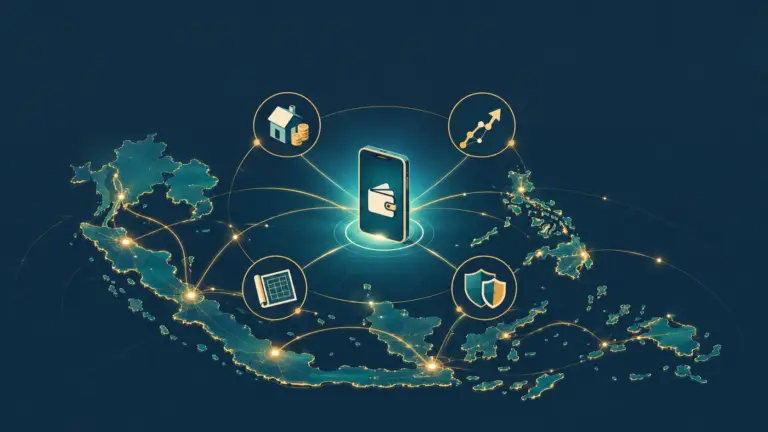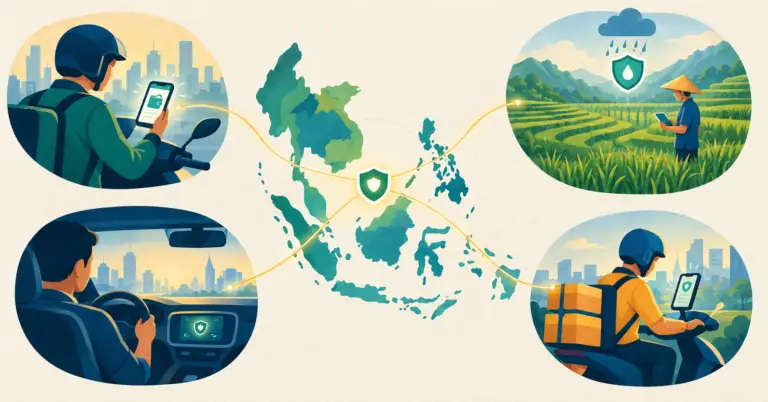
A close read of how PasarPolis, Igloo, bolttech, Qoala, GCash, Grab, and a farmer cooperative called CLIMBS turned checkout screens, mobile load top-ups, satellite rainfall data, and agent trust networks into insurance products a rival can’t copy by signing the same partnership.
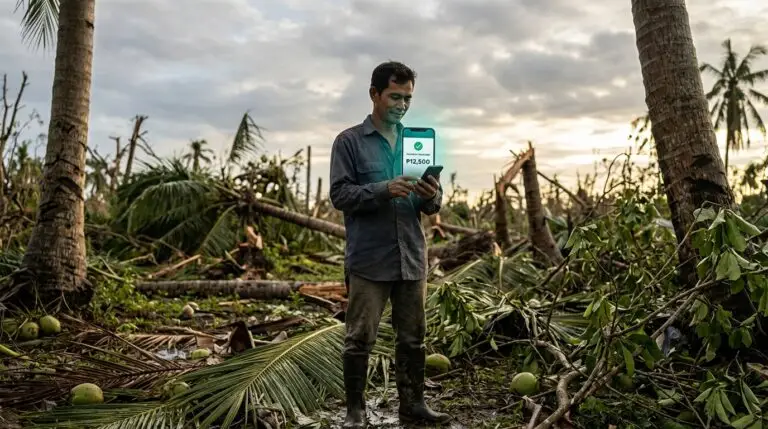
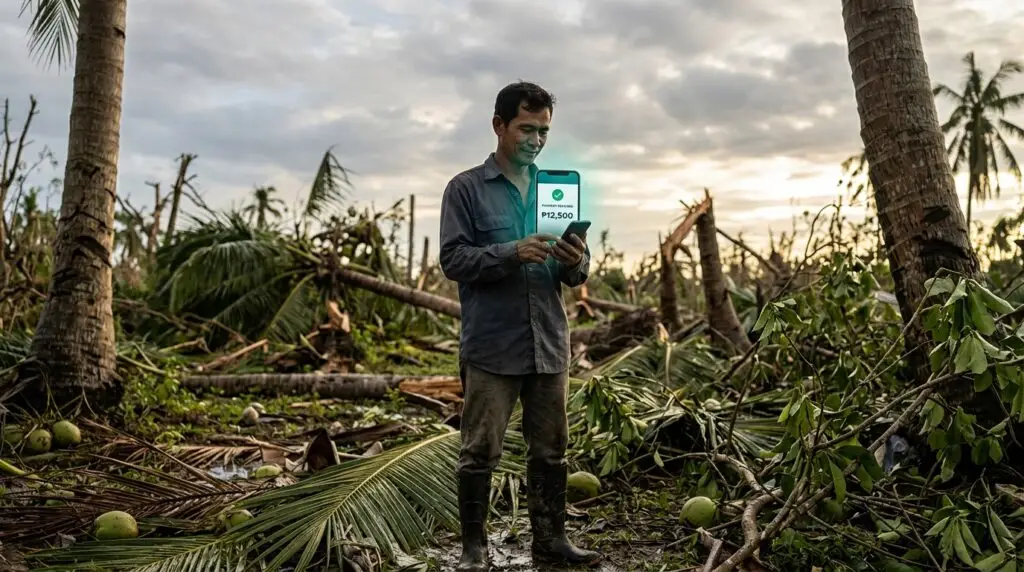
A coconut farmer in a cooperative in Mindanao doesn’t file a claim after a typhoon. There’s no adjuster visit, no photograph of a flattened plantation, no six-week wait for a regional office to sign off. Within days of the storm, a payout lands, triggered the moment wind speed and rainfall data crossed a threshold the farmer’s cooperative agreed to months earlier. Nobody assessed the farmer’s actual damage. Nobody needed to. The payout isn’t compensation for what was lost; it’s cash released the instant satellite data confirmed the storm was bad enough to matter. That product, run by a Philippine cooperative insurer called CLIMBS, has now reached over 180,000 farmer-members across 324 cooperatives for wind and rain risk alone, and another 58,000 for drought.
None of the pieces in that product are new. Satellite rainfall monitoring has existed for decades. Cooperatives have been the backbone of rural Philippine finance for longer than that. Parametric triggers, insurance that pays on a measurable event rather than a measured loss, are a known instrument reinsurers have sold since the 1990s. What CLIMBS actually did was notice that a data feed nobody had wired into a payout trigger and a distribution network nobody had wired into an insurance policy could solve the exact problem the country’s traditional crop insurer has failed to solve for forty years. That’s the pattern worth tracking across Southeast Asian insurtech this year. The companies doing something that actually matters aren’t inventing insurance products. They’re taking things that already existed separately, checkout screens, mobile load top-ups, ride-hailing trip data, satellite weather feeds, agent networks built on decades of personal trust, and wiring them together in an order nobody had tried, aimed at a customer specific enough to name in one sentence.
It’s a small distinction that changes everything downstream. A partnership announcement, insurer X teams up with platform Y, is something any competitor with a business development budget can copy inside a quarter. A product built by reconnecting a data source and a distribution channel around one named customer is much harder to catch, because copying it means understanding not just the feature but the person it was built for.
In This Issue
- Why Asia’s health protection gap runs to $1.8 trillion, and why that number is the entire opportunity, not a footnote
- How PasarPolis, Igloo, GCash, and Grab turned checkout moments and mobile load top-ups into the cheapest insurance distribution channel in the region
- Why bolttech doesn’t sell insurance at all, and why that’s exactly why it’s worth $2.1 billion
- Inside CLIMBS: how satellite rainfall data and a cooperative network out-performed the Philippines’ forty-year-old crop insurance system
- Why Qoala kept its agent network instead of going fully digital, and what that says about trust in Southeast Asian insurance
- What to watch through the rest of 2026: bolttech’s pivot toward Africa, Sunday’s move into Indonesia, and a co-insurance pool launching in January 2027
The Framework at a Glance
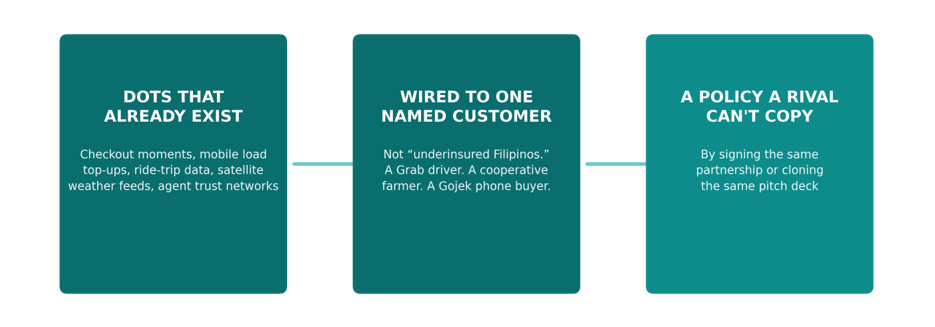
Signing a bancassurance deal or an API integration is a procurement exercise. Nearly every insurer in the region can do that part. Reconnecting an existing data source into a product built around a customer specific enough to name is where the list of companies actually pulling ahead gets short.
The need isn’t a slide. It’s a $1.8 trillion gap that shows up as skipped hospital visits.
Start with the number that makes the rest of this issue make sense. Swiss Re’s most recent research puts Asia’s health protection gap at $1.8 trillion, close to $2,000 per household, roughly a tenth of the average household’s annual income. More than 40 million households across the region skip medical treatment they need because they can’t afford the financial hit. That’s not a market waiting to be discovered. It’s a market that already knows exactly what it’s missing and still can’t buy the fix.
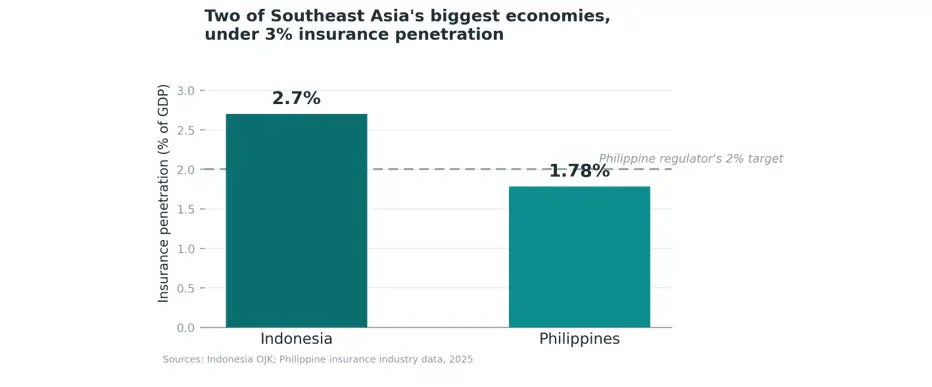
Indonesia’s Financial Services Authority puts national insurance penetration at 2.7% of GDP, one of the lowest rates of any economy this size anywhere in the world. The Philippines isn’t much better: premiums reached ₱502.6 billion (about $8.37 billion) in 2025, up 14.1% year-on-year, but penetration still sits at 1.78–1.79% of GDP, below the regulator’s own 2% target. On the catastrophe side specifically, the country’s protection gap runs to roughly 98%. Almost every peso of typhoon and earthquake damage in the Philippines lands on households and the government, not on an insurer’s balance sheet.
That gap isn’t evenly spread. It concentrates hardest on people who already live a digital life, gig drivers, e-commerce sellers, smartphone-owning farmers, and simply never had an insurance product built for them. That’s the opening every company in this issue is working.
The checkout dot: turning a purchase into a policy
The cheapest way to sell insurance to someone who’s never bought it is to stop asking them to buy it separately. PasarPolis figured this out early. Founded in 2015, the Jakarta insurtech doesn’t sell through agents or a standalone app first; it embeds bite-sized policies, smartphone-screen protection, flight-delay cover, personal accident insurance, directly inside Gojek, Tokopedia, and Xiaomi’s checkout flows. Buy a phone, get screen insurance at the same tap. Book a flight, get delay cover before you confirm payment. Tokio Marine Holdings backed PasarPolis’s most recent extension round, and the company is now using that capital to push into Singapore, having already proven the model in Vietnam and Thailand.
Igloo runs the same logic with a sharper edge on gig work specifically. Its per-ride insurance product with Angkas, the Philippine motorbike-taxi app, covers more than 20,000 riders with premiums priced per trip rather than per month, a structure that only makes sense once you have the ride-level data to price it that granularly. Regionally, Igloo now processes more than 80 million policies a month across six Southeast Asian markets, 1.6 billion policies cumulatively, and in the Philippines alone has struck partnerships with over 40 digital platforms, including GCash, Shopee, Lazada, and Smart Communications, to distribute more than 55 locally built products. The company’s own language for what it’s becoming is telling: not an embedded insurance distributor anymore, but “a full-stack technology infrastructure provider.” It’s moving up a layer, from selling through other people’s checkout screens to building the rails other insurers plug into.
Grab took the checkout-dot idea and connected it to something more personal: driver income. Grab partnered with Chubb back in 2018 to build personal accident and critical illness cover for its driver and delivery-partner network, priced and triggered by the same in-app behavior, trip volume, earnings stability, platform tenure, that Grab already tracked for entirely different reasons. It later extended the same rail to consumer travel and personal-accident products for riders. The insurance didn’t require new infrastructure. It required someone to notice that the app already had the data an underwriter would otherwise have to ask for.
GCash’s version of the same move might be the most Filipino-specific dot in the region: mobile load. Buying prepaid mobile credit is one of the most universal small-ticket digital transactions in the Philippines, something tens of millions of people do every week regardless of income or banking status. GCash’s GInsure platform bundles free health and accident coverage, up to ₱30,000, plus a ₱500-a-day hospital income benefit for five days, directly into its “Buy Load Plus” product. Buy load the way you always have; the insurance just comes with it now. As of the first quarter of 2025, GInsure had unlocked insurance access for 14.6 million users and issued 51.4 million policies across more than 48 products. Nobody invented mobile load. Nobody invented micro health insurance. GCash noticed nobody had put the two behind the same button.
The exchange dot: selling insurance to everyone by selling insurance to nobody
Not every company in this space wants to be the insurer or the distributor. bolttech picked a different seat entirely: the exchange connecting them. Founded in Singapore in 2020 by insurance veteran Rob Schimek, bolttech doesn’t underwrite risk and doesn’t own the customer relationship. It connects roughly 700 distribution partners, from Lazada to Samsung to telcos, with more than 230 insurers, including Allianz, AXA, and Liberty Mutual, across more than 6,500 products. In June 2025 it closed a $147 million Series C at a $2.1 billion valuation, backed by Sumitomo Corporation, Baillie Gifford, and Generali, with Tokio Marine and MetLife also on the cap table as strategic insurer-investors. Annualized quoted premiums flowing through the exchange hit $65 billion as of that raise, up from roughly $55 billion two years earlier.
The comparison worth making is to payments infrastructure, not to any other insurer. bolttech is doing for insurance distribution roughly what a payments-rail company does for checkout: it doesn’t need to win any single customer relationship, because every insurer and every distributor who plugs in becomes reliant on the pipes, not the brand. A rival can copy an API integration in a quarter. It cannot copy 230 insurer relationships and 700 distribution partnerships built over five years, and it cannot easily replicate the trust an Allianz or an AXA has already placed in the exchange’s underwriting and settlement plumbing.
The trust dot: why the agent didn’t disappear
Here’s where Southeast Asian insurtech breaks from the standard “digital replaces analog” script. Qoala, one of Indonesia’s best-funded insurtechs, raised $47 million in a Series C led by PayPal Ventures and MassMutual Ventures, and it didn’t use that money to kill its agent network. It kept the agents and built digital tools around them, running an omnichannel model that pairs independent agents with direct digital partnerships across health, motor, travel, gadget, and lifestyle insurance. Fuse, another Indonesian player, went further in the same direction: a business-to-agent-to-consumer platform that equips independent brokers with digital policy tools and claims management rather than trying to disintermediate them, while separately running embedded micro-insurance through Tokopedia and Grab. Fuse crossed $200 million in gross written premium by 2022 on that combined model.
The reason neither company went fully digital-only is the same reason CLIMBS routes payouts through cooperatives instead of an app: in a market where formal insurance penetration sits under 3%, most first-time buyers don’t trust an unfamiliar brand enough to hand over a premium with no human in the loop. The agent, or the cooperative officer, isn’t a legacy channel insurtechs are stuck maintaining. It’s the actual trust infrastructure, and the companies pairing it with digital underwriting and claims tools are outperforming the ones that tried to route around it entirely. Sunday, the Bangkok-based full-stack insurtech that raised $45 million in a Series B backed by Tencent and SCB 10X, is now testing the opposite bet: building AI into the sales and underwriting layer directly and planning to carry that model into Indonesia. Whether an AI-first approach can earn the same trust an agent or a cooperative already has is arguably the most interesting open experiment in the region right now.
The climate dot: satellite data plus a network nobody else has
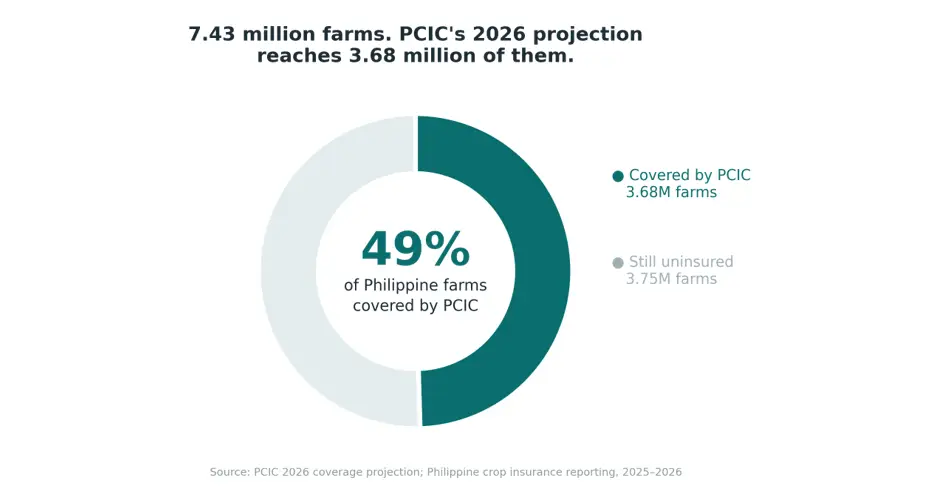
Come back to the coconut farmer. The Philippines has 7.43 million farms, and the government’s crop insurer, PCIC, projected it would cover just 3.68 million of them in 2026, roughly 49%, even after a 45% budget expansion. PCIC carries the entire underwriting risk itself, with no reinsurance and no sovereign risk transfer, which means a single bad typhoon season is a direct fiscal liability for the government, not a risk spread across a reinsurance market the way it would be almost anywhere else. Private insurers have stayed out for four decades, deterred by limited subsidies, premium taxes, and a smallholder market, 98.7% of Philippine farms sit under seven hectares, that doesn’t fit conventional underwriting.
CLIMBS’ Weather Protect Insurance skips the entire assessment step that makes traditional crop insurance slow and expensive to run. It pays on rainfall, windspeed, and drought intensity thresholds validated through ERA5 satellite data, not on a claims adjuster’s field visit. When Typhoon Tino hit in November 2025, 32,247 insured farmers received an estimated ₱250.6 million in payouts, and the pattern across the program has been consistent: 324 cooperatives across 81 provinces reaching 180,485 farmer-members for rainfall and wind risk, plus 381 cooperatives across 903 municipalities reaching 58,690 farmer-members for drought. A willingness-to-pay study found 95% of surveyed farmers believe parametric coverage genuinely reduces their financial losses.
The two dots that make this work, satellite weather validation and a cooperative distribution network cooperatives had already spent decades building trust through, existed independently for years. Nobody had put them behind the same payout trigger. A private insurer trying to copy this would need both the data science to run a parametric model and the decades of on-the-ground trust CLIMBS’ cooperative members already had; buying either one separately doesn’t get you the product. A co-insurance pool bringing private capital into Philippine crop insurance through a first-loss facility and index-based products is set to launch in January 2027. Whether it borrows CLIMBS’ playbook or repeats PCIC’s forty-year mistake is one of the clearer things to watch in this space next year.
Figure: five reconnects, and the specific customer each one targets
| Company | The dots it connected | The specific customer |
| PasarPolis | Checkout data (Gojek, Tokopedia, Xiaomi) + micro-premium underwriting | First-time insurance buyers already transacting on Indonesian super-apps |
| Igloo | Per-ride trip data (Angkas) + platform partnerships (GCash, Shopee, Lazada) | Gig-economy riders and platform users with no prior coverage |
| bolttech | 230+ insurer relationships + 700 distribution partners on one exchange | Any distributor that wants to sell insurance without becoming an insurer |
| CLIMBS | ERA5 satellite weather data + agricultural cooperative trust networks | Smallholder farmers below seven hectares, outside PCIC’s effective reach |
| GCash (GInsure) | Mobile load top-up behavior + bundled micro-health coverage | Filipinos who transact digitally every week but have never bought insurance |
What to watch through the rest of 2026
Four things worth tracking if you’re following this space closely. Watch whether bolttech’s fresh capital, earmarked partly for expansion into Africa and North America, means Southeast Asia stops being its primary growth engine, or whether the region simply becomes the proven model it exports elsewhere, the same way Malaysia’s GXBank re-ran a Singapore-proven digital banking playbook one border over. Watch Sunday’s move into Indonesia and whether an AI-first underwriting approach can out-compete Qoala and Fuse’s agent-hybrid model on a market this trust-sensitive. Watch the January 2027 Philippine co-insurance pool closely: it’s the first real test of whether the country’s crop insurance system will finally adopt the index-based, satellite-triggered approach CLIMBS has already proven at a cooperative scale, or whether private capital enters and rebuilds the same claims-adjuster bottleneck that kept insurers out for forty years in the first place. And watch how far GCash and Maya push into insurance and lending ahead of GCash’s parent Mynt targeting a roughly ₱92.3 billion IPO in the fourth quarter of 2026; insurance, like lending, is a thicker-margin business than payments, and how convincingly that shift shows up in the numbers is likely to matter to how that listing is read.
None of this shows up as one dramatic headline. It shows up as a coconut farmer getting a text message instead of a field visit, a motorbike-taxi rider getting covered per trip instead of not at all, a phone buyer getting screen insurance without ever deciding to shop for it. That’s a quieter kind of change than a funding round, and it’s easy to miss if you’re only reading press releases about partnerships. But it’s the part that actually moves the number Swiss Re keeps citing: $1.8 trillion in unmet health protection across Asia, sitting mostly on the shoulders of people who already live digitally and simply never had a product built for them.
Workshop: is your insurtech idea a dot or a reconnect?
Next time a company, yours, a competitor’s, one you’re evaluating as an investor, announces a new insurance partnership, run it through two questions before you believe the headline.
| # | Question | Your answer |
| 1 | The dot. What single data source, distribution channel, or trust network does this add that the company didn’t have access to before? Name it specifically. “AI” and “digital transformation” don’t count as answers. | |
| 2 | The reconnect. Is this dot wired to at least one other dot the company already had, aimed at a customer precise enough to name in one sentence? Or is it shipping alone, as a standalone integration? |
If you can only answer question one, you’re looking at a partnership announcement. If you can answer both, and the customer in your answer to question two is specific enough that a rival can’t serve them by copying a feature list, you’re looking at what PasarPolis, Igloo, bolttech, and CLIMBS actually built.
Hit reply with your two answers. A future issue will feature one submission, anonymized on request, with a real breakdown of where the model holds and where it doesn’t.
References
- Closing Asia’s USD 1.8 trillion health protection gap — Swiss Re
- Top Insurtech Companies in Indonesia 2026: Who’s Closing the Gap? — Fintech News Indonesia
- PasarPolis Secures Extension Funding with Tokio Marine as Lead Investor — Fintech News Indonesia
- Insurtech Igloo expands Philippines strategy as insurance market hits $8.4B — TechNode Global
- Singapore-based insurtech bolttech closes $147M Series C at a $2.1B valuation — TechCrunch
- PayPal backs Indonesia insurance startup Qoala in $47M funding — TechCrunch
- Thai insurtech startup Sunday raises $45m in Series B funding — DealStreetAsia
- Faster Payouts, Stronger Farmers: How Cooperative-Led Climate Insurance Is Reshaping Agricultural Resilience in the Philippines — CLIMBS
- Typhoon losses expose the gap Philippine crop insurance was never built to close — Insurance Business Asia
- PH fintech GCash unlocks insurance for 14 million Filipinos — Yahoo Finance / Manila Bulletin
- Grab’s Next Big Bet: Insurance — GabGrowth
- Grab and Chubb sign partnership to provide innovative in-app insurance solutions throughout Southeast Asia — Grab