A close read of how RCBC, UnionBank, GoTyme, Tonik, Security Bank, CIMB, Landbank, BPI, Maya, and GCash turned government data, super-app rails, biometric scans, and tokenized assets into products a rival can’t copy in a weekend.
A Filipino SSS member opens the DiskarTech app on their phone. They confirm a few pre-filled details pulled straight from their SSS record, do a quick face scan, and pick a repayment window of 15, 30, 60, or 90 days. Minutes later, up to ₱20,000 lands in their account. No branch visit, no payslip upload, no loan officer deciding whether they look creditworthy. RCBC launched that product, SSS Loan Lite, in August this year. It’s aimed squarely at the one to two million SSS members who’ve never had a bank move this quickly for them. Most are Gen Z and Gen X. Most work formal jobs but have been locked out of fast credit.
None of the pieces in that product are new. SSS contribution records have existed for decades, long before anyone thought to plug them into a lending decision. Facial verification is standard in half the apps on your phone already. Instant loan disbursement isn’t a breakthrough either. Plenty of lending apps in this country will hand you money fast, usually at rates that would make a loan shark blush. What RCBC actually did was notice that nobody had wired those three things together before, and that the combination solved a real problem for a specific, nameable group of people. That’s the pattern worth paying attention to across Philippine banking this year. The banks doing something genuinely new aren’t inventing financial products. They’re taking things that already existed separately: a government database, a super-app’s login screen, a biometric scan, a blockchain settlement rail. Then they’re connecting them in an order nobody had tried.
It sounds like a small distinction. It isn’t. A bank that signs a partnership and bolts it onto the app as a standalone feature is doing something any competitor with a budget can copy inside a quarter. A bank that reconnects an existing capability into a product built around one specific customer is much harder to catch up to, because copying it means understanding not just the feature but the customer it was built for.
In This Issue
- Why RCBC’s SSS Loan Lite and its gold-tokenization talks with PDAX are the same move, aimed at opposite ends of the wealth spectrum
- How UnionBank built a branch with no teller counter, and why the blockchain rail behind it matters more than the VR headset
- Inside GoTyme Bank’s Apple Pay rollout to 10 million customers, and the crypto exchange it quietly plugged in months earlier
- Why Tonik’s employer-and-merchant lending combo made it the first standalone digital bank in the Philippines to turn a profit
- What Security Bank, CIMB, and Landbank are doing quietly, and where BPI, Maya, and GCash are still catching up
- What to watch through the rest of 2026: the GCash IPO, RCBC’s gold pilot, and the four new digital bank licenses now up for grabs
The Framework at a Glance

Collecting dots is a procurement exercise: sign the API deal, buy the data license, announce the MOU. Almost any bank with a budget can do that part. Reconnecting them into something a customer actually needs, delivered at the moment they need it, is where the list of Philippine banks doing this well gets short fast.
Worth remembering why any of this is even possible right now. The BSP only started issuing standalone digital bank licenses in 2021, gave Tonik license number one, and then capped the total at six and froze new applications for three years while it watched how that first batch behaved. The freeze only lifted at the start of 2025, with room for four more entrants and a ceiling of ten digital banks total. That three-year pause mattered more than it looked like at the time. It meant six banks had a head start nobody else in the market could buy. They had years to work out lending, onboarding, and underwriting at digital speed before a fresh wave of competitors showed up. It’s a big part of why the products worth talking about this year keep coming from the same short list of names.
RCBC: SSS Loan Lite and Tokenized Gold, Aimed at Opposite Ends of the Market
RCBC is running this trick twice at once. The SSS loan pulls a first-time borrower into formal credit. In the same month, RCBC signed a memorandum of understanding with the Philippine Digital Asset Exchange to explore tokenized gold, sold through RCBC’s own banking app. That’s a way around the storage and authenticity headaches that keep most Filipinos from owning physical gold at all. That one’s still just an MOU. RCBC and PDAX have said as much: no pricing, no minimums, no launch date yet. But it’s the same underlying move as the SSS product, aimed at the opposite end of the wealth spectrum. Take something a bank has never connected to a consumer account before, such as government contribution data or a regulated crypto exchange, and wire it straight into the app people already open every day. It’s also not a coincidence that this is the same bank whose innovation chief, Lito Villanueva, was named Digital Banking Champion of the Year at the World Financial Innovation Series in 2026, and whose digital banking arm has now taken Euromoney’s top award seven years running. Awards season noise usually deserves to be ignored. Seven straight years is harder to write off as noise.
UnionBank’s ARK: A Digital Branch With No Teller Counter
UnionBank took the same logic and applied it to the physical branch. The ARK, its fully digital branch, has no teller counter. In its place: a virtual teller machine for deposits and withdrawals, and a VR tool that lets a customer see what a home loan actually buys before they sign anything. Separately, the bank’s Project i2i uses blockchain settlement to plug rural banks into the national and international remittance network. Many of these banks had no direct pipe into major financial institutions before. The new rail cuts out days of manual reconciliation. On their own, neither idea is new. Virtual reality has existed for a decade. Blockchain settlement rails aren’t novel either. What’s actually interesting is that one bank is running both experiments against the same underlying problem: Filipinos who are geographically cut off from a working bank branch, whether that’s a rural town with no major-bank presence or an OFW family waiting days for a remittance to clear.
GoTyme Bank: Apple Pay and Crypto Trading for 10 Million Customers
GoTyme Bank added a dot from a completely different direction. In August, it became one of the first Philippine digital banks to support Apple Pay, letting its roughly 10 million customers tap a debit card straight from Apple Wallet. The transaction is tokenized, so the merchant never sees the actual card number, and it’s authenticated with Face ID or Touch ID. That ran through Paymentology’s processing platform. A few months before that, GoTyme had already put a regulated crypto exchange behind the same login, through a partnership with Alpaca. Neither move invents anything. Apple Pay exists. Crypto exchanges exist. What GoTyme did was put a fully licensed Philippine bank account, a global payment rail, and a crypto exchange behind one sign-in, for a customer base that’s grown to 10 million people faster than almost any other digital bank in the country.
Tonik Bank: How Salary and Merchant Lending Made It Philippines’ First Profitable Digital Bank
Tonik is the cleanest example of why this matters more than the partnership itself. It didn’t build a super-app. It didn’t lean on a parent company’s transaction data the way GXS Bank does in Singapore. It built two lending channels from scratch: salary-deduction loans distributed through employers, and installment financing distributed through merchants at checkout. It ran both against its own underwriting engine. Neither channel is a new idea. Salary deduction lending predates digital banking by decades; so does merchant installment credit. Tonik’s move was connecting both to one underwriting system and pointing the combination at the roughly 90% of Filipinos the bank says have no meaningful access to formal credit. The results showed up fast: an 82% loan-to-deposit ratio, the highest of any Philippine digital bank, a loan book that grew 2.3 times year-on-year to $110 million by the first quarter of 2026, and a 51% net interest margin. Tonik became the first standalone digital bank in the country to post a genuinely profitable quarter. Not a narrower loss. Profit.
Figure 1. Three reconnects, and the specific customer each one targets
| Bank | The dots it connected | The specific customer |
| RCBC | SSS contribution history + instant digital loan | Formal-sector worker with no prior access to fast credit |
| UnionBank | Blockchain settlement + rural bank network (Project i2i) | Provincial customer cut off from major-bank remittance rails |
| Tonik | Employer payroll channel + merchant checkout channel | The roughly 90% of Filipinos without meaningful formal credit access |
Notice what all three have in common. None of them describe “Filipinos” or “small businesses” as the target. Each one names a customer precise enough that a competitor can’t serve them by copying a feature list. That precision is the tell that a bank actually did the harder reconnect work, rather than stopping at a partnership announcement.
Security Bank, CIMB, and Landbank: Smaller Moves, Same Logic
Security Bank and CIMB are doing smaller, quieter versions of the same thing. Security Bank’s biometric onboarding has pulled in more than 23,000 new-to-bank customers digitally, and its QRPay API saw transaction counts jump 284% and volume climb 187% between 2024 and 2025. The API lets corporate clients generate and reconcile payments straight from their own systems. CIMB Philippines picked up Best Digital Bank Philippines 2026 at the Global Banking & Finance Review Awards, largely on GSave, a savings account that pays a real yield without the balance minimums and lock-ins that most traditional Philippine savings accounts still carry. Landbank, which has the least fintech branding of any bank in this piece, moved ₱4.41 trillion through digital channels in 2025, up 30% year-on-year. That’s a scale most digital-only challengers won’t touch for years. It was built almost entirely on digitizing government and agricultural transactions that used to run on paper.
Figure 2. Year-over-year growth across the products named in this issue. Different metrics, one direction.
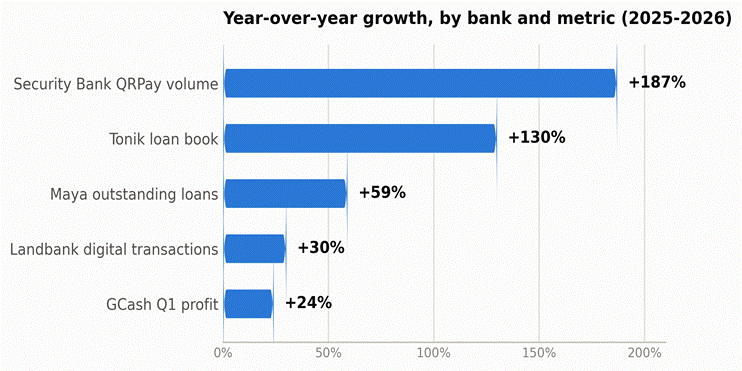
Security Bank QRPay is transaction-volume growth; Tonik is loan-book growth; Maya is outstanding-loan growth; Landbank is digital-transaction-value growth; GCash is quarterly profit growth. Sources in the References section.
The Risk Nobody Puts in the Press Release
None of this is free of risk, and it’s worth saying so before this reads like a highlight reel. Underwriting a ₱20,000 loan off an SSS record works because SSS data is reliable. But it also means a data breach at one government agency now has consequences for a private lender’s balance sheet, not just for the agency itself. Tokenizing gold through a crypto exchange solves a real accessibility problem, and it also puts a first-time investor’s savings one smart-contract bug or exchange failure away from disappearing. The BSP has been deliberate about this exact tension. The three-year license moratorium and the careful sandbox testing before wider rollouts exist precisely because connecting two systems that were never designed to talk to each other tends to create failure modes nobody tested for. The banks getting this right aren’t just wiring things together faster than everyone else. They’re the ones that seem to have actually thought about what breaks when the wiring fails.
Where Philippine Banks Are Still Stuck: BPI, Maya, and GCash
Now for the banks that collected the right pieces and haven’t quite connected them yet.
BPI’s Track and Plan tool, built with Personetics, reads a customer’s spending and surfaces personalized insights inside the app. It’s genuinely useful, and BPI has said it plans to fold in credit card data to sharpen it further. But right now it’s one capability doing one job: giving better information to a customer who already banks with BPI. It hasn’t been wired into a second piece, a lending decision or a merchant partnership, that would turn insight into a different kind of product rather than a nicer dashboard.
Maya’s ambitions are bigger than what’s actually shipped. Maya Bank’s outstanding loans hit ₱27 billion as of September 2025, up 59% from the end of the prior year, and the bank turned profitable in 2025 on the back of that growth. Founder Orlando Vea has talked publicly about housing loans, car loans, earned wage access, supply chain financing, even fractional stock investing. That’s a wide, ambitious list of new capabilities. None of it had a confirmed launch date as of this writing. On paper, it reads like the same move RCBC and Tonik already made. Until those products actually ship and get connected to Maya’s existing wallet and merchant network, it’s a roadmap, not a product.
GCash sits in the same spot at a much bigger scale. Its parent, Mynt, is preparing what would be the largest IPO in Philippine history. The listing, roughly ₱92.3 billion, is targeted for the fourth quarter of 2026. First-quarter profit is already up 24% year-on-year to ₱5.6 billion. On the payments side, GCash’s reach is close to unmatched. It’s the default wallet for a huge share of Filipino digital transactions. But payments is a thinner-margin business than lending, and GCash’s push into credit and investment products is still the least proven part of the story. Whether that shift happens convincingly before or after the IPO prices might be the single biggest question hanging over the listing.
What to Watch in Philippine Digital Banking Through the Rest of 2026
Worth watching for the rest of the year: whether RCBC’s gold MOU turns into an actual product with real pricing, or quietly stays a headline. Whether Maya can execute on housing and auto lending. That’s a very different underwriting problem than the salary and merchant lending Tonik already proved out. Whether GCash’s public listing forces it to show real progress on lending rather than payments volume alone. And whether any bank outside RCBC starts underwriting against government records like SSS, Pag-IBIG, or BIR. Once that’s proven safe and compliant at scale, every other lender in the country is going to want it too. With four fresh digital bank licenses now up for grabs after the moratorium lifted, that question stops being theoretical fast: whoever wins those slots will either copy what Tonik and RCBC already proved out, or spend years relearning it the slow way.
None of this shows up as a single dramatic headline. It shows up as an SSS member getting cash in minutes instead of days, a provincial family getting a remittance settled without a five-day wait, a gig worker getting approved for a loan a conventional bank would have declined on paper alone. That’s a quieter kind of change than an IPO or a funding round, and it’s easy to miss if you’re only reading the press releases. But it’s the part that actually moves the number the BSP keeps citing every year: the roughly half of Filipino adults still without a formal bank account. Every product in this piece is really an argument about how you close that gap.
The banks worth paying attention to this year aren’t the ones with the longest list of partnerships, and they’re rarely the loudest ones on stage at an awards dinner. They’re the ones that took two things nobody had put together before and pointed the combination at a customer specific enough to name in one sentence. Everyone else is still shipping features and calling it transformation.
Workshop: Is Your Bank’s “Innovation” a Dot or a Reconnect?
Next time a bank, yours, a competitor’s, one you’re evaluating as an investor, announces something as an innovation, run it through two questions before you believe the headline.
| # | Question | Your answer |
| 1 | The dot. What single new data source, partner, or channel does this add that the bank didn’t have before? Name it specifically. “AI” and “digital transformation” don’t count as answers. | |
| 2 | The reconnect. Is this dot wired into at least one other dot the bank already had, aimed at a customer precise enough to name in one sentence? Or is it shipping alone, as a standalone feature? |
If you can only answer question one, you’re looking at a partnership announcement. If you can answer both, and the customer in your answer to question two is specific enough that a competitor can’t serve them by copying a feature list, you’re looking at what RCBC, UnionBank, and Tonik actually built this year.
References
- Paymentology Powers GoTyme Bank’s Apple Pay Launch in the Philippines, Media OutReach Newswire
- GoTyme Bank Launches Crypto Trading in the Philippines in Partnership with Alpaca, Business Wire
- How AI and blockchain are making banks more inclusive in the Philippines, GovInsider
- SSS Members Can Now Get Instant Emergency Cash Up to ₱20,000 via RCBC DiskarTech, BitPinas
- RCBC, PDAX Partner to Explore Tokenized Gold Access in PH, SunStar Davao
- BPI & Personetics utilise AI to help customers simplify money decisions, IBS Intelligence
- WINNING | Security Bank deepens digital, green finance play, InsiderPH
- CIMB Bank Philippines Wins Best Digital Bank Philippines 2026, Global Banking & Finance Review
- LANDBANK digital transactions hit ₱4.41T, up 30% in 2025, BusinessMirror
- Maya’s big plans: Home and car loans to power growth, IPO possible, InsiderPH
- Tonik Becomes the First Standalone Digital Bank in the Philippines to Achieve Profitability, Yahoo Finance Singapore
- GCash value could hit P673 billion by 2030, Philstar