Ryt Bank’s in-house assistant, Ryt AI, logged more than 10 million interactions in its first year and drives real repeat usage — a rarer result than it sounds for a bank chatbot. The “sovereign Malaysian AI” story wrapped around it, and the interests that story quietly serves, deserve more scrutiny than the launch headlines gave them.
| Ryt AI is a real product with real repeat usage, but the “sovereign Malaysian AI” story built around it is doing work the disclosed facts don’t fully back up, and it serves interests bigger than the product itself. 1. People actually use it, repeatedly. Ryt AI logged more than 10 million interactions for real banking tasks in its first year, and customers who use the chatbot return to the app roughly twice as often as typical banking-app users — a genuine engagement product, not a gimmick bolted onto a launch press release. 2. Nobody outside the building has checked the harder claim. ILMU, the model behind Ryt AI, is described as “built from scratch as a foundation model” trained on more than 100 GPU nodes, but no parameter count, architecture, or independent benchmark has ever been published — a technical claim resting entirely on the word of the team that built it. 3. The AI story is doing double duty for a business it isn’t. YTL Power is simultaneously building Malaysia’s flagship “sovereign AI” data-centre infrastructure with Nvidia, and a bank majority-owned by Singapore’s Sea Limited but fronted almost entirely by YTL executives as a “built by Malaysians” AI success story is a convenient public proof point for that unrelated, much larger infrastructure business. Pull those three threads apart and Ryt AI looks like a genuinely good product carrying a story that was never really about banking. |
Ryt Bank’s first anniversary press release, on August 20, 2026, led with a customer count: 1.5 million, enough to call itself Malaysia’s largest digital bank. Buried a few paragraphs down was a smaller number that actually says more about what this bank is betting on: Ryt AI, its conversational assistant, had been accessed more than 10 million times in twelve months for actual banking tasks — transfers, bill payments, reading a photographed receipt to split a bill with friends.
That’s the product worth examining on its own, separate from the bank around it. Ryt Bank didn’t launch as “a digital bank with a chatbot.” It launched, on August 25, 2025, branded explicitly as “the world’s first AI-powered bank,” with YTL Power managing director Datuk Seri Yeoh Seok Hong promising an assistant that “speaks our languages, understands our culture, and sets a new standard for how banking should feel.” The AI isn’t a feature bolted onto Ryt Bank. It is, by the bank’s own marketing, the entire reason to believe Ryt Bank is different from GXBank, Boost Bank, AEON Bank, or KAF Digital Bank — the four rivals it launched last against in a five-way race, all offering broadly the same savings accounts, cards, and small-credit products.
So does the AI hold up? Three separate questions are hiding inside that one, and they have three separate answers.
The number that’s actually real
Start with the most basic test: do people use it, or did 1.5 million Malaysians just open an account for the free money and never come back? Ryt Bank has run plenty of free-money campaigns that make that a fair question. Its Chinese New Year push gave away more than 500,000 digital ang pows. Its Hari Raya follow-up in March 2026 offered both sides of a referral up to RM99 each, with no cap on invitations. By late February 2026, the app was sitting at No. 1 on both the Apple App Store and Google Play in Malaysia — a ranking that giveaway campaigns are very good at buying, and that says nothing on its own about whether anyone opens the app again once the bonus clears.
Ryt AI’s own usage numbers are where the picture changes. By April 2026, at 1.2 million users, the bank had logged more than 25 million app transactions, and — this is the figure that actually matters — customers who use the AI chatbot return to the app roughly twice as often as typical banking-app users. By the one-year mark in August 2026, total AI interactions for real banking tasks had passed 10 million, spread across a customer base of 1.5 million. That works out to somewhere around six or seven AI interactions per customer over the year, not a one-time novelty tap. The bank’s own reporting adds that PayLater usage, facilitated conversationally through the assistant, skewed toward “essential spending” rather than discretionary purchases — the pattern of someone actually managing money through the app, not someone chasing a promo. A newer feature, Ryt Groups, lets users photograph a receipt, have the assistant itemize the bill including tax and service charge, and split it with friends inside the app — a specific, unglamorous task that a bank chatbot either handles cleanly or doesn’t, and one that’s hard to fake with a marketing budget.
None of that proves Ryt AI is a breakthrough. Reading a receipt and calculating a bill split is solved technology, not a research result. But it is a real, repeatedly-used product wrapped around real customer money movement, which puts it well ahead of the median “AI-powered” feature in Southeast Asian fintech, where the phrase often means a chatbot that answers three FAQ categories and gets abandoned within a week. Credit where it’s due before the rest of this issue gets more skeptical: the adoption number is not manufactured.
What “built from scratch” actually claims
Here’s where the story gets harder to verify. Ryt AI runs on ILMU, unveiled in August 2025 and described, in the words of the academic who helped lead its development, as “built from scratch as a foundation model, not a fine-tuned version on other platforms.” Malaysian Prime Minister Anwar Ibrahim appeared at the launch. ILMU was trained using more than 100 GPU nodes, developed by a team drawn from Universiti Malaya and YTL AI Labs, and is hosted entirely on infrastructure inside Malaysia. Coverage since has repeated some version of “100% Malaysian AI, built by Malaysians, for Malaysians” almost without exception.
Compare that compute budget to what came before it: MaLLaM, an earlier open Malaysian-language model effort, trained on roughly 10 A100 GPU nodes. ILMU’s stated 100-plus nodes is a real, meaningfully larger commitment, and that part is easy to take at face value — more compute than a prior public effort is a verifiable, specific claim.
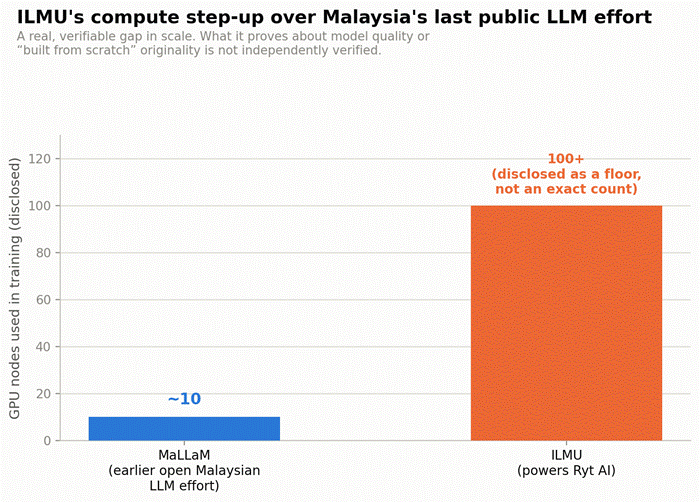
Figure: disclosed GPU training scale, MaLLaM vs. ILMU. ILMU’s figure is stated by its developers as “more than 100” nodes, not an exact count.
What isn’t verifiable is the more important half of the claim: “built from scratch” as something technically novel, rather than “built from scratch” as in trained locally using entirely standard, publicly documented transformer techniques applied to Malaysian-language data. Both of those would honestly be called homegrown. Only one of them would justify a “world’s first” framing. As of this writing, there is no public parameter count, no disclosed model architecture, no published benchmark against comparable regional or global models, and no independent technical audit. The claim currently rests entirely on the word of the team that built it, presented at a press event with the country’s prime minister in the room. A skeptical reader should credit what’s checkable — a Malaysian team, Malaysian training data, Malaysian hosting, a real compute step-up from the last public effort — and stay genuinely agnostic on the novelty claim until someone outside YTL AI Labs has actually looked under the hood.
Whose interest the story actually serves
This is the part that rarely makes it into coverage of Ryt AI, and it changes how the “built by Malaysians” framing should be read. Corporate filings with the Companies Commission of Malaysia, dated December 11, 2024, show Ryt Bank’s actual ownership: SeaMoney Holding MY Ltd — a subsidiary of Sea Limited, the Singapore-headquartered, Nasdaq-listed parent of Shopee and Garena — holds 49.99% of the entity. YTL Digital Capital holds 40.02%. A single Malaysian individual holds the remaining 9.99%. Sea, not YTL, is the largest shareholder of the legal entity, YTL Digital Bank Berhad, trading as Ryt Bank. Yet it is YTL’s executives who do almost all of the public talking about Ryt AI, and Sea is barely mentioned in the Malaysian coverage of “Malaysia’s” AI bank.
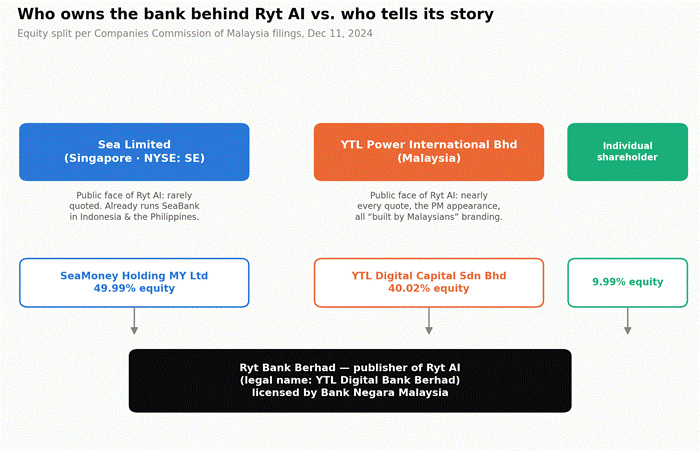
Figure: Ryt Bank’s equity structure against its public messaging. Equity split per Companies Commission of Malaysia filings, December 11, 2024.
Now line that up against something happening on a completely different part of YTL’s balance sheet. On October 31, 2025 — barely two months after Ryt AI’s public debut — YTL Power completed its first Nvidia-powered AI data centre, in Kulai, Johor, at the 600-megawatt YTL Green Data Center Park, running on Nvidia’s Grace Blackwell GB200 GPUs and renewable power from an on-site solar plant. The announcement came out of a meeting between Prime Minister Anwar Ibrahim, Nvidia chief executive Jensen Huang, and YTL Power’s managing director at the APEC summit in South Korea. The facility is explicitly positioned as “one of the region’s first sovereign AI platforms for government and public services,” backed by RM5.9 billion the Malaysian government allocated to the AI sector under Budget 2026.
Look at the language doing the work in both stories: “sovereign,” “built by Malaysians,” a prime ministerial appearance, YTL’s own executives as the face of it. Ryt AI is a retail banking chatbot. The Johor data centre is gigawatt-scale national infrastructure aimed at hosting government AI services. They are different businesses, different customers, and different risk profiles entirely — but they share the same conglomerate, the same “Malaysian sovereign AI” branding, and the same small set of spokespeople. A consumer-facing product with 1.5 million real users and a genuinely good repeat-usage story is an unusually effective public proof point for a company trying to convince the Malaysian government and enterprise customers that it can be trusted with sovereign AI infrastructure at a much larger scale. None of this means ILMU is fake or that Ryt AI is a Trojan horse. It does mean the loudest voice explaining what Ryt AI is and why it matters has a second, much bigger business that benefits from Malaysians believing the sovereignty story regardless of how the bank chatbot performs.
The kind of bank AI that’s hard to copy — and the kind that isn’t
There’s a distinction worth drawing out that the “world’s first AI-powered bank” framing conveniently blurs: not all bank AI is the same kind of hard. Southeast Asia already has a live example of the other kind, and putting the two side by side sharpens exactly what should make a skeptical reader pause on Ryt AI specifically.
GXS Bank, the Grab-Singtel digital bank in Singapore, uses AI differently. Its FlexiLoan product — a personal loan where the borrower sets the amount, tenure, and repayment date — is underwritten using what GXS calls an “ecosystem risk score,” built with customer consent from years of Grab ride, delivery, and Singtel mobile-usage data, layered on top of conventional credit bureau scoring. That score is explicitly part of a lending decision: it’s the reason GXS can approve gig workers and self-employed borrowers a conventional bank would decline on paper alone, because roughly 15% of that customer base has no traditional credit file at all. A rival bank could copy GXS’s loan terms in an afternoon. It could not copy five years of Grab’s transaction history on the same customers, and it could not get inside the Grab app to reach them at the point of financial need. The AI there isn’t the headline feature — it’s invisible infrastructure sitting underneath an ordinary-looking loan product, and that’s precisely what makes it hard to replicate.
Ryt AI is a different kind of thing. Every disclosed use case — transfers, bill payments, reading a receipt to split a bill, explaining a fee in plain language — is a conversational interface layered on top of banking functions that already existed before the AI arrived. There is no public disclosure that ILMU plays any role in credit decisions, fraud scoring, or underwriting at Ryt Bank the way GXS’s ecosystem score does at GXS. PayLater’s approval process, as described publicly, requires no documents and imposes no late fees, which reads more like a low-limit, low-risk onboarding product than a credit engine leaning on proprietary AI-driven risk assessment. That doesn’t make Ryt AI worthless — the usage numbers say otherwise — but it does mean the “AI” in “AI-powered bank” is doing a service-layer job, not an underwriting-moat job.
That distinction matters because moats and marketing get confused with each other in exactly this kind of story. A chat interface that reads receipts and answers questions in Manglish is a genuinely pleasant product experience, and building a large language model with local-language fluency is real work. But it is also, as an engineering problem, more replicable than a proprietary risk score trained on years of exclusive transaction data. Any well-funded competitor with API access to a capable foundation model, from a major AI lab or another regional bank’s own stack, can stand up a multilingual banking chatbot inside a year or two. None of Ryt Bank’s four Malaysian rivals has copied GXS’s ecosystem-score approach either, for the same reason it’s hard: it requires years of proprietary transaction data none of them has. GXBank, Boost Bank, AEON Bank, and KAF Digital Bank could all plausibly ship their own version of a conversational assistant faster than they could replicate a Grab-style ecosystem score, precisely because a chat layer is the easier kind of AI to build.
None of this means Ryt AI is destined to be commoditized tomorrow — first-mover advantage, brand association, and a year of user trust are real, if modest, defenses. But a reader evaluating any bank’s AI claim should ask which category it falls into: AI as an invisible underwriting advantage that competitors structurally cannot copy, or AI as a visible, well-executed interface that a well-resourced rival can approximate once it decides to try. Ryt AI, on the evidence available, is unambiguously the second kind — a good product, not yet a moat.
What a skeptical reader should still watch
Two things can be true here, and both are worth holding onto instead of resolving into a single verdict. Ryt AI is a genuinely well-used product: real repeat interactions, a return rate that beats the app-wide average by roughly double, and specific features like receipt-splitting that solve an actual small annoyance rather than performing intelligence for its own sake. That’s a sharper first-year result than most “AI-powered” claims in Southeast Asian fintech produce, and it deserves to be taken seriously as a product, on its own terms.
But three specific things separate “Ryt AI gets used” from “Ryt AI’s story is what it says it is,” and they’re worth tracking rather than taking on faith. First, whether ILMU’s technical claims ever get an independent look — a published architecture, a third-party benchmark, anything beyond the builder’s own description — because right now “built from scratch” and “fine-tuned on standard techniques” would look identical to an outside reader, and only one of them earns the “world’s first” framing attached to it. Second, whether Sea’s larger equity stake eventually pulls Ryt Bank’s AI roadmap toward Sea’s own proven technology stack, rather than continued investment in a bespoke Malaysian model — a bank chatbot is expensive to keep training and maintaining independently, and the shareholder with the deeper existing fintech infrastructure elsewhere in the region is not the one currently setting the narrative. Third, whether Ryt AI’s usage growth holds up on its own, separate from Ryt Bank’s broader promotional calendar, since the CNY and Raya campaigns that inflated total registered users make it hard to fully separate organic AI adoption from opportunistic signups still working through their first few app sessions.
Ryt AI earned its usage numbers. The “sovereign Malaysian AI” framing wrapped around it is carrying weight for a much larger YTL ambition that has very little to do with whether a bank chatbot can split a dinner bill. Both facts are true at once, and the second one is easy to miss when the first one arrives with a prime ministerial photo op.
Workshop: stress-test the next “our AI” claim you read
Before taking any company’s AI feature, adoption milestone, or “built here” branding at face value — your own product’s, a competitor’s, or one you’re evaluating as an investor — run it through the three questions this issue actually used.
| # | Question | Ask yourself |
| 1 | Whose usage is it, really? | Strip out signup bonuses, referral campaigns, and app-store giveaways. What’s left — repeat, self-motivated usage of the AI feature specifically, or a spike that decays once the incentive stops? |
| 2 | Can the technical claim survive outside verification? | Is there a published architecture, parameter count, or benchmark — or does “built from scratch” rest entirely on the word of the team that built it, delivered at a press event? |
| 3 | Whose interest does the story actually serve? | Pull the real ownership structure and check for a bigger, unrelated business nearby. Does someone benefit from the AI narrative regardless of whether the product itself succeeds? |
Hit reply with what you found. A future issue will feature one submission, anonymized on request, with a real breakdown of where the story and the facts diverge.
Tags: Ryt Bank, Ryt AI, ILMU LLM, YTL Power, Sea Limited, Malaysia AI, Sovereign AI, Fintech AI, Digital Banking, Nvidia
References
- Ryt Bank marks first anniversary with 1.5mil customers, The Star
- Ryt Bank is now Malaysia’s largest digital bank with over 1.5 million users, SoyaCincau
- Ryt Bank says AI chatbot has twice more returning users as accounts top 1.2 mil, The Edge Malaysia
- Ryt Bank hits 1.2M users. Paylater on Card and Invest coming soon, SoyaCincau
- YTL Group, Sea officially launch AI-powered digital bank ‘Ryt Bank’ in Malaysia, Marketech APAC
- Ryt Bank Debuts as Malaysia’s First AI-Powered Digital Bank, Fintech News Malaysia
- YTL Power-Sea digital bank secures regulatory nod for operations, The Edge Malaysia
- YTL gets green light for Ryt Bank, Malaysia’s first AI-powered digital bank, in venture with Shopee owner, Malay Mail
- YTL Power launches Malaysia’s first homegrown LLM, Ilmu, The Edge Malaysia
- ILMU: Deep dive into Malaysia’s first homegrown LLM with Prof Chan, w.media
- Ryt Bank CEO Melvin Ooi Preparing to Exit Role, Sources Say, Fintech News Malaysia
- Ryt Bank Launches Duit Raya Referral Campaign Offering Up To RM99, RinggitPlus
- YTL Power completes first Nvidia-powered AI data centre in Johor, YTL AI Cloud now operational, The Edge Malaysia
- Nvidia & YTL Power partner for $4.3bn AI data centers in Malaysia, Data Center Dynamics
- GXS FlexiLoan: Lending Reimagined for the Underserved, Grab