Tonik became the Philippines’ first profitable standalone digital bank in 2026. Its Solo Stash paid 4% in February and still pays 4% after three central bank hikes. Here is who that rate really works for.
| Solo Stash is sold as a savings goal tool, but its real job is to be cheap, sticky funding for Tonik’s lending machine, and 2026’s rate reversal is the first real test of how long savers will accept 4%. 1. Its job is funding, not yield. Lending made up 99% of Tonik’s revenue by early 2026, and loans equal 82% of deposits, so every peso parked in a Stash is raw material for a loan book now 2.3 times its size a year earlier. 2. It still wins on price, so Tonik has no reason to move. At 4.00% a year, Solo Stash beats the base savings rates at OwnBank (3.8%), MariBank (3.25%) and GoTyme (3.0%), even after the BSP lifted its policy rate to 5.00%. 2. The saver carries the cost. After the 20% withholding tax, 4.00% nets 3.20%, headline inflation ran at 6.1% in August 2026, and Tonik can reprice every Stash balance the day a new rate takes effect. To see how those three facts meet, start with one ordinary saver and one tuition bill. |
Take a call center agent in Cebu who earns ₱32,000 a month. That puts her squarely in the ₱25,000 to ₱40,000 monthly band where Tonik says many of its borrowers sit. She has ₱60,000 set aside for her son’s tuition, due next June.
Until this year the money sat in her regular Tonik Account. That account pays 1.00% a year. Over twelve months, ₱60,000 earns ₱600 before tax and ₱480 after the 20% withholding tax. She checks the balance, sees almost no movement, and stops checking.
Then she taps the Stash tile on the app’s home screen. She picks Solo, uploads a photo of the school gate, types ₱60,000 as the target and sets a June deadline. There is no minimum balance and no fee. She can pull the money out any day without a penalty. Interest is computed on each day’s cleared balance and posted at month end.
The rate is 4.00%. The same ₱60,000 now earns ₱2,400 in a year, or ₱1,920 after tax. That is four times what the plain account paid. Every month a small credit lands next to the photo of the school gate, and the progress bar creeps toward the goal. It feels like the money is finally working.
Now run the other half of the math. In August 2026, Philippine consumer prices were 6.1% higher than a year earlier, according to the Philippine Statistics Authority. If prices keep rising at that pace, next June’s tuition and uniforms will cost what ₱63,660 buys today. Her Stash will hold ₱61,920. In the old account she would have fallen ₱3,180 short. In the Stash she falls ₱1,740 short.
That is the product in one line. Solo Stash makes saving feel better, and it really does cut the damage nearly in half. It does not protect her. Meanwhile, on the other side of the screen, her ₱60,000 is doing a very different job for Tonik.
A Savings Product With a Lender’s Job
Tonik’s product page describes Solo Stash as a personal savings account where you decide your goals and split cash across them. Each customer with a verified ID can hold up to five Stashes, Solo and Group combined. Group Stash pays up to 4.5%, but only when the owner has at least two other people contributing, and only the creator can withdraw. Solo Stash pays a flat 4.00%. That is the story the app tells: goals, photos, progress bars.
Tonik’s own investor story is different. When it announced in May 2026 that it was the first standalone Philippine digital bank to report sustained profitability, the numbers it chose were all about credit. Its loan portfolio had reached US$110 million by April 2026, up 2.3 times from a year earlier. Lending produced 99% of revenue. Net interest margin was 51%. The loan to deposit ratio was 82%, a level Tonik says no other Philippine digital bank matches. The release also made a pointed comparison: as a BSP licensed bank, Tonik raises retail funding at 3% to 6% a year, while non-bank lenders pay 15% or more for theirs.
Read those lines together and the real job of a Stash becomes clear. Tonik is a consumer lender that happens to hold a banking license, and the license is valuable mainly because it unlocks cheap deposits. For every ₱100 sitting in Tonik deposits, about ₱82 is out on loan. Tonik does not disclose its deposit total in these releases, but its own figures imply roughly US$134 million, which is the US$110 million loan book divided by 0.82. That derived figure is an estimate, not a reported number.
So the real problem Solo Stash solves is not “help Filipinos save for goals.” It is “fund a fast growing, high margin loan book with retail money that is cheap and does not leave, at a moment when the cost of money is rising and investors have just been handed the profit they were promised.” This is the same shape we traced in Cake by VPBank’s Profit Is Real. So Is the Risk Underneath It.: a digital lender whose headline profit is real, and whose fragility sits in a line of the balance sheet the headline skips.
The Pressure Behind a Rate That Didn’t Move
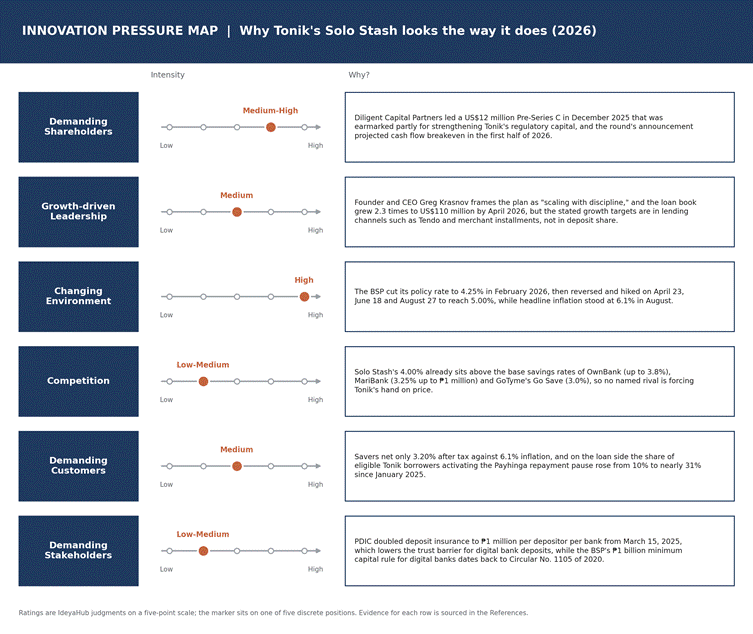
Figure 1. Innovation Pressure Map for Tonik’s Solo Stash, 2026. Intensity ratings are IdeyaHub judgments on a five-point scale; each marker sits on one of five discrete positions.
Sources: Tonik Pre-Series C release via PR Newswire (Dec 2025); Tonik profitability release (May 2026); Tonik Payhinga release (Jul 2026); Metrobank Wealth Insights, Philippine Daily Inquirer, Philippine News Agency, Philstar and The Manila Times (BSP decisions, 2026); PSA (Aug 2026 CPI); GoTyme, MariBank and OwnBank rate pages; PDIC PR-038-25; BSP Circular No. 1105 via ADB. Full links in References.
The two highest rows are Changing Environment and Demanding Shareholders. Neither one is about savers setting goals. The environment row says the price of money moved hard against every bank in 2026. The shareholder row says Tonik has just proved it can make money and now has to keep proving it, quarter after quarter, with a capital base that its latest round was partly raised to shore up. The product page answers the Customers row. The pressure sits somewhere else.
The Competition rating is the most honest surprise. In most digital bank stories competition is the loudest pressure. Here it is Low-Medium, because Tonik is already the price leader among the base rates we could verify at each bank’s own site. That low rating is the key to the whole story, and it is also the rating most likely to be wrong in six months. If any large rival lifts its base savings rate above 4%, the row jumps two notches overnight. The Customers row is also soft. It could climb to Medium-High if inflation stays above 6% into 2027, because that is when savers start comparing real returns instead of headline rates. The Shareholders row could ease to Medium if the second and third quarters confirm that the Q1 profit was not a one-off.
Three Readings of a 4% Rate Under a 5% Benchmark
Solo Stash paid a flat 4.0% in February 2026, according to Fintech News Philippines, when the policy rate stood at 4.25%. It still pays 4.00% in September, after three hikes took the policy rate to 5.00%. There are three plausible explanations. Each one predicts a different row on the map should matter most. Only one fits all of the evidence.
Reading one: Tonik is putting savers first
This is the reading the marketing invites. A bank that has just turned profitable shares the upside with depositors and keeps a generous, simple rate. If that were true, the Customers row would be the dominant pressure, and you would expect Tonik to lift the Stash rate as the policy rate rose.
The evidence says no. When Tonik repriced in 2026, it was the time deposit grid, reset effective August 24, three days before the BSP’s August hike. The Stash rate carries no new effective date, and the Tonik Account sits at 1.00%. Solo Stash now pays 100 basis points below the 5.00% policy rate. A saver-first bank does not let its flagship savings product fall that far behind the benchmark. This reading is ruled out.
Reading two: Tonik doesn’t need to move
The second reading is simpler. Tonik holds the rate because nobody is beating it. If that were the main driver, Competition would be the row that decides pricing, and the product would sit just above the pack.
That is exactly where it sits. GoTyme’s own help page computes Go Save interest at 3.0%. MariBank’s product page shows 3.25% on balances up to ₱1 million. OwnBank advertises up to 3.8% on savings. Solo Stash at 4.00% clears all three. This reading explains why the rate did not rise. It does not explain why the product exists, or why Tonik structured its time deposits the way it did.
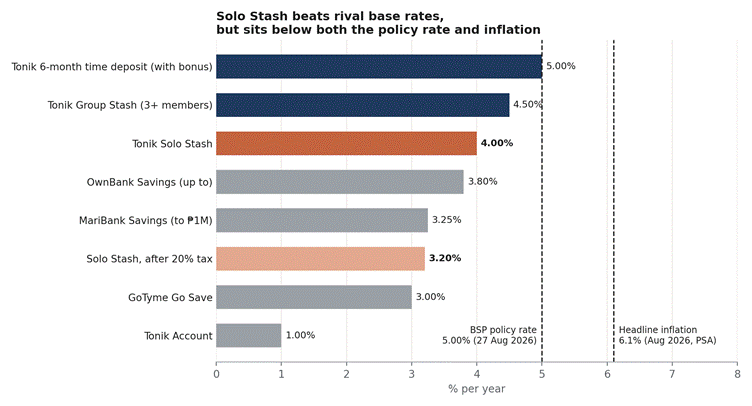
Figure 2. Where Solo Stash sits, September 2026: advertised annual rates before the 20% withholding tax, against the BSP policy rate and August 2026 headline inflation. OwnBank is an “up to” rate; MariBank is the rate on balances up to ₱1 million; the Tonik time deposit rate includes a 1% bonus paid only if a ₱10,000 average daily balance is kept in the savings account every month.
Sources: Tonik Bank deposit rates page; GoTyme Bank Go Save help page; MariBank PH savings page; OwnBank homepage; Philstar and The Manila Times (BSP decision, 27 Aug 2026); Philippine Statistics Authority (August 2026 CPI). After tax figure is an IdeyaHub calculation.
Get the next SEA banking case study in your inbox
Free. Unsubscribe anytime.
Reading three: the Stash is a funding cost lever
The third reading treats Solo Stash as a tool for managing what Tonik pays for money. If that is right, Environment and Shareholders should be the top pressures, and Tonik should behave like a treasurer: pay up only for money it can count on, keep the ability to reprice everything else, and avoid locking in today’s high rates for long.
The time deposit grid is the tell. From August 24, 2026, a six month deposit pays 4.00% plus a 1.00% bonus. The 9, 12, 18 and 24 month terms all pay 3.50% plus the same bonus. Tonik pays more for its shortest lock-in than for its longest. A bank that expected rates to keep climbing, or that simply wanted to grab long term funding, would do the opposite. Tonik is declining to commit to today’s rate environment for two years.
The bonus itself carries a second signal. The extra 1.00% is paid only at maturity, and only if the customer keeps an average daily balance of at least ₱10,000 in the Tonik Savings Account every month of the term. The time deposit is built to keep liquid balances sitting inside Tonik alongside it.
Then there is the repricing clause. Tonik’s FAQ states that when it changes the rate on the Tonik Account, Solo Stash or Group Stash, the new rate applies to all available balances from the effective date. There is no grandfathering. A single decision reprices the whole stock of Stash money at once. Time deposits work the other way: they keep the rate they were opened at.
Put together, the third reading fits every fact. Reading two survives as the reason Tonik can get away with it. Tonik holds 4.00% because Competition is weak, and it uses the Stash as a flexible, instantly repriceable funding line because Environment and Shareholders are strong. Reading one does not survive.
Where the Peso Goes After It Lands in a Stash
The mechanics of Solo Stash are built for low friction at the front door. A customer who skips ID verification can still open up to two Solo Stashes, with a combined cap of ₱50,000 across the account and Stashes, valid for 12 months. A verified customer can open up to five. There is no minimum balance to earn interest and no fee to hold the account. Interest follows a plain formula: the daily cleared balance times the rate, divided by 365 days, or 366 in a leap year. It accrues daily, posts monthly and is taxed at 20% at source. Everything is covered by PDIC up to ₱1 million per depositor.
Each of those features lowers the cost of saying yes. None of them raises the cost of leaving. There is no lock-in, no penalty, no tiered loyalty rate. The one feature with real stickiness, the social commitment in Group Stash, carries a higher 4.5% rate precisely because it needs three people and only the owner can withdraw.
This design is not unusual. It is the savings pocket model that Southeast Asia’s digital banks have used to gather cheap deposits. We looked at the most successful version of it in Bank Jago’s Numbers Are Real. Its Underwriting Almost Isn’t., where GoPay savings pockets fed a bank that let partners make most of its lending calls. Tonik runs the model in reverse. It keeps its lending decisions in house, having moved to AI credit decisioning in October 2025, but it relies on the same kind of flexible, goal labeled money to fund them.
On the lending side, the money moves fast. Tonik’s loan book went from US$83 million at the time of the December 2025 funding round to US$110 million by April 2026. Its annualized revenue run rate went from over US$40 million to over US$60 million in the same stretch. Deposits have to grow alongside that to keep the loan to deposit ratio near 82%. So does capital. Digital banks in the Philippines must hold at least ₱1 billion in capital under BSP Circular No. 1105, and Tonik said part of its US$12 million Pre-Series C, where Diligent Capital Partners took the lead and Plio Limited and Altara Ventures joined, would go to strengthening its regulatory capital position.
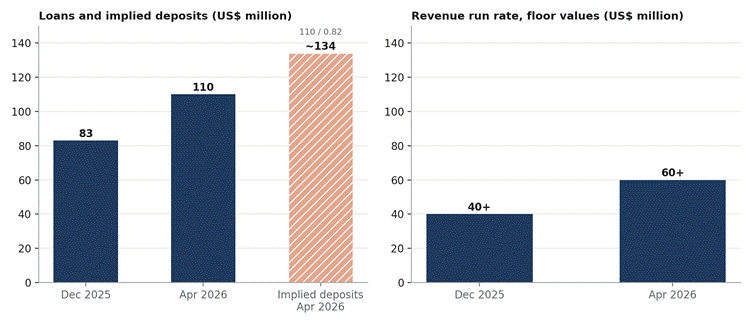
Figure 3. Tonik’s loan book and revenue run rate, December 2025 vs April 2026 (US$ million). Revenue values are floors (“over US$40 million”, “USD 60M+”). Deposits are not disclosed; the April 2026 figure shown is implied from the 82% loan to deposit ratio.
Sources: Tonik Pre-Series C release (Tonik Bank and PR Newswire, Dec 2025); Tonik profitability release (May 2026). Implied deposits are an IdeyaHub calculation.
Here is where the threads join. Tonik reports a 51% net interest margin and pays 4.00% on the Stash. A one point rise in the Stash rate would barely scratch that margin. Cost per peso is not what holds the rate down. What the flat rate protects is optionality. A no lock-in product that is repriceable in one move gives Tonik a lever it can pull in either direction as the BSP changes course. Raising the rate is easy. Cutting it back later on money with no lock-in, in full view of customers who picked Tonik for its rate, is much harder.
That brings back the map. The design of Solo Stash answers the Competition row, with a headline rate that beats peers, and the Shareholders row, with cheap and flexible funding. It does very little for the Environment row as the saver experiences it. A deposit that pays 100 basis points under the policy rate and roughly 290 basis points under inflation, after tax, stays put because of habit, convenience and a nice progress bar. Habit is powerful. It is not a contract.
There is also a correlation that the numbers make hard to ignore. In July 2026, Tonik reported that the share of eligible borrowers switching on Payhinga, its loan payment holiday, had climbed from 10% to nearly 31% since January 2025, peaking near 34%. Tonik says many of those borrowers earn ₱25,000 to ₱40,000 a month and are the main breadwinner at home. That is the same income band as our Cebu saver. When household budgets get squeezed, borrowers pause repayments and savers draw down goals. For a lender funded by no lock-in pockets, those two moves arrive in the same months. Tonik has not reported any deposit outflow, and its liquidity may be ample. But it is the scenario a skeptical reader should model first.
What the 4% Gets Right, and What It Oversells
Start with what works. Solo Stash beats the base savings rate at every rival digital bank we checked, without missions, promo caps or minimum balances. It is free, simple and insured to ₱1 million. And the funding it gathers has helped carry Tonik to a milestone it bills as a first for a standalone Philippine digital bank: positive net income in Q1 2026 after all costs, including credit losses, plus profit under IFRS accounting.
Now what is oversold. Rate roundups such as PesoHub’s 2026 list of high yield savings accounts include Solo Stash. In 2026 that label is only true in nominal terms. The real, after tax return is negative by roughly three percentage points. The “up to 4.5%” figure attached to Stashes belongs to Group Stash, which needs three participants. Even the rate itself is hard for customers to track. One consumer review published in May 2026 lists Solo Stash at about 2.50%, even though Fintech News Philippines reported 4.0% in February and Tonik’s own rate page shows 4.00% now. A saver who cannot be sure of today’s rate is unlikely to notice a change tomorrow, and that inattention may be part of what keeps the funding cheap.
Where the model is fragile:
- Repricing cuts both ways. Tonik can lower every Stash balance’s rate in a single move, but a competitor can also lift its base rate above 4% in a single move, and Stash money can leave just as fast.
- Stress arrives together. Rising Payhinga use shows borrowers under pressure. The same households hold withdraw-anytime Stashes. A bad quarter for credit can also be a bad quarter for deposits.
- Rates may not be done. The BSP’s hikes in 2026 add up to 75 basis points since April. The BSP described its August move as preemptive, meant to keep inflation expectations anchored. Every further hike widens the gap between the Stash and the benchmark.
- Disclosure is thin. Tonik publishes its loan book, margin and loan to deposit ratio, but not its deposit total, its mix between Stashes, accounts and time deposits, or its customer count in these releases. Outside analysts are working from implied figures.
What still deserves doubt: the profit is one quarter old. A 51% net interest margin says nothing about operating costs or next year’s credit losses. And none of Tonik’s public material says how much of its funding sits in Solo Stash specifically. The whole thesis that Solo Stash is the core funding line rests on the product’s prominence and on Tonik’s own description of cheap retail deposits as its edge. It is a strong inference, not a disclosed fact.
Three Readers, Three Verdicts
For the saver: use it, but know what it is
The verdict tracks the Demanding Customers row, rated Medium. Solo Stash is a good place for money you may need at short notice and want kept separate from spending. It pays more than the base rates at GoTyme, MariBank and OwnBank, and it costs nothing to hold. It is not an inflation hedge. At 3.20% after tax against 6.1% inflation, ₱100,000 left for a year loses about ₱2,900 of buying power, where the plain account would lose about ₱5,300. For money you can lock for six months and keep at least ₱10,000 in the savings account alongside, Tonik’s own six month time deposit pays up to 5.00%, or 4.00% after tax. That narrows the gap without closing it. Keep your total at any one bank under the ₱1 million PDIC cap.
For Tonik: rational now, tested later
This verdict tracks Demanding Shareholders, rated Medium-High. Holding 4.00% is a sound call today. It keeps funding cheap, keeps Tonik on top of the rate tables, and preserves the option to move either way. The test is arithmetic. Loans grew 2.3 times in a year. If deposits fail to keep pace, the loan to deposit ratio climbs from 82% and the Stash rate stops being a choice. The number to watch in Tonik’s next update is not profit. It is whether that 82% holds.
For the regulator and outside analyst: a transmission gap, not a solvency flag
This verdict tracks Changing Environment, rated High, and Demanding Stakeholders, rated Low-Medium. Nothing here suggests risk to depositors. Balances are insured to ₱1 million and Tonik has just added capital. But Solo Stash is a clear case of weak pass-through. The BSP added 75 basis points of tightening between April and August, and a headline digital savings rate did not move with it. It now sits a full point below the policy rate. Analysts covering Philippine digital banks should ask for the deposit mix by product. Without it, no one outside Tonik can tell how much of its cheap funding is held by habit.
Run the Solo Stash Test on Your Own Product
Tonik’s choice is a pattern that shows up well beyond banking. A product looks like it serves the customer, but its real job is to serve a pressure the customer never sees. That can be a sound strategy. It becomes fragile when the pressure the product was built for is not the strongest one on the map. Use the questions below on your own product, pricing decision or initiative.
| # | Question | Your answer |
| 1 | If your price, rate or fee stayed flat while your cost environment moved, who would notice first, and what would they do the next day? | |
| 2 | Which pressure row does your product’s design actually answer, and is it the highest rated row on your map, or a weaker one that is easier to win? | |
| 3 | What does your customer lose in real terms by staying with you, and how much of their loyalty is habit rather than a reason they could name? |
Now fill in your own map. Rate honestly. If every row reads High, go back and find the evidence that would move one of them down.
Your Innovation Pressure Map
| Where is the pressure coming from? | Intensity (Low to High) | Why? |
| Demanding Shareholders | Low ○○○○○ High | |
| Growth-driven Leadership | Low ○○○○○ High | |
| Changing Environment | Low ○○○○○ High | |
| Competition | Low ○○○○○ High | |
| Demanding Customers | Low ○○○○○ High | |
| Demanding Stakeholders | Low ○○○○○ High |
IdeyaHub newsletter
Enjoyed this case study?
Get the next deep dive on Southeast Asian banks, fintechs and insurers in your inbox. One email a week.
Free. Unsubscribe anytime.
References
- Deposit Interest Rates, Tonik Bank
- Stashes, Tonik Bank
- Accounts FAQs, Tonik Bank
- How is my Tonik Account/Solo Stash/Group Stash interest calculated?, Tonik Bank
- How will rate changes affect my Tonik Savings?, Tonik Bank
- Tonik Becomes the First Standalone Digital Bank in the Philippines to Achieve Profitability, Tonik Bank press release
- Tonik becomes first profitable standalone digital bank in the Philippines, Manila Bulletin
- Tonik raises US$12M Pre-Series C to scale capital-efficient lending in the Philippines, Tonik Bank press release
- Tonik raises US$12M Pre-Series C to scale capital-efficient lending in the Philippines, PR Newswire
- More Filipinos Turn to Repayment Flexibility as Economic Pressures Mount, Tonik Bank press release
- News (Tonik Completes Transition to AI Credit Decisioning, 30 October 2025), Tonik Bank
- Comparing Deposit Interest Rates of Philippines Digital Banks (2026), Fintech News Philippines
- Consumer Price Index and Inflation Rate, August 2026, Philippine Statistics Authority
- BSP Update: Giving a subtle nod to growth (19 February 2026), Metrobank Wealth Insights
- BSP hikes policy rate by 25 bps to fight inflation surge (23 April 2026), Philippine Daily Inquirer
- BSP hikes policy rates by another 25 basis points (18 June 2026), Philippine News Agency
- BSP policy rates hiked 25 bps (28 August 2026), Philstar