Hexagon Club promises exclusivity for the price of a used motorcycle. The bank’s own numbers on whether that bet paid off are five years old.
| RCBC built its Hexagon Club priority banking program around the lowest deposit threshold of any major Philippine bank, and turned that low bar into a funding advantage that is now cushioning the bank’s margins right as loan losses eat into profit. 1. The price is the strategy. RCBC’s Hexagon Club Privilege tier opens at ₱100,000 in combined checking and savings balances, a tenth of BPI Preferred’s ₱1,000,000 threshold and a thirtieth of HSBC Premier’s ₱3,000,000 requirement. 2. The proof is stale. The only hard performance numbers RCBC has ever disclosed for Hexagon, a 3-to-1 cross-sell ratio and a ₱165 billion deposit base tied to the program, date to a 2020-2021 marketing push that has not been updated in any later filing or interview. 3. The payoff shows up in the funding line, not the loyalty brochure. RCBC’s CASA ratio stood at 52% of deposits at the end of 2025 and net interest margin rose to 4.77%, even as first-half 2026 net income fell 22.6% on higher loan-loss provisions, proof that cheap deposits are propping up a bank whose credit book is under strain. To see how a ₱100,000 balance turns into a bank’s cheapest source of money, start with one saver’s account. |
Every inter-branch or inter-regional peso cash withdrawal or check encashment on an ordinary RCBC savings account costs ₱100, according to the bank’s own published fee schedule. A bank certification costs ₱250. A manager’s check costs ₱75. A checkbook costs another ₱250. None of those figures is large by itself, but a small business owner in Cebu who supplies party equipment to hotels across the region, paying suppliers by manager’s check and moving client payments between branches every month, felt them add up on an ordinary account holding roughly ₱120,000. The day her combined checking and savings balance crossed ₱100,000, RCBC’s terms say she became eligible to enroll in Hexagon Club Privilege. Enrollment costs nothing beyond keeping the balance. In exchange, RCBC’s published terms erase exactly the fees she had been paying: waived inter-regional and inter-branch transfer fees, one free checkbook and manager’s check a year, a complimentary bank certification, and unlimited free InstaPay transfers through the RCBC Pulz app, on top of a dedicated branch manager, a Mastercard with no annual fee for life, free basic life insurance and ATM card insurance, preferential rates on time deposits, foreign exchange and loans, a reimbursed appraisal fee if she takes out a home loan, and a free lounge pass the next time she flies. None of that required her to change banks, open a new product, or negotiate. It required her to stop being an anonymous depositor and start being a line item RCBC tracks. If her business grows enough that her company itself holds ₱500,000 in CASA, RCBC has a separate door waiting: Hexagon Club Prestige, built for business and SME accounts, with access to RCBC Trust Corporation’s unit investment trust funds and fixed-income products, cash management tools, and a specialist to help with retirement or estate planning once the balances get serious. She never has to choose between the two tracks. RCBC built one for her as a person and a second for the business she runs, and both tracks report back to the same balance sheet.
That shift, from anonymous balance to tracked relationship, is the actual product. Everything else, the lounge access, the raffle promos, the Mother’s Day webinar invitations, is packaging around it.
The Pitch Is Inclusion. The Ledger Says Something Else
RCBC’s own marketing for Hexagon leans hard on accessibility. The bank’s website defines the Philippine “mass affluent” segment as anyone holding ₱100,000 to ₱1,000,000 in liquid assets, citing the Philippine Institute for Development Studies’ definition of the upper middle class as households earning ₱63,700 to ₱109,200 a month. Frame it that way and Hexagon looks like democratization: a bank opening a service tier once reserved for the wealthy to anyone who can save up what amounts to roughly one month of upper-middle-class household income.
That framing survives only if you don’t look too closely at who actually clears ₱100,000 in savings in a country where the same government research institute’s own income bands put “upper middle class” above the median household. A ₱100,000 CASA balance is a low bar next to what rival banks charge for a comparable relationship, but it is not a low bar next to what a typical Filipino household holds in liquid savings. RCBC isn’t selling banking to the mass market. It is selling a two-tier definition of “affluent” that happens to sit substantially below what Citibank, HSBC or BPI would ever call the same thing, and marketing the gap as generosity.
That doesn’t make the gap meaningless. ₱100,000 is still real money that a large share of Philippine households cannot set aside, and RCBC deserves credit for putting its threshold far below every rival still standing: a saver who could never clear BPI’s or HSBC’s bar can clear RCBC’s, and walks away with a demonstrably better banking relationship than an ordinary account offers for the same balance. The honest description sits between the two extremes. Hexagon isn’t democratizing banking for the masses, and it isn’t a hollow gesture either. It is a real, calculable upgrade for a specific slice of savers who happen to sit just below where every other bank drew its own line. RCBC has done this before on the credit side: Philippine Banks Aren’t Inventing New Products. They’re Reconnecting Old Ones. traces how its SSS-linked loan reached a borrower segment the rest of the market had never named.
The more interesting question isn’t whether Hexagon is inclusive. It’s what RCBC actually gets out of setting the bar there, and the honest answer requires holding three different explanations up against each other, because RCBC’s own communications have offered all three at different points without ever fully reconciling them.
The first explanation, the one in the press releases, is financial inclusion: RCBC calls itself a bank that widens access to premium service. The second, buried in a 2021 trade-press writeup that is still the single most detailed disclosure the bank has made about the program, is cross-selling: Retail Banker International reported that Hexagon members carried an average of three RCBC products each, against roughly one for non-members, a 3-to-1 ratio the bank achieved by bundling a low-cost entry ticket with automatic upsells into cards, insurance and loans. During that same 2020-2021 stretch, the enhanced Hexagon offer reportedly helped lift RCBC’s total deposit base tied to the program to ₱165 billion, 48% of the bank’s total retail deposits, with ₱113 billion of that in CASA, and pulled in ₱8 billion in new consumer loans and 19,000 new credit cardholders by April 2021. The third explanation, visible only in RCBC’s balance sheet and never once mentioned in a Hexagon press release, is funding cost: CASA deposits are the cheapest money a bank can hold, and a program engineered to pull retail balances into CASA accounts and keep them there is, structurally, a cost-of-funds strategy wearing a lifestyle-perks costume.
Only one of those three explanations is actually supported by anything RCBC has disclosed in the last two years, but the evidence for each cuts both ways rather than pointing in one direction. The inclusion story is partly real: RCBC’s own 2020-2021 numbers show 42% of new Hexagon-linked deposits came from customers new to the bank, a genuine and creditable financial-inclusion outcome, not a rounding error. It is also partly overstated: the remaining 58% came from people who already banked with RCBC and were simply reclassified into a paying-more-attention tier, and RCBC has never published a figure for how many previously unbanked or underbanked Filipinos the program brought into the formal financial system beyond that one snapshot. The cross-sell story holds up the same way. What RCBC actually achieved in 2020-2021, a 3-to-1 product ratio and ₱165 billion in program-linked deposits, was a real and well-executed result, and three different industry bodies rewarding the same program across three separate years since, a “Best Mass Affluent Banking Offering” recognition from Digital Banker in 2023, a Retail Banker Asia Trailblazer Award in 2024, and an Asian Banking and Finance award the same year for the Hexagon Club Priority Platinum Debit Mastercard launched jointly with Mastercard Philippines, is a real signal that independent judges keep concluding the product is well built, not a marketing fluke. What those awards can’t do is substitute for the bank telling its own depositors and analysts how many people actually use Hexagon now, or what it currently returns: no membership count, cross-sell ratio, or Hexagon-specific deposit figure has been re-disclosed since that original 2020-2021 push, even though RCBC has run at least four separate Hexagon marketing campaigns in 2026 alone (a Chinese New Year time-deposit offer, an economic outlook webinar series, an expanded slate of perks aimed at mothers announced in May, and an August-to-December deposit raffle). A bank that wanted to prove the model still works at 2026 scale would have an easy opportunity to say so with fresh numbers. It has chosen not to.
The funding-cost story is the one the current evidence actually backs, and it backs it precisely because nobody at RCBC is telling it as a story. It shows up only in filings meant for analysts, not customers.
What the Balance Sheet Rewards
Start with the tier structure itself, because it contains a small design puzzle. Hexagon has three named levels: Privilege, the ₱100,000 entry tier for individuals; Priority, a ₱1,000,000 tier for individuals with more capacity; and Prestige, a ₱500,000 tier built for business and SME accounts. The names imply an ascending ladder, Privilege sounding like the starter tier and Prestige like the top one, but Prestige actually sits below Priority in deposit terms, because it isn’t a higher rung on the same ladder at all. It’s a parallel product for a different customer type, business owners rather than individuals, priced lower than Priority because business CASA behaves differently than personal CASA. A customer comparing the two by name alone, without reading the fine print, could reasonably assume Prestige outranks Priority. It doesn’t. That’s a naming choice that rewards the bank’s segmentation logic at the expense of customer clarity, and it is the kind of detail that never comes up in a lounge-access press release. Business owners are the customer Chinabank has been built around for more than a century, which is the subject of Chinabank Was a Niche Bank Before “Niche Banking” Had a Name.
Now put RCBC’s ₱100,000 entry point next to what competitors actually charge, verified directly against each bank’s own current terms rather than secondhand listicles that turn out to be wrong. Security Bank’s Gold Circle needs ₱500,000 in combined deposit and investment balances. BPI Preferred requires a ₱1,000,000 total relationship balance, not the ₱500,000 that several comparison sites still quote; BPI raised its own bar at some point and outdated aggregators never caught up. HSBC Premier sits far above both, at a ₱3,000,000 total relationship balance, or a mortgage loan of at least ₱6,000,000. Citibank Priority, which some of the same comparison lists still cite as a rival, no longer exists as a Philippine retail product at all: Citi sold its entire Philippine consumer banking business to UnionBank in 2022, meaning one of the two banks originally used to argue “RCBC isn’t special, others charge similarly low minimums” isn’t in the market anymore. The remaining field has consolidated toward higher, not lower, minimums, which makes RCBC’s ₱100,000 door look less like one option among several and more like a genuine outlier at the low end of a shrinking, hardening competitive set. Security Bank’s more interesting recent bet sits on the lending side of the small-business market, covered in Security Bank Picked the Cheaper Problem to Solve.
Get the next SEA banking case study in your inbox
Free. Unsubscribe anytime.
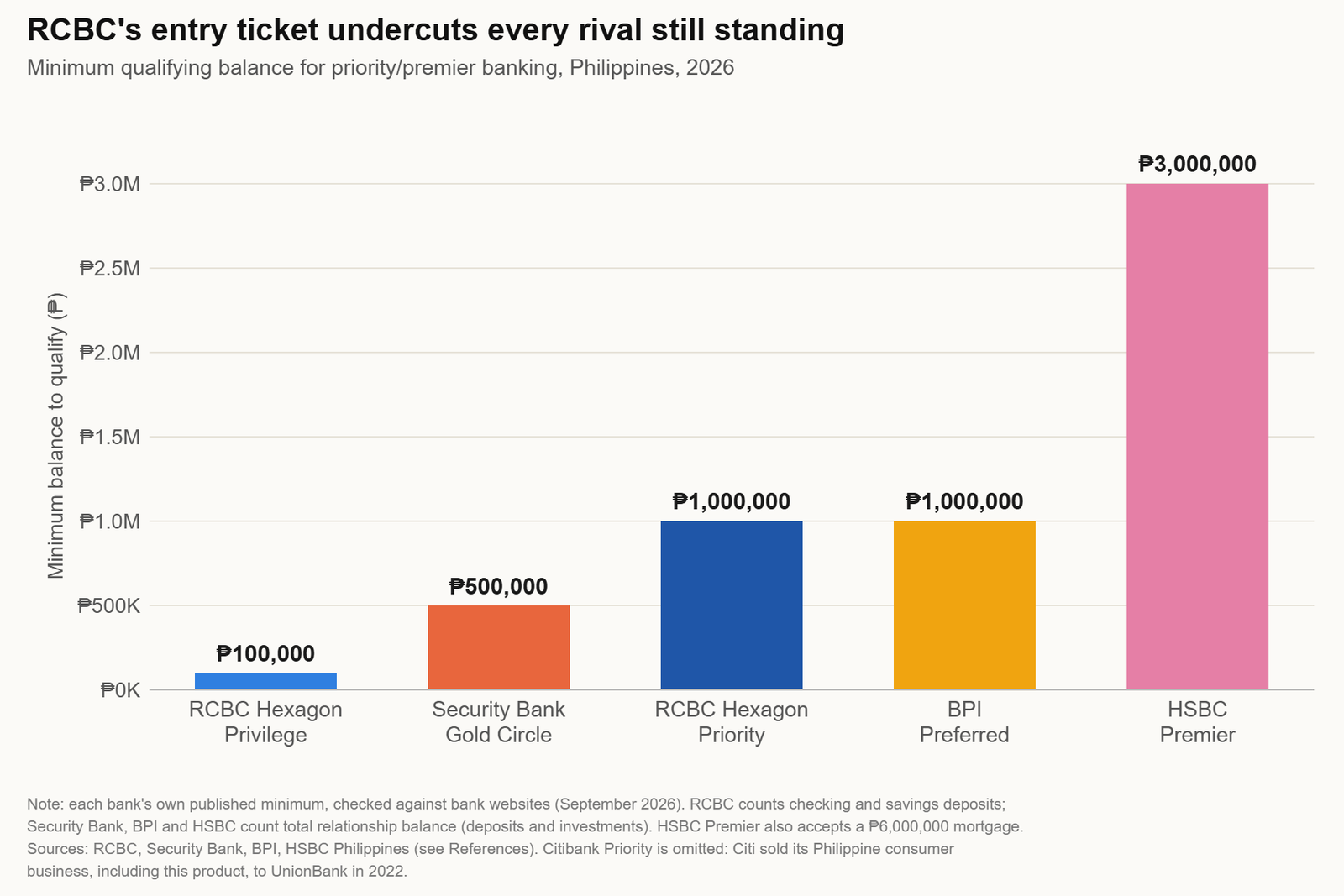
Figure 1. Minimum qualifying balance for priority/premier banking, selected Philippine banks, as published on each bank’s website (September 2026). Sources: RCBC, Security Bank, BPI, HSBC Philippines.
That outlier positioning only makes sense as a deliberate funding play once you connect it to who owns RCBC and what they’ve been paying for. Sumitomo Mitsui Banking Corporation, Japan’s second-largest lender, spent five years building a stake in RCBC in stages, roughly 5% in 2021, another 15% in 2023, and a final 4.46% in December 2025 for ₱6.4 billion, bringing its total to 24.46%. Cathay Financial Holdings of Taiwan and the International Finance Corporation, the World Bank’s private-lending arm, hold additional stakes alongside the founding Yuchengco family, which has controlled RCBC since 1960. None of those investors bought in for airport lounges. A regional bank and a development finance institution buying into a mid-sized Philippine lender in three separate tranches over five years are underwriting a funding and margin thesis, and that is, on its own terms, a vote of confidence a marketing budget cannot buy: three separate institutional owners chose to increase their exposure to RCBC, not reduce it, across five years that included a pandemic and a rising-rate cycle. The numbers RCBC has reported since back up that confidence far more directly than anything in a Hexagon Club brochure.
Full-year 2025 net income rose 11% to ₱10.6 billion, with net interest margin up 89 basis points to 4.77% and CASA holding at 52% of a ₱1 trillion deposit base. Loan-loss provisioning tightened through the first half of 2026, cutting net income 22.6% to ₱4.11 billion even as loans, digital banking activity and total assets kept growing, according to the bank’s own disclosures. Set against that, Q1 2026 alone showed net interest margin climbing further to 5.2% and deposit costs falling 29% year on year.
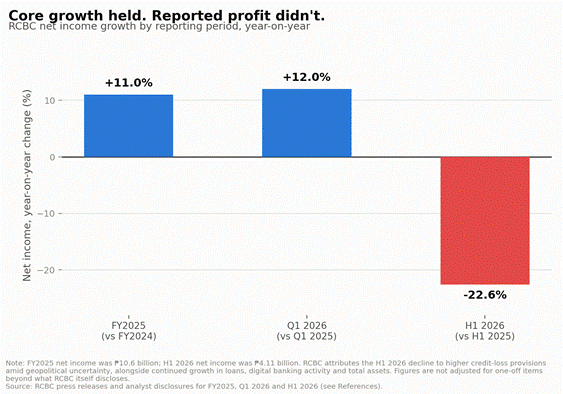
Figure 2. RCBC net income growth, year-on-year, by reporting period. Sources: RCBC press releases and analyst disclosures, FY2025-H1 2026.
A bank whose margin is improving and whose funding costs are falling at the exact moment its credit costs are rising isn’t running two unrelated businesses. It is running one balance sheet where a cheaper deposit base is absorbing the shock of a more expensive loan book, and Hexagon, whatever else it does for a customer’s travel plans, is one of the levers built to keep that deposit base cheap and sticky.
Does the Door Pay Off? Depends Who’s Walking Through It
Go back to the Cebu vendor moving party-supply payments between branches. For her, the arithmetic mostly works in her favor. A fee-free-for-life credit card, waived transfer fees, free basic life and ATM insurance, and preferential loan and time-deposit rates carry real, calculable value against the ₱100-per-withdrawal, ₱250-per-certification account she used to hold, and none of it costs anything beyond maintaining the balance itself. Her one blind spot sits upstream of the fee schedule: “priority access to investment opportunities” and coordination with wealth specialists, the language RCBC uses once a member’s balance climbs past Privilege, comes with no published fee schedule or return benchmark anywhere on RCBC’s own pages. If her goal shifts from saving on fees to actually growing the ₱120,000, she needs to ask RCBC for numbers its marketing won’t volunteer, and check whether a cheaper account elsewhere covers the same ground.
Zoom out from her account to RCBC’s boardroom and the picture looks better than the marketing lets on, for reasons the marketing doesn’t say out loud. A low entry bar widens the deposit funnel further than any competitor still standing in this fight is willing to go, and it does so exactly when a broader, cheaper deposit base is most useful, heading into a period of rising provisions, a genuinely well-timed piece of balance-sheet management that most of RCBC’s rivals aren’t positioned to copy at the same price point. What should worry an analyst modeling this segment isn’t the strategy. It’s the silence: RCBC has run Hexagon-branded campaigns constantly through 2026 while disclosing nothing about the program’s current scale or performance since 2021. Five-year-old inputs, dressed in a fresh media cycle, are still five years old.
Does any of this worry a bank supervisor? Not on the fundamentals. Deposit-gathering programs don’t add leverage, and a bank widening its CASA base ahead of a credit-cost cycle is doing precisely what prudential regulation wants to see. The one mechanic worth a second look sits outside the balance sheet entirely: the Hexagon Club “Double Your Deposit” raffle running from August 8 to December 31, 2026, gated by a “unique promo code” that RCBC’s own terms say customers “cannot request or claim,” handed out only via SMS, Viber or email at the bank’s discretion. An entry gate the bank alone controls is a different animal from an ordinary rate promotion open to anyone who clears a published threshold, and it’s exactly the kind of consumer-facing mechanic BSP’s financial consumer protection rules exist to scrutinize. None of it makes RCBC an unsafe bank. It just means the next time a bank calls a deposit-gathering tool a members’ club, the honest read is a rate promotion with an unusually selective guest list.
Where This Leaves a Reader Building Their Own Tiered Product
Hexagon Club is a case study in a pattern that shows up constantly in banking and fintech: set a threshold low enough to widen the top of the funnel, wrap it in perks that read as generosity, and let the real payoff land somewhere the customer never sees, on the funding or margin line rather than the loyalty statement. Anyone designing a tiered product, a subscription, a “premium” account, a loyalty club, can borrow the same three-question test used above before publishing a single perk.
| Question | Why it matters |
| What is your entry threshold actually filtering for: genuine capacity to pay, or just the willingness to be tracked and cross-sold? | RCBC’s own 2020-2021 numbers show most new Hexagon deposits came from existing customers being reclassified, not new money. A threshold that mostly re-labels people you already have isn’t inclusion, and knowing which one you’re building changes how you should measure success. |
| Which single metric would you have to keep disclosing, not just launch once with, to prove the model still works? | RCBC’s cross-sell ratio and deposit figures are five years stale despite constant marketing. Pick the one number that would actually validate your tiering strategy and commit to reporting it on a cadence, before a competitor or regulator asks why you stopped. |
| Which of your “exclusive” perks is really a line item on your own cost of funds or unit economics, wearing a lifestyle costume? | RCBC’s lounge access and fee-free cards get the press coverage; its CASA ratio and net interest margin get the actual credit for the strategy’s success. Identify which perks are true costs and which are the mechanism doing the real financial work, so you know which ones you can never afford to cut. |
Tags: RCBC · Hexagon Club · priority banking · mass affluent banking · Philippine banking · CASA deposits · net interest margin · bank funding strategy · fintech Philippines · wealth management Philippines
IdeyaHub newsletter
Enjoyed this case study?
Get the next deep dive on Southeast Asian banks, fintechs and insurers in your inbox. One email a week.
Free. Unsubscribe anytime.
References
- RCBC, “Hexagon Club”
- RCBC, “Hexagon Club Priority”
- RCBC, “Hexagon Club Privilege”
- RCBC, “Fees & Charges” (standard schedule of fees)
- RCBC, “Start 2026 Strong: How Hexagon Club Prestige Powers Confident Business”
- RCBC, “What is the Meaning of Mass Affluent Banking?”
- RCBC, “Grow and Protect Your Assets with RCBC Hexagon Club”
- RCBC, “Hexagon Club Double Your Deposit Promo”
- Manila Bulletin, “RCBC's Hexagon Club expands perks for Filipino mothers,” May 9, 2026
- Retail Banker International, “RCBC scores cross sell ratio hit with enhanced Hexagon Club offering”
- Inquirer Business, “Biz Buzz: RCBC's triple win,” September 19, 2024
- Security Bank, “Gold Circle Membership”
- BPI, “Preferred Terms and Conditions”
- HSBC Philippines, “HSBC Premier”
- GMA News Online, “UnionBank acquires Citi's consumer banking in the Philippines”
- RCBC, “RCBC Achieves Php 10.6 Billion Net Income in FY 2025, Driven by Core Business Growth”
- Fintech News Philippines, “RCBC Reports 11% Profit Growth, Reaching PHP 10.6 Billion in 2025”
- RCBC, “RCBC Net Profit Up 12% in Q1 2026 from Core Business Growth”
- BusinessWorld, “RCBC profit up 12% on stronger lending,” April 29, 2026
- Philippine Institute for Development Studies, “Defining and Profiling the Middle Class” (Policy Notes 2018-20), Table 1
- Inquirer Business, “RCBC's 65 years of nurturing passions, fueling Filipino dreams”
- Daily Tribune, “RCBC 1H 2026 Profit Falls 22.6% on Higher Provisions as Loans, Digital Banking and Assets Grow,” July 30, 2026
- Daily Tribune, “RCBC Extends Euromoney's Best Digital Bank Streak to Seven Years,” July 27, 2026
- Inquirer Business, “SMBC boosts stake in RCBC to 24.46%,” December 2025