EasyLink Protect removes the medical exam and the paperwork from buying life insurance in the Philippines. It does not remove the missing price tag, the market risk sitting inside every peso paid in, or the new business race Sun Life is actually running to stay ahead of.
| Sun Life’s EasyLink Protect is a smart, low-risk move to win back new customers in a market it dominates by legacy scale but trails by new-money growth, not the financial-inclusion breakthrough its award citation and marketing copy suggest. 1. It answers a competitive problem, not an access problem. Sun Life Philippines still led the industry in total 2025 premium income at ₱61.8 billion, its 15th straight year at number one, but it ranked only second in new business sales at ₱9.2 billion, while FWD Life Insurance grew its new business 57% year on year to take the top new-money spot in the first quarter of 2025. 2. It removes paperwork, not price uncertainty. The plan drops the medical exam and guarantees acceptance, but Sun Life has not published a minimum premium anywhere a shopper can check without booking a call with an advisor, unlike BPI-AIA’s rival guaranteed-issue product, PamilyaProtect, which lists its ₱417-a-month starting price on its own website. 3. The award reflects reach, not scarcity. The Insurance Asia Awards 2026 that named EasyLink Protect the country’s product innovation winner also handed multiple category wins to PNB and iCare HMO Philippines in the same cycle, the pattern of a submission-based trade award, not proof the product beat a small, vetted field. None of that shows up in a press release. It shows up only once you follow one buyer through the old process and the new one. |
A 34-year-old sari-sari store owner in Cabanatuan kept putting off buying life insurance. Not because she didn’t want the coverage. Every rainy season, when dengue cases climbed in her neighborhood, she thought about what would happen to her two kids and her inventory loans if she got seriously sick. What stopped her was the process. A traditional variable life plan meant a multi-page medical questionnaire, a paramedical exam booked at a clinic across town (blood pressure, a urine sample, sometimes blood work if the coverage amount ran high), and a two- to four-week wait to find out whether she’d even been accepted, longer if anything on the exam needed a doctor’s follow-up note. She had mild, unmedicated hypertension from years of standing behind a counter. She had no idea whether that would get her declined, loaded with a higher premium, or waved through, and she didn’t want to spend weeks finding out.
She bought Sun Life EasyLink Protect instead. There is no medical questionnaire and no paramedical exam. Acceptance is guaranteed by design. She picked a premium, set it to pay quarterly over ten years, and her policy issued with a death benefit worth at least five times her annual premium, coverage that runs to age 100, her premiums split across local and global investment funds she chose to match how much risk she wanted to carry. The exam that used to be the sticking point simply isn’t part of the process anymore.
That’s a real change in who gets to walk out with a policy in hand, and it deserves to be taken seriously before asking what it doesn’t change: what she’s actually paying, what happens if the funds underperform, and why Sun Life built exactly this product in exactly this year.
The scoreboard Sun Life doesn’t put in its press releases
Any fair read of EasyLink Protect has to start with the actual problem it was built to solve, not the one implied by its own marketing. Sun Life’s launch materials point to its Financial Resilience Index: 64% of Filipinos surveyed in April and May 2025 felt capable of meeting their future financial goals, down from 72% in the prior wave, and one in three could not sustain themselves for more than three months without income. That is the inclusion story. It is also, by the company’s own later survey, a story that got worse, not better, after EasyLink Protect launched. When Sun Life repeated the index in 2026, confidence about meeting future goals had fallen further, to 48%, and the share of households with “high” financial resilience dropped to 19% from 33% a year earlier. One product from one insurer was never going to move a national number like that, and it didn’t. That isn’t EasyLink Protect’s failure. It is a sign that the index is describing a macroeconomic problem, inflation squeezing household budgets, not a product gap that a single guaranteed-issue VUL was ever built to close.
The problem EasyLink Protect actually answers sits in a different set of numbers, the ones the Insurance Commission publishes every year and that Sun Life’s own press office quietly folds into a “15 consecutive years at number one” headline. Sun Life Philippines closed 2025 with ₱61.8 billion in total premium income, up 8.2% from ₱57.1 billion in 2024, enough to lead the industry for a 15th straight year and beat its nearest competitor by ₱8.9 billion. It also led the Insurance Commission’s tally in five of six tracked metrics: net income, net worth, invested assets, total assets, and total premium income. On the metric that measures accumulated scale built up since Sun Life first took the industry’s top spot in 2011 (after a rival had held that position for more than six decades), Sun Life is untouchable.
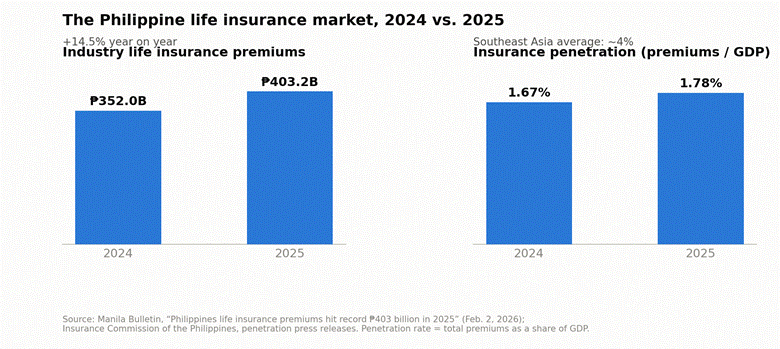
Figure 1. Industry premiums grew 14.5% and penetration barely moved. Sources: Manila Bulletin (Feb. 2, 2026); Insurance Commission of the Philippines.
But total premium income counts every policy ever sold that is still on the books, decades of renewals stacked on top of each other. It says almost nothing about which insurer is winning new customers this year. That’s what new business annual premium equivalent, or NBAPE, measures, and on that scoreboard Sun Life ranked second in 2025, at ₱9.2 billion, behind a rival it does not name in its own results. FWD Life Insurance, meanwhile, posted ₱2.5 billion in new business in the first quarter of 2025 alone, up 57% year on year, enough to take the industry’s number-one spot in new business on a per-company basis that quarter. FWD didn’t get there overnight. It ranked in the top six insurers by new business in 2022, climbed into the top three every year since, and used 2025 to push past the leaders on new money specifically. That is the scoreboard Sun Life is actually playing defense on, and it is the one EasyLink Protect was built to move.
Three ways to read the same launch
Hold those two threads next to each other and three different explanations for EasyLink Protect become available, and they don’t all survive contact with the numbers.
The first reading takes the marketing at face value: a genuine financial-inclusion product, built because Sun Life’s own survey data showed Filipinos underprepared and the company wanted to close that gap. The second reading is more cynical, the one plenty of trade coverage defaults to whenever an insurer launches something around the same time an award cycle opens: a PR-driven product engineered mainly to win a trophy and generate a press cycle. The third reading is narrower than either: a rational, competitively necessary product, built because Sun Life needed a guaranteed-issue, low-friction offer to compete for new business against FWD’s rise and against bancassurance rivals already selling guaranteed acceptance at a published price.
The timeline rules out the second reading almost by itself. EasyLink Protect launched on November 4, 2025. The Insurance Asia Awards recognition didn’t arrive until July 2026, eight months later, in a ceremony cycle where Charlton Media Group’s Insurance Asia magazine handed out dozens of category wins across the region that same cycle, including two separate honors each to PNB (at the sister Asian Banking & Finance Awards) and to iCare HMO Philippines, for an AI-powered telemedicine platform, in the same Insurance Asia Awards program EasyLink Protect won. A product built to chase one specific trophy doesn’t usually launch eight months before that trophy’s submission window, and a trade award that hands out this many category wins in a single cycle is a marketing amplifier, not a scarce, independently audited seal of superiority. That doesn’t make EasyLink Protect a weak product. It just means the award is a footnote to the launch, not the reason for it.
That leaves the inclusion reading and the competitive reading standing, and the underwriting rules tip the balance toward competitive necessity. A genuine inclusion product would be priced and gated to reach people who currently can’t get coverage at all: the uninsurable, the previously declined, the completely unbanked. EasyLink Protect’s guaranteed-issue underwriting does open the door to people with health conditions that would have triggered a decline or a loading under full medical underwriting, and that part is real. But Sun Life has not published what the plan costs anywhere a shopper can see before talking to an advisor, no rate card, no minimum monthly premium, nothing comparable to what a truly self-serve inclusion play would offer. Compare that to BPI-AIA’s PamilyaProtect, a guaranteed-issue, no-medical-exam life and accident plan sold through BPI’s app and website, which lists a starting premium of ₱417 a month for up to ₱2 million in coverage, right on the product page, no advisor required. If the goal were maximum reach to the underserved, publishing a price is the more inclusive design choice. Sun Life didn’t make it. That is far more consistent with a product built to give the agency sales force a faster, friction-free close on customers already in the pipeline than with a product built to reach Filipinos who don’t currently have access to an advisor at all.
What guaranteed issue actually trades away
Removing the medical exam doesn’t remove risk from the transaction. It moves it. In a normally underwritten VUL, the insurer prices for the individual: age, health history, smoking status, the paramedical exam results. In a guaranteed-issue plan, the insurer prices for the pool instead, because it can’t screen out the buyers who are more likely to file an early claim. Insurers typically manage that anti-selection risk through some combination of higher cost-of-insurance charges built into the plan, caps on how much coverage a guaranteed-issue applicant can buy, or waiting periods before the full death benefit applies to non-accidental causes. Sun Life’s own Grepa affiliate discloses a version of this directly in its version of the product: EasyLink Protect’s guaranteed-insurability option pays only the fund value plus charges, not the full death benefit, if the insured dies of non-accidental causes within the first two years. That is a standard, reasonable way to price around adverse selection. It is also a real limit on the “guaranteed acceptance, no medical exam” pitch that the launch coverage doesn’t emphasize, and a detail worth asking an advisor to spell out in writing before signing.
The investment side carries a separate, better-known risk that the “protection and growth” framing tends to undersell. EasyLink Protect is a variable unit-linked plan. Only the minimum death benefit, five times the annual premium, is guaranteed. The fund value that the policy is supposed to grow toward a financial milestone is not guaranteed at all; it moves with whatever local and global funds the buyer selects, minus insurance charges, fund management fees, and, in the early years of most Philippine VULs, a heavy front-loaded allocation to the insurer’s own costs and the selling agent’s commission. That structure is exactly what a Filipino personal-finance blogger writing under the pen name behind Poor Pinoy Investor has spent several posts warning readers about, citing reader accounts of surrendering VUL policies years in and getting back a fraction of what they paid in, in one case ₱20,000 back out of ₱100,000 paid over multiple years. That critique is anecdotal, not a regulatory finding, and it targets VULs broadly rather than EasyLink Protect specifically. But it describes a mechanic that is true of every VUL sold in the Philippines, including this one, and it’s the reason financial advisors who don’t sell VULs for a living routinely recommend buying term insurance and investing the difference separately instead. EasyLink Protect doesn’t remove that trade-off. It just wraps it in a faster application.
The same product, sold twice
Connect the underwriting mechanics to where Sun Life actually distributes this plan and a second, less obvious thread appears: EasyLink Protect isn’t one product competing in one channel. It’s the same mechanic sold through two separate companies that both carry the Sun Life name.
Sun Life of Canada (Philippines), Inc., the wholly Sun Life-owned entity that just won the Insurance Asia Award, sells EasyLink Protect through its roughly 22,000-strong agency force, the sales channel Benedict Sison spent his eight years as CEO building up before handing the company to JJ Moreno on April 1, 2026. Sun Life Grepa Financial, Inc., a joint venture in which Sun Life holds only a 49% stake, with the Yuchengco family’s holding company controlling the rest since the 2011 deal that created it, sells its own version, branded Sun Grepa EasyLink Protect, exclusively through Rizal Commercial Banking Corporation’s roughly two-million-strong customer base under a bancassurance agreement the two companies have renewed since, most recently in 2022. The two products share the same core mechanics, guaranteed acceptance, five-times-premium minimum death benefit, coverage to 100, five- or ten-year pay terms, but Sun Life Grepa’s version adds a Premium Bonus and a Loyalty Bonus, features not mentioned in Sun Life Philippines’ own materials, presumably tuned for a bank customer base with different price sensitivity than an agency-sold buyer.
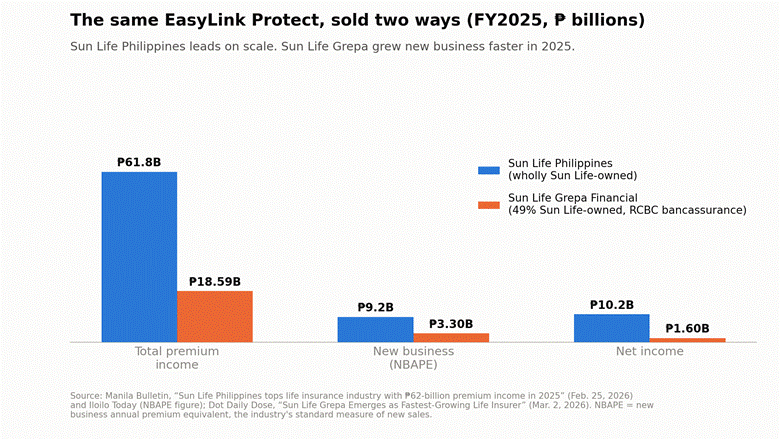
Figure 2. Sun Life Philippines leads on scale; Sun Life Grepa grew new business faster in 2025. Sources: Manila Bulletin (Feb. 25, 2026); Iloilo Today; Dot Daily Dose (Mar. 2, 2026).
That matters because Sun Life Grepa is currently outgrowing its majority-owned sibling on the metric that matters most here. Sun Life Grepa’s 2025 new business grew 66% year on year to ₱3.30 billion, the fastest new-business growth rate of any life insurer in the country that year, on total premium income of ₱18.59 billion (up 28%) and net income of ₱1.60 billion (up 17%). Sun Life Philippines, the bigger, wholly owned company, grew its own new business at a rate it hasn’t disclosed, and finished second overall in the category. A guaranteed-issue, self-service-friendly product family is, by design, better suited to a bank channel’s existing account holders than to an agency force that sells through relationships built over months. Sun Life built EasyLink Protect to run in both lanes at once, and the bank-distributed version is currently winning the race inside Sun Life’s own house.
None of this would be possible without the balance sheet sitting underneath it. Guaranteed-issue underwriting is a bet that a bigger, more diversified pool of policyholders will absorb the higher claims and lapse experience that come from skipping individual medical screening. That bet is easiest to make for an insurer with ₱60.1 billion in net worth and ₱10.2 billion in 2025 net income sitting behind it, numbers no other Philippine life insurer currently matches; the Insurance Commission’s own December 2024 filing shows Sun Life’s ₱10.68 billion in net income that year running more than double the second-place insurer, BPI-AIA, at ₱4.77 billion. A smaller or newer insurer copying this exact underwriting approach would be taking on meaningfully more risk relative to its capital cushion than Sun Life is. That’s the one piece of this story that isn’t easily copied by a rival chasing the same new-business scoreboard.
Three verdicts, because three different people are asking
Everything connected above still leaves three different readers with three different, honest answers, not one blended conclusion.
If you’re a Filipino deciding whether to buy this plan, the honest verdict is conditional. EasyLink Protect is a real improvement in access for people who would have been declined, loaded, or simply discouraged by a medical exam under a traditional VUL, and the guaranteed minimum death benefit at five times your annual premium is a genuine floor. But treat it as what it is: a variable life plan whose fund value is not guaranteed, priced through an advisor rather than a published rate card, and carrying the same early-year fee drag that has made VULs a target of consumer criticism in the Philippines for years. Ask your advisor in writing for the actual premium quote at your age and target coverage, the cost-of-insurance schedule, and what you’d get back if you surrendered the policy in year three or year five, before you commit to a five- or ten-year payment plan. Compare that number against a simple term policy plus a separate investment account. If the numbers still favor EasyLink Protect for your situation, buy it with your eyes open. If they don’t, at least you’ll know why.
If you’re evaluating Sun Life’s strategy rather than this one plan, the verdict is straightforwardly positive, on its own terms. A company that just handed leadership to a CEO with a payments and retail background, not an insurance one, needed a product that could plug a new-business gap fast, run through both its agency and bancassurance channels without a redesign, and do it without touching the pricing discipline that protects a ₱61.8-billion back book. EasyLink Protect does all three. It is a sound flanking move against FWD’s new-business momentum and against bancassurance rivals like BPI-AIA, built on a balance sheet strong enough to absorb the extra underwriting risk. The Insurance Asia Award is a nice amplifier for the sales force to use in client meetings. It is not, and was never meant to be, proof that the strategy is working; the NBAPE numbers due for 2026 will be that proof, not a trophy.
If you’re a regulator or an industry analyst, the useful signal isn’t Sun Life’s press release at all. It’s the gap between the company’s own inclusion narrative and its own follow-up survey data showing Filipino financial confidence falling further in 2026, alongside an industry-wide penetration rate that inched from 1.67% to just 1.78% of GDP over the same year EasyLink Protect launched, well below the Southeast Asian average of roughly 4% and behind Malaysia, Thailand, and Singapore. A guaranteed-issue product that lets previously declined applicants buy coverage is worth encouraging. Whether it is actually expanding the insured population, instead of mostly reshuffling existing insurance buyers between Sun Life’s own two channels and a handful of rival guaranteed-issue plans, is a question the Insurance Commission’s next NBAPE and lapse-rate releases will answer far more reliably than any awards ceremony will.
Run this test on the next “inclusion” launch
The value in taking EasyLink Protect apart isn’t limited to this one plan. Before you take any company’s claim that a new product closes an access or inclusion gap, run it through the same three questions this issue just answered for Sun Life.
| # | Question | Your answer |
| 1 | What scoreboard is the company actually behind on? Look past the inclusion framing for the metric the company is losing on this year (new sales, market share, a specific segment) rather than the one its press release highlights. | |
| 2 | Does removing friction also mean removing information? If the company took away a barrier (a medical exam, a form, a wait), check whether it also took away something you need to compare the offer fairly, like a published price. | |
| 3 | Who else can copy this by next quarter, and who can’t? Separate what’s easy for a rival to match (the product terms) from what isn’t (the balance sheet, the distribution network, the capital cushion behind it). |
If your answers to questions 1 and 3 point to a genuine competitive advantage but question 2 turns up a gap, you’re looking at a well-built business decision wearing an inclusion headline. That’s a fair trade for the company. Just don’t mistake it for the whole story before you sign.
Tags: Sun Life Philippines · Philippine Niche Banking · EasyLink Protect · Guaranteed Issue Insurance · Insurance Asia Awards 2026 · Philippine Insurance 2026 · Financial Inclusion · Insurtech
References
- Sun Life Philippines wins two awards at Insurance Asia Awards 2026, Inquirer.net
- Sun Life Philippines Wins Two Insurance Asia Awards 2026 for Product Innovation and Employee Engagement, Daily Tribune
- Sun Life EasyLink Protect, Sun Life Philippines
- Sun Life rolls out new investment-linked insurance, Philstar
- Sun Life Offers New Investment-Linked Policy With Easy Application, Fintech News Philippines
- Getting Started Made Simple: Sun Life Easylink Protect for every go-getter, Gadgets Magazine Philippines
- Sun Grepa EasyLink Protect, Sun Life Grepa Financial
- PamilyaProtect – Affordable Life Insurance, BPI-AIA Life Assurance Corporation
- Sun Life buys 49% of Grepalife, Inquirer.net
- Sun Life Grepa inks bancassurance partnership anew with YGC, Manila Times
- Sun Life Grepa Emerges as Fastest-Growing Life Insurer, Dot Daily Dose
- Sun Life Philippines tops life insurance industry with ₱62-billion premium income in 2025, Manila Bulletin
- Sun Life Maintains No. 1 Position in Philippine Life Insurance Industry for 15 Consecutive Years, Iloilo Today
- Performance of Life Insurance Companies, Net Income as of 31 December 2024, Insurance Commission of the Philippines
- Sun Life names JJ Moreno Philippines chief as Benedict Sison retires, Manila Bulletin
- FWD Life Insurance tops PH Insurance Industry in Q1 2025, Where’s RR
- Philippines life insurance premiums hit record ₱403 billion in 2025, Manila Bulletin
- Press Release: Philippine Insurance Penetration Rises to 1.79 percent in Q2 2025, Insurance Commission of the Philippines
- Sun Life Survey: Filipinos show rising financial confidence, but long-term challenges persist, Manila Insight (Sun Life Philippines press release)
- Inflation squeezes Filipinos’ finances, Sun Life study finds, Manila Bulletin
- The VUL Scam: How Thousands of Filipinos Were Misled Into Losing Money, Poor Pinoy Investor
- Our History, Sun Life Philippines
- Philippines’ upper middle-income status seen to boost insurance penetration, Philstar