Five years after quietly investing in a 16-year-old cash-payment gateway, Xendit finally folded it in. The deal reveals more about how fintech roll-ups actually work than about any new technology.
| Xendit’s July 2026 absorption of Dragonpay is not a new product launch. It is the fifth year of a five-year plan to buy Southeast Asia’s cash-payment plumbing one BSP-licensed operator at a time. 1. The cash bridge nobody wanted to build from scratch. Roughly half of Filipino adults still lack a formal bank or e-wallet account, so instead of building over-the-counter payment rails itself, Xendit needed Dragonpay’s existing network of 44 bank, e-wallet and outlet partners. 2. A playbook, not a one-off. Xendit ran the identical invest-then-absorb sequence on Malaysia’s Payex (invest in 2023, fully acquire in 2025) before repeating it with Dragonpay: invest in August 2021, fully integrate in July 2026. 3. A small patch on a very big platform. Dragonpay’s 905 merchants are a rounding error next to the 15,200 active merchants and $47.3 billion in payment volume Xendit reported group-wide for 2025. The Philippines did not even get its own line in that report. To understand why a modest, 16-year-old gateway took five years to fully join a regional payments company, start with the merchant it was built to serve. |
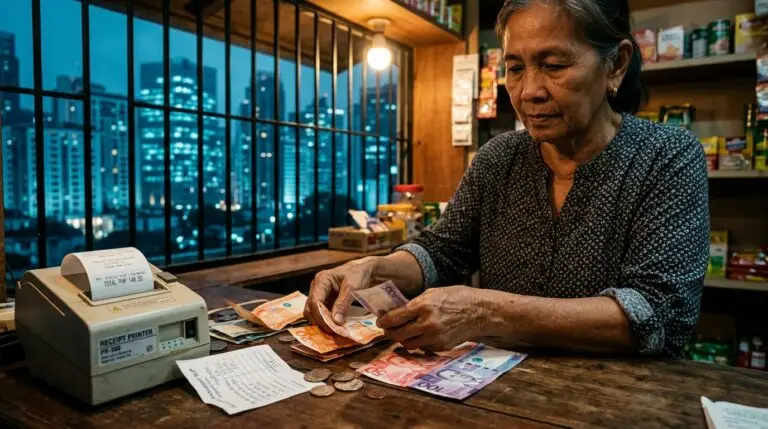
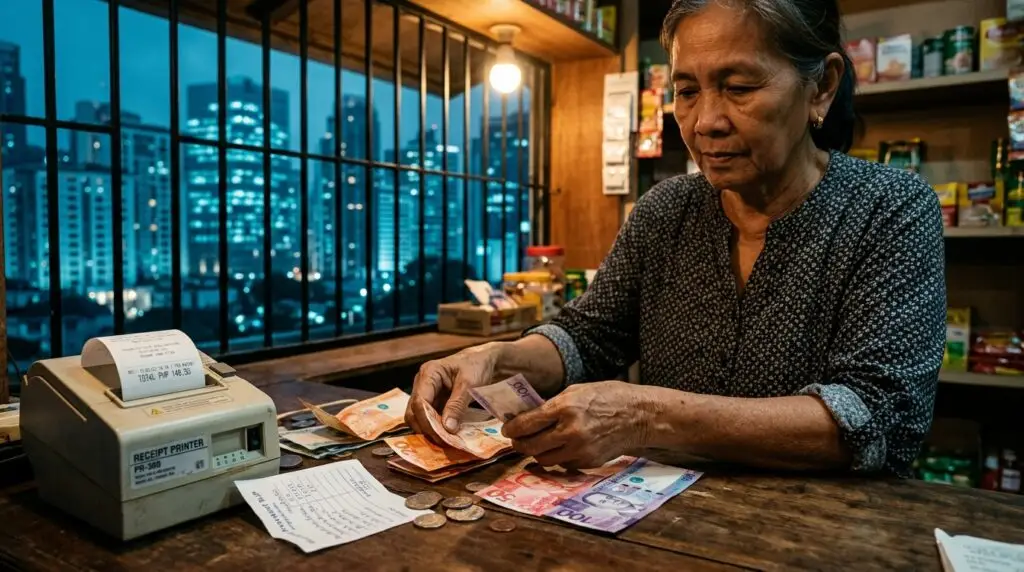
Every November, a home baker in Zamboanga named Marites starts taking preorders for hamon and queso de bola through a Facebook page, nothing more than a pinned post and a comments thread that fills up fast once the holiday rush starts. Half her buyers pay through GCash in a few taps. The other half, often relatives ordering and paying for family back home, or neighbors who just do not trust typing a card number into a Facebook comment, choose “over-the-counter” at checkout instead. They get a reference number by text, walk into whichever outlet is closest (a 7-Eleven, a Cebuana Lhuillier branch, sometimes a bank teller on a lunch break), and hand over cash. Marites sees the payment clear by the next business day. It costs the buyer a flat ₱20 fee. It is slow. It is manual. It is also the only rail that reaches that half of her customers at all, and every December it is running at full volume, dozens of orders a day, alongside her GCash sales.
What did not change for Marites in July 2026 is that walk to 7-Eleven. What changed is what happens behind it. Before, those OTC payments ran through Dragonpay: a separate login, a separate daily settlement file, reference numbers she matched by hand against her order list every night of the rush, apart from whatever she used for GCash and card sales. After the integration, that OTC channel sits inside the same Xendit account as her e-wallet collections, her payouts to the supplier in Cebu who sells her the hamon wholesale, and, if she needs cash to buy that inventory before the December orders even come in, Xendit’s own financing product, xencapital, which advances money against future receivables rather than requiring collateral. One settlement file instead of two. One login instead of two, in the exact week she has the least time to reconcile anything by hand. That is the entire pitch, and it is a real, if modest, improvement for someone running a seasonal business out of a home kitchen.
It is also a much smaller story than the press release makes it sound. To see why, it helps to separate what actually happened from what it was called.
The Half of the Philippines That Never Got a Bank Account
Xendit’s own framing, echoed by chief executive Moses Lo in the July 8 announcement, is that “Dragonpay wrote the first chapter of digital payments in the Philippines” and that bringing it into Xendit “gives Filipino businesses the best of both worlds.” That is true as far as it goes. But it skips the actual problem Dragonpay was built to solve, and that problem has not gone away.
According to the World Bank’s 2025 Global Findex survey, cited by the Philippine Daily Inquirer in July 2025, only 50.2% of Filipino adults aged 15 and older owned an account with a bank or other regulated financial institution in 2024. That is down slightly from 51.4% in 2021. Among people who do have some kind of account, 33.5% hold it at a bank, 32.7% hold a digitally enabled account, and 28.8% hold it in a mobile wallet, categories that overlap. Digital payments have still made real progress: 57.4% of retail transactions in the Philippines were cashless in 2024. But that statistic hides the size of the gap it describes. Even in a country where more than half of retail transactions are already cashless, close to half the adult population still has no formal account to receive a digital payment into. Visa is working the other side of that gap, sitting underneath bank transfers rather than cash counters, as covered in Visa Doesn’t Want Your Business. It Wants to Be Underneath It.
Dragonpay was built in 2010, years before GCash or Maya existed in their current form, specifically to bridge that gap: let someone without a bank account or card pay a real invoice by walking into a physical location with cash. That is what “over-the-counter” payment means in Philippine fintech. The customer selects a channel, such as a bank branch, a 7-Eleven counter, or a Cebuana Lhuillier or Bayad Center location, receives a reference number, pays cash to a teller, and the merchant gets a same-day or next-day confirmation. Dragonpay built relationships with BDO, BPI, Landbank, Metrobank, UnionBank and RCBC on the banking side, and with 7-Eleven, SM payment counters, Robinsons stores, Bayad Center and Cebuana Lhuillier on the cash side, accumulating what the July 2026 announcement puts at 44 total partners across banks, non-bank financial institutions, e-wallets and outlets. Building for the half of the market that still runs on cash is a theme that runs through Inside the Playbook Behind Southeast Asia’s Profitable Fintechs.
Xendit, founded in 2015 as an API-first infrastructure company, had already built some of that reach on its own. Its Philippine payments page advertises retail-outlet collection at more than 12,000 convenience stores, including 7-Eleven and Cebuana Lhuillier, routed through its own partner ECPay. What it had not built, and what Dragonpay brought with it, was sixteen years of direct relationships with the universal banks whose branch counters and deposit slips still matter to customers who trust a teller more than an app: BDO, BPI, Landbank, Metrobank, UnionBank and RCBC. It also brought a second, overlapping layer of pawnshop and bills-payment coverage through Bayad Center and Cebuana Lhuillier’s own network, all wrapped in sixteen years of market presence, formal registration as a Bangko Sentral Operator of Payment Systems since February 2020, and settlement relationships that do not get rebuilt by signing an API contract. Negotiating that from zero, bank by bank, would have taken years. Buying the company that had already done it, and that Xendit had been a minority shareholder in since 2021, was faster.
Three Ways to Read a Five-Year-Old Investment
That efficiency argument is the version of the story Xendit wants told. It is plausible, but it is not the only explanation, and a careful reader should hold at least three interpretations open before picking one.
The first is the product-integration story. Xendit needed Dragonpay’s specific technical capability, its OTC network and its 44 partner relationships, and the five-year gap between the original August 2021 investment and the July 2026 full integration reflects the time it took to build trust, migrate infrastructure and get the technical integration right. Under this reading, the deal is about capability, and the delay is about care.
The second is the roll-up story. Xendit is a well-funded regional consolidator. It has raised more than $538 million across known rounds, including a $150 million Series C in September 2021 led by Tiger Global and a $300 million Series D in May 2022 co-led by Coatue and Insight Partners, and it has a repeatable pattern of taking a minority stake in a locally licensed payment operator, waiting, and then fully absorbing it once the relationship is proven and the price is right. Under this reading, Dragonpay is not a special technical need. It is the second data point, after Malaysia’s Payex, in a strategy of buying regulatory licenses and local merchant books market by market, and the five years is simply how long Xendit needed to be confident the asset was worth fully owning rather than partnering with.
The third is the defensive-consolidation story. Dragonpay, a 16-year-old company, had plateaued. Its own numbers as of the 2026 announcement, 905 merchants after 16 years in business, are not the numbers of a company still growing quickly in a country whose e-commerce sector has expanded many times over in that period. GCash alone reports more than 6 million partner merchants and social sellers. Under this reading, Xendit did not integrate Dragonpay because Dragonpay was thriving. It integrated Dragonpay because Dragonpay’s standalone growth had stalled, and full absorption was the only way to keep the merchant book and the licenses from decaying further or drifting to a competitor.
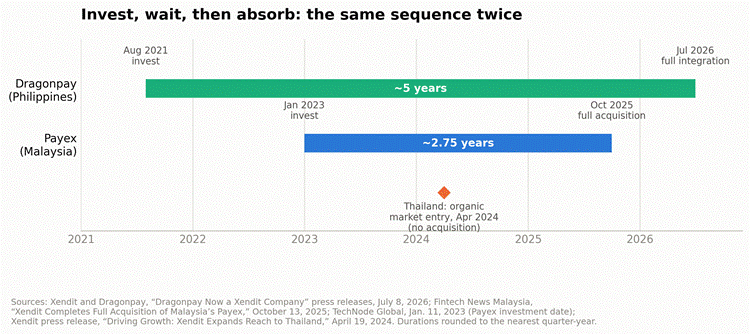
Xendit ran the same invest-then-absorb sequence on Payex in Malaysia before repeating it with Dragonpay. Thailand, entered organically in 2024 with no acquisition, shows the alternative path Xendit chose not to take in the Philippines or Malaysia. Sources: Xendit and Dragonpay press releases, July 8, 2026; Fintech News Malaysia, Oct. 13, 2025; TechNode Global, Jan. 11, 2023; Xendit press release, Apr. 19, 2024.
The evidence available points most strongly toward the second and third readings together, and away from the first. The clearest tell is the Payex precedent. Xendit invested in Malaysia’s Payex, a Bank Negara Malaysia-licensed payment gateway, in January 2023. It fully acquired Payex in October 2025, nearly three years later, and immediately rebranded it as Xendit Malaysia, folding in Payex’s reported base of more than 4,500 onboarded businesses and RM5 billion (roughly US$1.05 billion) in processed payment volume. That is close to the exact shape of the Dragonpay deal: invest first, prove the relationship, then absorb and rebrand. A company executing a single bespoke integration for a specific technical need does not usually happen to repeat the same multi-year sequence, almost step for step, in a second country. A company running a regional roll-up playbook does. That rules out “this was a one-off technical necessity” as the primary explanation, even though the technical need for OTC rails was real.
Get the next SEA banking case study in your inbox
Free. Unsubscribe anytime.
The stalled-growth reading also holds up better than the flattering version once you look at Dragonpay’s numbers next to the market around it. A company whose merchant base was compounding quickly would have more market leverage in any negotiation and less reason to fully cede control. Nine hundred and five merchants after sixteen years, in a market where GCash alone counts more than 6 million partner merchants and social sellers, is not a company negotiating from strength. Xendit’s own July 2026 statement frames the deal as additive rather than corrective: “the same trusted local service, now supported by a stronger technology platform,” in Robertson Chiang’s words as Dragonpay’s founder.
One detail complicates a clean version of any of these three readings. According to a company spokesperson quoted by Crowdfund Insider, “no shareholders exited” as part of the July 2026 announcement, and Dragonpay’s earlier investors, including UBX and GMO Global Payment Fund, kept their positions. Chiang himself remains a director and president of Dragonpay Corporation. That is a materially different structure from the Payex deal, which Xendit’s own press materials explicitly called a “full acquisition” and which came with a full rebrand to Xendit Malaysia. Whatever “full integration” means for Dragonpay, the public record does not show it means the same clean ownership transfer the headline, “Dragonpay Now a Xendit Company,” implies. The operational pattern (invest, wait years, consolidate the brand and the onboarding pipeline) still holds. The idea that this was a straightforward buyout of a plateaued founder does not.
The Math Behind the Merger
Whichever motive dominates, the deal only makes sense once you put three separate facts side by side: what Xendit’s balance sheet can afford, how big Dragonpay actually is next to Xendit’s real business, and how crowded the Philippine payments market already is at the layer Dragonpay serves.
Start with capital. Xendit’s fundraising has been large relative to a payments infrastructure company at its stage: $150 million in September 2021, the round that made it Indonesia’s newest unicorn at the time, and $300 million in May 2022, on top of earlier rounds that brought its total since 2015 past $538 million by mid-2022, according to disclosures at the time. Neither round’s post-money valuation was publicly disclosed, but by the Series D, Xendit reported serving more than 3,000 customers, including Traveloka, Wise and Grab, and said its annualized transaction count had grown from 65 million to 200 million and its annualized transaction value from $6.5 billion to $15 billion. A company with that kind of capital and that trajectory can afford to buy a 16-year-old, 905-merchant gateway outright rather than negotiate a long-term revenue-share partnership with it. The acquisition is a rounding error on Xendit’s balance sheet even without a disclosed price tag.
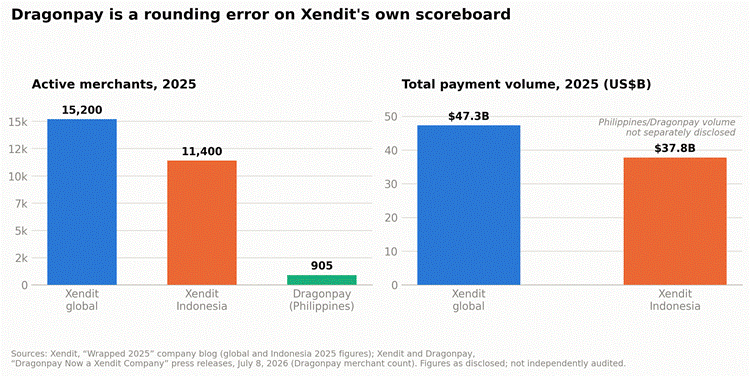
Dragonpay’s 905 merchants are under 6% of Xendit’s global merchant base, and the Philippines did not rate a disclosed payment-volume figure at all in Xendit’s 2025 report. Sources: Xendit, “Wrapped 2025” company blog; Xendit and Dragonpay press releases, July 8, 2026.
Now put Dragonpay’s size next to Xendit’s current scale. In its own year-end “Wrapped 2025” report, Xendit disclosed group-wide 2025 numbers of 15,200 active merchants, up 52% year on year, 544 million transactions, up 30%, and $47.3 billion in total payment volume, up 45%. Indonesia alone, Xendit’s home market, accounted for 11,400 of those active merchants and $37.8 billion of that volume, meaning Indonesia represents roughly three-quarters of Xendit’s merchant base and about four-fifths of its processed volume. The Philippines did not receive its own disclosed figure in that report at all. Dragonpay’s 905 merchants, folded into that picture, amount to well under 6% of Xendit’s global merchant count and a smaller share still of its processed volume. This is not the numbers profile of a transformative acquisition. It is the numbers profile of a tidy, low-risk bolt-on.
Finally, place Dragonpay’s channel, cash paid at a physical counter, inside the competitive map of Philippine payments. GCash’s own reported base of more than 94 million users and over 6 million partner merchants and social sellers as of April 2025, and the $5 billion valuation its parent company Mynt announced in August 2024 after Ayala Corporation and Mitsubishi UFJ Financial Group each took an 8% stake, show where the real gravity in Philippine digital payments sits: e-wallets, not OTC counters. Xendit’s most direct local rival, PayMongo, already bundles GCash, Maya, GrabPay, ShopeePay and buy-now-pay-later options like BillEase natively, with a transparent published price list and standard settlement cycles of two to seven days unless a merchant pays extra for instant settlement. Xendit itself already reaches over 12,000 convenience stores in the Philippines through its ECPay partnership, without Dragonpay. Dragonpay’s specific value, then, was never breadth of retail-outlet coverage in general. It was depth of relationship in one narrower layer: the universal banks’ own branch counters and the pawnshop and bills-payment chains, plus sixteen years in that specific market serving cash-paying, often unbanked customers outside Metro Manila. That is a real niche. It is not a large or fast-growing one on its own, which is exactly why full ownership, not partnership, made sense once Xendit decided the niche was worth keeping permanently rather than renting.
What This Actually Means, Depending on Who You Ask
For a merchant like Marites, the deal is a genuine, if incremental, upgrade. She keeps the exact OTC reach she had: the same banks, the same 7-Eleven counters, the same ₱20 fee, the same next-day settlement. She also gains a single API and dashboard that covers e-wallets, cross-border payouts and short-term financing through xencapital, instead of stitching two vendors together herself. The realistic risk for her is migration friction. Bolt-on acquisitions in payments routinely bring pricing changes, support-line handoffs and short outages during platform cutovers, and Dragonpay’s own announcement is explicit that all new onboarding, pricing and support now route through Xendit rather than Dragonpay directly. Nothing in the public record suggests fee increases so far, but merchants who valued Dragonpay’s “trusted local service” specifically because it was small and Philippine-run should watch what that service looks like once it is fully run out of a seven-country regional platform.
For Xendit’s own strategy, the deal is sound and low-risk, but it is not the growth story its press release implies. It completes a payment-method checklist (banks, e-wallets, cards, cross-border, OTC, financing, all under one roof) that matters for winning larger enterprise merchants who want one vendor for everything in the Philippines. It also removes a small, defensible legacy competitor from the field rather than fighting it. But at under 6% of Xendit’s global merchant base, this deal will not move Xendit’s headline numbers. Investors or analysts reading the July 2026 announcement as evidence of Philippine market momentum should notice that the Philippines still did not warrant its own disclosed figure in Xendit’s most recent annual report, while Indonesia did, in detail.
For a regulator or an outside analyst, the more interesting question is about market structure, not technology. Both companies hold their own certificates of registration as a Bangko Sentral Operator of Payment Systems (Xendit Philippines, Inc.’s dated July 27, 2020; Dragonpay Corporation’s dated February 21, 2020, per the BSP’s own published registry), and this transaction reduces the number of independently owned OTC-capable payment operators serving smaller, cash-dependent Philippine merchants by one. That is a small data point on its own. But it fits a broader regional pattern: the same company doing the same thing in Malaysia with Payex, expanding organically into Thailand in 2024, and now doing it again in the Philippines. That pattern is worth tracking over the next few years. How many of Southeast Asia’s remaining independent, nationally licensed payment gateways get folded into two or three regional platforms, and what does that mean for pricing power and resilience once there are fewer alternatives left standing if one of those platforms has an outage or a policy change a smaller merchant does not like?
None of that makes the deal wrong or bad for Filipino businesses today. Marites’s checkout page did not get worse in July 2026. If anything, it got marginally more capable. The healthy skepticism belongs a layer up, in how the deal gets described rather than in what it does. This was not a new product Xendit built for the Philippines. It was the closing of a five-year-old position, following the same script Xendit had already run once before, in a market too small to change Xendit’s own numbers but large enough, and legally clean enough, to be worth owning outright.
Before You Call Any Acquisition a Product Launch
Every fintech “integration” announcement asks you to read it as a leap forward for customers. Some are. Plenty are actually the final step of a slow-moving ownership decision that started years earlier, dressed up as news. Before you take a deal at its press-release value, whether you are evaluating it as a customer, a competitor, or someone deciding whether to build a similar partnership yourself, run it through a short worksheet.
| Question | Why it matters |
| What is the actual gap in time between the first investment or partnership and the “full integration” announcement, and has this company done the same thing before, on the same timeline, somewhere else? | A repeated multi-year sequence (invest, wait, absorb, rebrand) signals a roll-up playbook, not a bespoke response to a new technical need. |
| Whose numbers were actually growing before the deal (the acquirer’s, the target’s, or neither), and did the target disclose a merchant or user count that looks flat next to the market around it? | An acquisition of a plateaued asset is a different story, and carries different risk for existing customers, than an acquisition of a fast-growing one. |
| What does the acquired company’s license, regulatory history, or partner network spare the acquirer from building itself, and how much of the announced “improvement” is really about that license rather than anything new for the end customer? | If the real asset is a license or a partner list built over a decade, the deal is about buying time and compliance history, not about inventing a better product. |
Tags: Xendit, Dragonpay, Philippines fintech, payment gateways, over-the-counter payments, financial inclusion, Southeast Asia payments, fintech M&A, BSP, embedded finance
IdeyaHub newsletter
Enjoyed this case study?
Get the next deep dive on Southeast Asian banks, fintechs and insurers in your inbox. One email a week.
Free. Unsubscribe anytime.
References
- Xendit Corporation, “Dragonpay Now a Xendit Company,” press release, July 8, 2026.
- Dragonpay Corporation, “Dragonpay Now a Xendit Company,” company announcement, July 8, 2026.
- Fintech News Philippines, “Dragonpay Is Now Part of Xendit, Five Years After First Investment,” July 2026.
- TNGlobal / Technode Global, “Indonesia's Xendit Integrates with Philippines' Dragonpay,” July 8, 2026.
- Crowdfund Insider, “SE Asia's Xendit Integrates Philippines' Dragonpay Into Regional Payments Platform,” July 2026.
- Fintech News Malaysia, “Xendit Completes Full Acquisition of Malaysia's Payex,” October 13, 2025.
- Xendit, “Xendit Positions as Malaysia's Digital Growth Partner,” press release, 2025.
- Xendit, “Xendit Wrapped 2025: What Businesses Need to Prepare for 2026,” company blog, 2025/2026.
- TechCrunch, “Indonesian fintech Xendit is now a unicorn, with $150M in fresh funding led by Tiger Global,” September 14, 2021.
- Forbes, “Indonesian Unicorn Xendit Bags $300 Million In Series D Funding,” May 19, 2022.
- Xendit, “Fast, flexible financing to grow with xencapital,” product page, accessed September 2026.
- Xendit, “About Xendit,” company page, accessed September 2026.
- Xendit, “Online Payment Methods,” Philippines product page, accessed September 2026.
- Xendit, “Driving Growth: Xendit Expands Reach to Thailand,” press release, April 19, 2024.
- PayMongo, “Pricing,” accessed September 2026.
- Philippine Daily Inquirer, “50.4% of Pinoys ride financial inclusion,” July 17, 2025, citing World Bank Global Findex 2025 data.
- Mynt (GCash's parent company), “Empowering the Future: GCash Showcases AI and Fintech's Role in Economic Inclusion at WEF 2025,” April 2, 2025.
- Mynt, “GCash Valuation Soars to $5 Billion,” press release, August 2, 2024.
- Wise, “Dragonpay guide: Features, fees, and how it works,” accessed September 2026.
- Bangko Sentral ng Pilipinas, “List of BSP-Registered Operators of Payment Systems (Certificates of Registration),” official registry, accessed September 2026.
- Intellectual Property Office of the Philippines online services portal, “Dragonpay Table of Charges/Fees of Payment Channels,” filed fee schedule, accessed September 2026.