Vietnam’s best-known insurtech built its name on parcel cover and motorbike policies sold inside other people’s apps. Its new money is going into life insurance and a 15,000-strong sales network, in a life market that is still shrinking.
| Saladin’s Series A is not a bet on Vietnam’s digital insurance boom; it is a bet that human sellers on commission can lift revenue per customer in a market where Saladin’s original micro-policies have turned into a price-fixed commodity. 1. The old engine sells volume, not value. Saladin had sold nearly 10 million policies to about 600,000 customers by September 2023, and its parcel cover on Ahamove costs 1,000 dong per delivery point. 2. The new engine is people, aimed at a falling market. Its December 2025 round funds a move into term life and health through Saladin Pro, a network of more than 15,000 registered agents and collaborators, while life new business in Vietnam fell 22.2% by contract count in the first four months of 2026. 3. The money behind the move carries a life insurer’s interests. The round was led by a fund that SBI Ven Capital co-runs with Kyobo Securities, an entity of South Korea’s Kyobo Life Insurance Group, and SBI Holdings won Korean approval that same month to lift its stake in Kyobo Life from 9.3% to 20.4%. Start with a phone case seller in Ho Chi Minh City and a parcel that went missing. |
Linh sells phone cases and charging cables from a rented room in Ho Chi Minh City. On a good day she ships thirty orders across the city by motorbike courier through Ahamove. For years, a lost or crushed parcel meant the same routine. She messaged the courier, opened a support ticket, sent photos, and waited. Whether she got anything back, and how much, depended on a compensation policy she had never read.
Then a toggle appeared at checkout. Ahamove calls the feature “Khai giá hàng hoá,” or declare cargo value. Behind it sits a goods-in-transit policy that Saladin built with Bao Viet Insurance. Saladin’s product page lists one flat premium: 1,000 dong per delivery point. Documents are covered up to 500,000 dong. Goods without a VAT invoice are covered up to 1 million dong. Goods with a VAT invoice are covered up to 5 million dong. If something goes wrong, she has 24 hours from the end of the delivery to file, with a description and photos of the damaged goods.
For Linh, thirty orders now cost 30,000 dong a day in cover, a little over one US dollar. She no longer argues about whether a parcel is covered. She knows the limit before she taps “book.” That is a real improvement, and it is the kind of product that made Saladin one of the better-known insurtech names in Vietnam.
Now look at the same transaction from Saladin’s side of the screen. Each of Linh’s policies brings in 1,000 dong of premium. Saladin’s share of that, as a broker, is a slice of a slice. Selling ten million of them builds a brand. It does not obviously build a business. That gap is where this story starts.
What Saladin actually has to solve
The December 2025 announcement is upbeat and general. Lead investor SBI Ven Capital headlined it as Saladin raising money to “ride the momentum of Vietnam’s insurance transformation.” Founder and CEO Vivien Vân Lê said that Vietnam’s “push for reform, digitalization, and international standards reflects a nation preparing for its next leap forward.” The money, according to lead investor SBI Ven Capital, will fund term life and comprehensive health products, better claims operations, AI tools, and partnerships with large companies in health, term life, and travel.
Read the numbers Saladin has chosen to publish, and a narrower problem shows up.
In September 2023, when Monk’s Hill Ventures led what it called a pre-Series A round, Saladin reported about 600,000 unique customers, nearly 10 million policies sold, and nine insurer partners. That works out to roughly 16 policies per customer. Nobody buys sixteen health plans. That ratio only makes sense for micro-policies: parcel cover, trip cover, small add-ons bought many times over inside a partner’s app.
By December 2025, Saladin reported “nearly 1 million” unique customers and 15 insurer partners. It did not repeat a policy count. It added a new number instead: more than 15,000 registered partners in Saladin Pro, its agent and collaborator program.
Its brokerage website now claims more than 1 million customers and 16 insurers. So the customer count went from about 600,000 to around 1 million in a little over two years. Respectable, not explosive. And the metric Saladin led with in 2023, policy volume, quietly dropped out of the release. The headline metric changed from transactions to people who sell.
That is the real problem. Saladin’s embedded model reaches many people cheaply but earns very little from each one. The fix it has chosen is to put human sellers in front of bigger-ticket products, life and health, where one sale is worth more than thousands of parcels.
Where the pressure on Saladin comes from
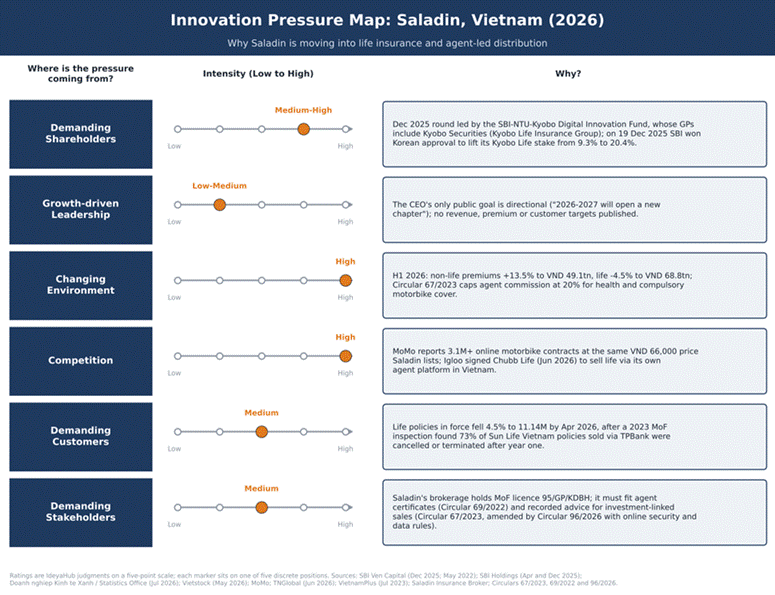
Figure 1. Innovation Pressure Map for Saladin, 2026. Ratings are IdeyaHub judgments on a five-point scale; markers sit on one of five discrete positions.
Sources: SBI Ven Capital (Dec 2025; May 2022); SBI Holdings (17 Apr 2025; 19 Dec 2025); Doanh nghiệp Kinh tế Xanh citing the Statistics Office (Jul 2026); Vietstock (May 2026); MoMo; TNGlobal (Jun 2026); VietnamPlus (Jul 2023); Saladin Insurance Broker JSC; Circulars 67/2023/TT-BTC, 69/2022/TT-BTC and 96/2026/TT-BTC. Full links in References.
| Where is the pressure coming from? | Intensity (Low to High) | Why? |
| Demanding Shareholders | Medium-High | The December 2025 round was led by the SBI-NTU-Kyobo Digital Innovation Fund, whose general partners include Kyobo Securities, an entity of Kyobo Life Insurance Group, and SBI Holdings received Korean approval on 19 December 2025 to raise its Kyobo Life stake from 9.3% to 20.4%. |
| Growth-driven Leadership | Low-Medium | The CEO’s only public goal is directional, that “2026-2027 will open a new chapter of innovation,” and Saladin has published no revenue, premium, or customer targets. |
| Changing Environment | High | In the first half of 2026, Vietnam’s non-life premiums rose 13.5% to 49.1 trillion dong while life premiums fell 4.5% to 68.8 trillion dong, and Circular 67/2023 caps agent commissions at 20% for health and compulsory motorbike cover. |
| Competition | High | MoMo says it has issued more than 3.1 million motorbike insurance contracts at the same 66,000-dong annual price Saladin lists, and Igloo signed Chubb Life in June 2026 to sell life cover through its own agent platform in Vietnam. |
| Demanding Customers | Medium | Life policies in force fell 4.5% to 11.14 million by April 2026, after a 2023 Ministry of Finance inspection found that 73% of Sun Life Vietnam policies sold through TPBank were cancelled or terminated after the first year. |
| Demanding Stakeholders | Medium | Saladin’s brokerage operates under Ministry of Finance licence 95/GP/KDBH, and the rules it must fit include agent certificates under Circular 69/2022 and recorded advice for investment-linked sales under Circular 67/2023, which Circular 96/2026 amended in July 2026 with new security and data rules for brokers selling online. |
Ratings are IdeyaHub judgments on a five-point scale. Sources: SBI Ven Capital; SBI Holdings; Vietnam Investment Review; Doanh nghiệp Kinh tế Xanh (Statistics Office data); Vietstock; MoMo; TNGlobal; VietnamPlus; Saladin Insurance Broker; Thư Viện Pháp Luật; Xây dựng Chính sách (Government of Vietnam). Full links in References.
The two High rows, Environment and Competition, are about the same thing seen from two sides. The part of the market Saladin grew up in, non-life, is growing fast. But the products Saladin sells most of in that segment are the easiest for anyone to copy. Compulsory motorbike cover is priced by government decree: 60,000 dong a year before VAT for bikes of 50cc and above, with insurers allowed to move it by no more than 15% based on a rider’s claims record. Saladin lists it from 66,000 dong a year. So does MoMo. MoMo adds that a customer can buy in one minute and that it has issued more than 3.1 million of them, more than three times as many contracts as Saladin has customers. When the price is fixed and the product is identical, the app with the most daily users wins.
Leadership is the softest row, and it is rated Low-Medium on purpose. Saladin has not published a numeric target in either funding release. That could mean leadership pressure is modest. It could also mean it is simply private. If Saladin later discloses a premium or agent target for 2027, this row would move up at least one notch.
The Shareholders row is the most uncertain. It rests on who led the round, not on any published term sheet. The amount was undisclosed. That makes the row a reasonable inference, not a proven fact.
Three ways to read the life insurance move
There are three plausible explanations for why Saladin is moving into life insurance now. Each one predicts a different row on the map should be doing the most work.
Reading one: the bancassurance vacuum. This is the story in the press coverage. Banks dominated life insurance sales until 2023. Then the Ministry of Finance inspected four life insurers and found serious problems. Prudential Vietnam sold more than 94,000 policies through banks in 2021, and up to 41% were cancelled or lapsed after the first year. BIDV MetLife took 99.2% of its premium from the bank channel. Circular 67/2023 followed in November 2023. It bars banks from selling investment-linked insurance to borrowers within 60 days before or after a loan is disbursed, and it requires the advice session for those products to be recorded. Banks pulled back. A digital broker could, in theory, fill the gap.
If this reading were right, the Changing Environment row should show a life market starting to recover, with new sellers picking up the slack. The data says otherwise. Life premiums grew just 0.5% in 2025, to 148.8 trillion dong. In the first half of 2026 they fell 4.5%. In the first four months of 2026, new life contracts fell 22.2% to 348,010, and term insurance, the exact product Saladin plans to sell online, fell 16.7% in new business. The vacuum is real. Nobody is filling it yet, including the insurers that already have large agency forces. This reading explains the timing of the pitch. It does not explain why now is a good time to sell term life.
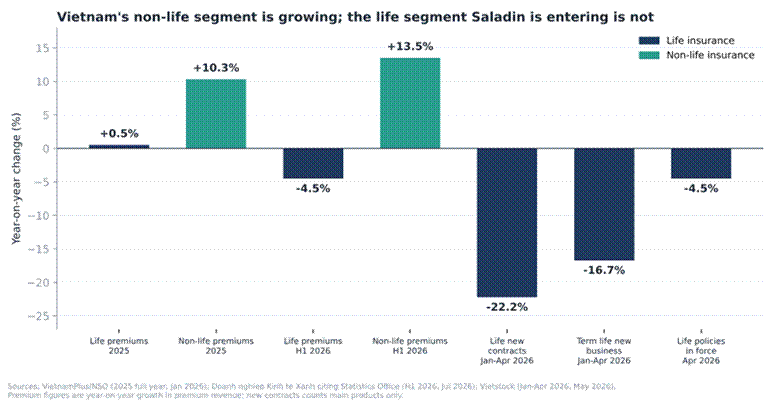
Figure 2. Year-on-year change in Vietnam’s life and non-life insurance indicators, 2025 to April 2026.
Sources: VietnamPlus citing the National Statistics Office (2025 full year, published 8 Jan 2026); Doanh nghiệp Kinh tế Xanh citing the Statistics Office (H1 2026, published 6 Jul 2026); Vietstock (January to April 2026, published May 2026). New contracts count main products only.
Reading two: the investors want it. The lead investor in December 2025 was the SBI-NTU-Kyobo Digital Innovation Fund. SBI Holdings announced it in May 2022 with a US$75 million target, with Kyobo Securities named as a Kyobo Life Insurance Group entity. In April 2025, SBI Holdings held 9.3% of Kyobo Life and announced a deal to take its stake to 20.4%. It received approval from Korean financial authorities on 19 December 2025, the same month the Saladin round was announced. A fund tied to a Korean life insurer and to a Japanese group building an insurance position leads the round, and the round’s stated use of funds now features life insurance. The 2023 round’s use of funds did not mention life at all.
This reading predicts that Demanding Shareholders should be the top row. It is close, at Medium-High. But the evidence is circumstantial. Neither SBI nor Kyobo has said publicly that it wants Saladin to distribute any particular insurer’s products. The investor ties make the life move easier to fund. They do not prove the investors caused it.
Reading three: the economics of the old model ran out. This is the reading the evidence supports best. Saladin’s embedded products are high in volume and low in value. A 1,000-dong parcel policy and a 66,000-dong motorbike policy are small tickets. The motorbike policy competes against a super-app at the same decree-set price. The parcel policy depends on one courier platform’s checkout. Saladin reached about a million customers in roughly three and a half years of public operation, while MoMo alone reports more than three times that number of motorbike contracts. The way out of a low-ticket business is a higher-ticket product, and in Vietnamese retail insurance, higher-ticket products are mostly sold by people.
This reading predicts Competition should be the top row, with Environment close behind. That is exactly where the map lands. It also explains the metric swap in the press releases. A company moving from transaction volume to adviser-led sales would stop advertising policy counts and start advertising its sales network.
The three readings are not exclusive. The bancassurance retreat gives Saladin a story to tell. The investors give it the money and possibly a long-term partner. But the reason it has to change is in its own unit economics, and the map’s highest rows point straight at that.
Get the next SEA banking case study in your inbox
Free. Unsubscribe anytime.
The machine Saladin is building
Saladin now runs two engines side by side.
The first is the embedded engine, run by the company that built the original platform, 10X Consulting and Technology Co., Ltd. It plugs cover into partner checkouts: Ahamove for deliveries, Vexere for bus tickets, ZaloPay and VNPay for payments, Shopee for e-commerce. Its strengths are speed and reach. A Bao Viet partnership signed in September 2022 set the template, with insurance built into delivery services.
The second is the human engine. Saladin Insurance Broker JSC holds a brokerage licence, number 95/GP/KDBH, from the Ministry of Finance. Under the 2022 Law on Insurance Business, which took effect on 1 January 2023, insurers, agents, and brokers are the three kinds of business allowed to sell insurance online. The broker licence lets Saladin offer products from many insurers rather than acting as one insurer’s agent. On top of it sits Saladin Pro.
Saladin Pro is a recruiting machine. Its website’s description promises recruits that they can “receive remuneration of up to 65% in just 60 seconds,” and calls it “online work, no capital needed” (IdeyaHub translations from Vietnamese). The App Store listing for the Saladin Pro app, published by 10X Consulting and Technology, advertises “attractive remuneration up to 44%” (also translated) and covers motorbike, car, health, travel, accident, cancer, and property insurance.
Those numbers deserve a hard look. Circular 67/2023 sets maximum agent commissions as a share of premium. Health insurance is capped at 20%. Compulsory motorbike liability is capped at 20%. Voluntary motor cover is capped at 10%. Compulsory car liability is capped at 5%. The highest cap that matters for Saladin’s new direction is term life, at 40% of premium in the first contract year for regular-premium policies, a level Circular 96/2026 keeps for contracts issued from 1 January 2027. Neither Saladin page says what the 65% or the 44% is a percentage of. If they are shares of premium, the 44% sits just above even the 40% first-year term life cap, and the 65% sits far above every cap in the circular. If it is a share of Saladin’s own brokerage fee, then a recruit’s real take is a fraction of a fraction, and the headline means much less than it sounds. Either way, a would-be seller cannot tell from the advertising what they will earn on a policy. That is a disclosure gap, and it sits in the exact channel Saladin now wants to grow.
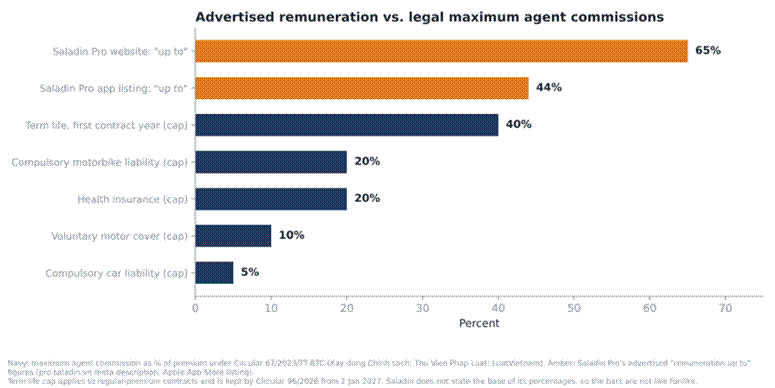
Figure 3. Saladin Pro’s advertised remuneration ceilings next to the maximum agent commissions in Circular 67/2023.
Sources: Circular 67/2023/TT-BTC via Xây dựng Chính sách (Government of Vietnam), Thư Viện Pháp Luật and LuatVietnam; Circular 96/2026/TT-BTC via Thư Viện Pháp Luật and LuatVietnam (term life first-year cap kept at 40% for regular-premium contracts from 1 Jan 2027); pro.saladin.vn page description; Saladin Pro listing on the Apple App Store (Vietnam), accessed 3 Oct 2026. Saladin does not state what its percentages are calculated on, so the amber and navy bars are not like-for-like.
There is also a qualification question the public pages do not answer. Circular 69/2022 requires individual agents to hold a certificate for the product line they sell, with separate certificates for basic life, unit-linked life, non-life, and health. The exam has 40 questions in 60 minutes and a 70% pass mark. A brokerage can also use referral partners who introduce customers without advising them. Saladin Pro calls its members “partners,” “agents,” and “collaborators” in different places. How many of the 15,000 hold a certificate, and for which lines, is not disclosed.
Igloo already ran this play
Saladin is not the first Southeast Asian insurtech to make this turn. Igloo, the Singapore-based platform that also operates in Vietnam, built its name on embedded micro-cover: device protection, credit life, and weather-index cover for rice farmers in Vietnam. In June 2026, Igloo signed a regional deal with Chubb Life to distribute life, critical illness, and health products in Vietnam and Indonesia through its own agency network, run on an AI-assisted sales platform called Ignite. According to the announcement, Ignite by Igloo works with more than 40 insurer partners and more than 75 distribution partners across the region.
Igloo also shows what this model costs at scale. When Tokio Marine bought a 1.65% stake for US$5 million in January 2026, the filing disclosed Igloo’s 2024 numbers: revenue of US$55.46 million, up 49%, and a net loss of US$21.8 million, up 11%. Igloo has raised about US$100 million since 2016 and has facilitated more than 600 million policies. Six hundred million policies, and still not profitable. Policy volume, even in the hundreds of millions, does not turn a distribution insurtech profitable by itself. We made a similar point about the survivors in Why Most Insurtech Startups in Southeast Asia Die Young: the ones still standing kept their business models boring and built the operating engine around them.
For Saladin, the Igloo comparison cuts both ways. It validates the strategy. A larger rival, with more capital and a global insurer partner, concluded the same thing at the same time. It also raises the bar. Saladin enters life distribution in Vietnam against Igloo with Chubb Life, against the incumbent agency forces at Bao Viet Life, Dai-ichi Life, AIA, and Manulife, which led new business premiums in early 2026, and against banks that still own the customer relationship.
Non-life has its own well-capitalised digital players too. OPES, the non-life insurer in the VPBank ecosystem, wrote 2,654 billion dong in premiums in the first half of 2026, up 23.5%, for 5.3% of the non-life market and seventh place. It says its fast-track claims process has cut payout time to about 30 minutes. An insurer with a bank behind it can embed cover in its own group’s channels without paying a broker.
A trust problem answered with a sales incentive
Put the threads together and the central tension is clear.
The pressure Saladin feels most is commercial: competition and a market split that favours non-life. But the barrier in the market it is entering is trust. The Demanding Customers row is rated Medium, not High, because Vietnamese households are not demanding new life products. They are walking away from existing ones. Life policies in force fell to 11.14 million by April 2026, down 4.5%. Claims paid kept rising, up 18.2% across the whole market in the first half of 2026, so insurers are paying out. Customers still are not buying.
What broke trust in 2023 was not a lack of distribution. It was distribution driven by incentives. Policies were sold alongside bank loans, often without the direct advice the law requires, and many customers walked away within a year. According to the ministry’s inspection, 73% of Sun Life Vietnam policies sold through TPBank were cancelled or terminated after the first year. Saladin’s answer to the life market is a large network of sellers recruited online with the promise of remuneration “up to 65%.” The mechanism is different from bancassurance. The incentive logic is not. In the Philippines, we saw a version of this in Sun Life Skipped the Checkup. It Kept the Sales Call., where removing friction for the buyer still left an adviser, and an adviser’s commission, at the centre of the sale.
That is the mismatch the map exposes. The product design answers the strongest commercial pressure: Saladin needs revenue per customer, and commission-led human selling delivers it. It does not obviously answer the market’s real barrier: customer trust in life insurance sales. If the collaborator network grows faster than its training and supervision, Saladin could reproduce, at small scale, the pattern regulators just spent three years cleaning up.
There is a positive version of this story, and it deserves a fair hearing. Saladin’s core strengths fit the trust problem better than a bank branch did. Its embedded products already handle claims digitally, with fixed limits and short deadlines that customers can see before they buy. Term life is far simpler than the investment-linked products at the centre of the 2023 problems. A clear, low-cost term policy, sold online, with the price published and the adviser optional, would be a genuine improvement. Whether Saladin sells that product, or sells whatever pays the network best, is the question to watch.
A skeptical reader should also keep a few smaller doubts open. Saladin’s own materials have given 2021 and 2022 as its founding year in different funding releases. The 2023 round was described as a Series A by its law firm and as a pre-Series A by its lead investor. The December 2025 round amount was not disclosed. None of these are red flags on their own. Together they mean outsiders are judging Saladin mostly on numbers it chooses to publish, and the set of numbers it publishes has changed.
Three verdicts for three different readers
For a customer. For small, compulsory, or embedded cover, Saladin works and is easy to use. It has no price edge on compulsory motorbike cover, because the price is regulated; buy wherever is most convenient. For parcel cover, the 1,000-dong premium and the 24-hour claim window are clear and fair. For term life or health sold through a Saladin Pro member, ask three things before you sign: is the seller a certified agent for this product line, which insurer actually carries the risk, and what is the full annual premium in writing? This verdict ties to the Demanding Customers row. In a market where policies in force are shrinking, the safest buyer is the one who asks.
For Saladin’s own strategy. The diagnosis is right. Embedded micro-cover alone was not going to carry a venture-backed company, and Igloo’s 2024 loss shows that volume does not fix this. The vehicle is riskier than the diagnosis. Saladin is entering a shrinking life market against a better-funded regional rival, entrenched agency forces, and banks, with a sales network whose pay and qualifications it does not disclose. Its best edge is the one it has not yet stressed: transparent pricing and digital claims. If it leads with those in life, it has a real position. If it leads with commission, it is one more agency force in a crowded field. This verdict ties to the Competition and Demanding Shareholders rows.
For a regulator or analyst. Saladin is a useful test case for whether brokers and digital platforms can rebuild life insurance distribution after bancassurance without repeating its incentives. Three disclosures would settle most of the open questions: what the advertised “up to 65%” is a percentage of, how many Saladin Pro members are certified and for which lines, and lapse rates for life policies sold through the network. This verdict ties to the Demanding Stakeholders row. That rating is Medium today. It moves to High the first time a commission-driven complaint pattern shows up in the online channel.
Run this test on your own growth pivot
Saladin’s move is a familiar one. A company finds that its first product reaches many people but earns little from each, and it reaches for a higher-value product sold a different way. The questions below apply to any team making that move.
| # | Question | Your answer |
| 1 | Which metric did you stop reporting, and why? When a company swaps its headline number (policies sold for agents recruited, users for revenue), the old number usually stopped flattering it. Name yours and say what it would show today. | |
| 2 | Does the new channel answer your strongest pressure or the market’s real barrier? Write down the single biggest reason customers are not buying in the new segment. Then check whether your new channel removes that reason or just adds more sellers in front of it. | |
| 3 | Who has already run this exact play, and what did it cost them? Find the closest rival that made the same pivot. Look up its revenue, losses, and partners. If it needed far more capital than you have, say how you will do it cheaper. |
Your Innovation Pressure Map
| Where is the pressure coming from? | Intensity (Low to High) | Why? |
| Demanding Shareholders | ||
| Growth-driven Leadership | ||
| Changing Environment | ||
| Competition | ||
| Demanding Customers | ||
| Demanding Stakeholders |
If your two highest rows point to a commercial problem while the market’s main barrier sits in a different row, you have found the same mismatch Saladin faces. Fix that gap before you scale the channel.
Tags: Saladin · Saladin Pro · Vietnam Insurtech · Insurtech · Insurance · Embedded Insurance · Vietnam Life Insurance · Fintech · Southeast Asia Fintech · AI & Data in Financial Services
IdeyaHub newsletter
Enjoyed this case study?
Get the next deep dive on Southeast Asian banks, fintechs and insurers in your inbox. One email a week.
Free. Unsubscribe anytime.
References
- Saladin Raises Series A Round to Ride the Momentum of Vietnam’s Insurance Transformation, SBI Ven Capital
- Insurtech startup Saladin wraps up Series A funding round, Vietnam Investment Review
- Vietnam’s Saladin secures Series A for insurance expansion, FinTech Global
- Vietnam’s Saladin raises Series A round led by SBI Ven Capital, TNGlobal
- Saladin Raises Pre-Series A Round Led by MHV to Provide One-Stop Insurtech Solution Targeting Millions in Vietnam and Beyond, Monk’s Hill Ventures
- Saladin’s series A funding round led by Monk’s Hill Ventures, Rajah & Tann Asia
- Saladin Raises Series A Funding, Venturra
- SBI Holdings, Kyobo Life Insurance Group and NTU Singapore’s NTUitive to Raise US$75 Million Venture Fund, SBI Ven Capital
- Notice Regarding Acquisition of Shares of Kyobo Life Insurance Co., Ltd. (17 April 2025), SBI Holdings
- Notice Regarding Approval from South Korean Financial Authorities for the Acquisition of Kyobo Life Insurance Co., Ltd. (19 December 2025), SBI Holdings
- Bảo hiểm hàng hoá vận chuyển (Delivery Protection), Saladin
- Bảo hiểm xe máy Saladin, Saladin
- Saladin bảo hiểm công nghệ, Saladin
- Công ty cổ phần môi giới bảo hiểm Saladin, Saladin Insurance Broker JSC
- Saladin Pro: Thu nhập không giới hạn!, Saladin Pro
- Saladin Pro: CTV Bảo hiểm, Apple App Store
- Saladin and BaoViet Corporation enter strategic partnership, Vietnam Investment Review
- Saladin: bảo hiểm công nghệ của người Việt, VnExpress
- Insurance revenue reaches 9 billion USD in 2025, VietnamPlus
- Bảo hiểm phi nhân thọ dẫn dắt tăng trưởng, doanh thu toàn thị trường đạt gần 118 nghìn tỷ đồng sau nửa đầu năm 2026, Doanh nghiệp Kinh tế Xanh
- Khai thác mới bảo hiểm nhân thọ giảm hơn 22% trong 4 tháng đầu 2026, Vietstock
- Non-life insurers rebound on strong first-half results, Vietnam Investment Review
- Ministry of Finance unveils wrongdoings of insurance companies, VietnamPlus
- Thông tư số 67/2023/TT-BTC hạn chế tình trạng ép khách mua bảo hiểm kèm khoản vay, Tạp chí Kinh tế Tài chính
- Quy định mới về mức hoa hồng đại lý bảo hiểm, Xây dựng Chính sách, Government of Vietnam
- Tỷ lệ hoa hồng đại lý bảo hiểm sức khỏe theo Thông tư 67/2023/TT-BTC, Thư Viện Pháp Luật
- Circular 69/2022/TT-BTC on certificates in insurance and certificates of insurance agents, Thư Viện Pháp Luật
- Law No. 08/2022/QH15 on Insurance Business, LuatVietnam
- Các tổ chức, cá nhân được phép cung cấp dịch vụ, sản phẩm bảo hiểm trên môi trường mạng, Luật sư Việt Nam
- Mua bảo hiểm xe máy MoMo, MoMo
- Igloo partners with Chubb Life to distribute insurance solutions across Vietnam and Indonesia, TNGlobal
- Tokio Marine buys minority stake in Singapore insurtech Igloo, Insurance Business Asia
- Đạt gần 2.700 tỉ đồng doanh thu nửa đầu 2026, OPES củng cố vị thế trên thị trường bảo hiểm phi nhân thọ, Luật sư Việt Nam
- Điều kiện, mức phí bảo hiểm bắt buộc trách nhiệm dân sự của chủ xe cơ giới, Báo Điện tử Chính phủ
- Hướng dẫn mới về mức hoa hồng đại lý bảo hiểm, LuatVietnam
- Sửa đổi tỷ lệ hoa hồng tối đa đối với hợp đồng bảo hiểm nhân thọ cá nhân (Thông tư 96/2026/TT-BTC), Thư Viện Pháp Luật
- Từ 01/01/2027, hoa hồng đại lý bảo hiểm nhân thọ tối đa bao nhiêu?, LuatVietnam
- Đã có Thông tư 96/2026/TT-BTC sửa đổi Thông tư 67 hướng dẫn Luật Kinh doanh bảo hiểm?, Thư Viện Pháp Luật
- Tổng doanh thu phí bảo hiểm 6 tháng đầu năm tăng 2,2%, phi nhân thọ dẫn dắt đà tăng trưởng, Đầu tư Chứng khoán