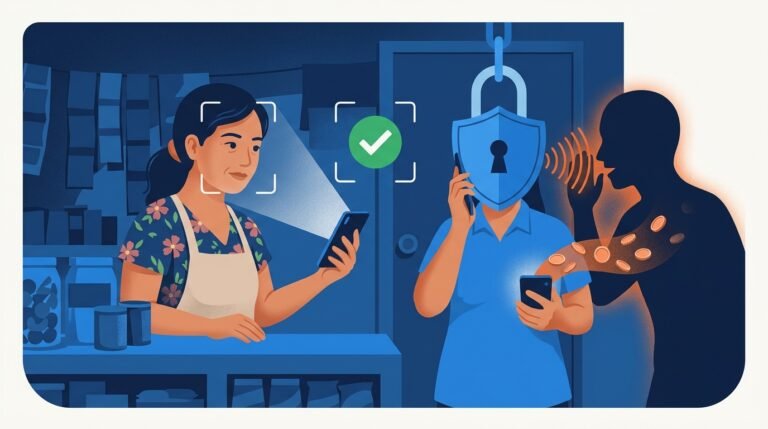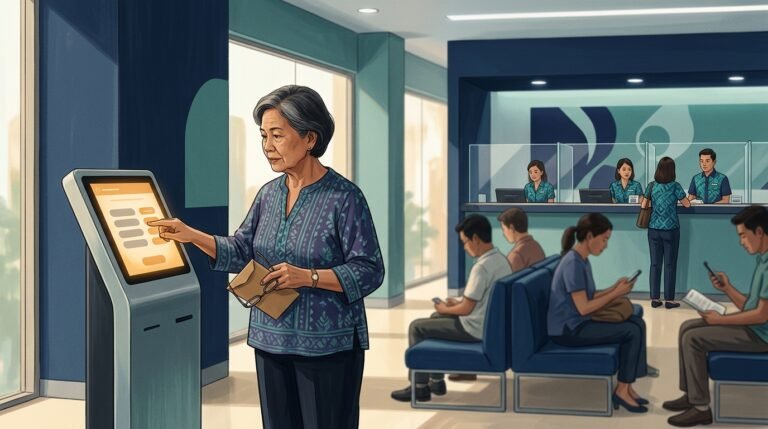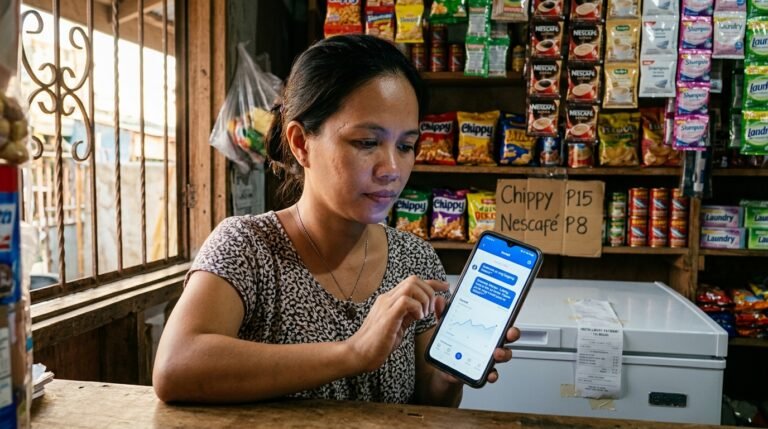
UnionBank pioneered app-only account opening in 2019 and won a 2026 award for it. The selfie flow is now table stakes. What still sets the bank apart is who hands it the customer, and what happens after the account opens.
| UnionBank’s digital onboarding no longer wins on speed, so its value in 2026 rests on bringing in customers that someone else has already verified and turning them into active, borrowing clients before the National ID turns app sign-up into a public utility. 1. The selfie flow is now table stakes. BPI and GoTyme already check applicants against the government’s National ID registry, GoTyme in as little as five minutes, and an August 2026 BSP draft would require banks, starting with retail lenders, to connect to that same registry. 2. The growth is arriving through sponsors. UnionBank’s recent onboarding launches, from Zero-Touch Payroll, which cut payroll account opening from up to two weeks to under 24 hours, to digital PERA and KYC-as-a-Service, all start with an employer, a government fund or a partner that already knows the customer. 3. Sign-ups are not the bottleneck; activity is. Only 5.9 million of UnionBank’s 18.6 million customers were actively using its digital channels at the end of 2025, while unsecured consumer loans grew 19.2% against customer growth of 7.6% in early 2026. A new hire at an Ortigas call center shows what changed, and what did not. |
Carla was 23 when she took her first job at a call center in Ortigas a few years ago. On day one, HR gave her a payroll enrollment form, asked for two photocopied IDs and sent a batch of new-hire papers to the bank. Then she waited. A payroll account could take up to two weeks to open. Her first cutoff came and went. HR scrambled for a workaround, and Carla borrowed from her cousin to cover her fare for the second week.
Her younger brother, Paolo, started at the same company in 2026. HR generated a QR code from UnionBank’s business platform, The Portal, and put it on the onboarding slide. Paolo scanned it with his phone. The UnionBank Online app opened. He photographed his ID, took a selfie, and finished in minutes. HR never touched a form. It simply saw his new account number appear on its screen. Carla and Paolo are composites, but the timings are UnionBank’s own: account opening now takes under 24 hours instead of up to two weeks, and salary can be credited as early as the next day.
That is Zero-Touch Payroll, launched in December 2025. The change for Paolo is real. But notice two things he did not see. First, he still photographed a plastic ID card. Across town, a BPI applicant with a National ID no longer has to, because BPI’s app now checks the person against the government registry directly. Second, the reason Paolo was easy to sign up had little to do with the selfie. His employer had already confirmed who he was, what he earns, and where his salary will land. UnionBank did not find Paolo. His employer delivered him.
What the Award Counts, and What the Annual Report Counts
In 2026, Capital Finance International named UnionBank its Digital Onboarding Excellence Champion for Southeast Asia. The citation is fair. UnionBank introduced mobile-only account opening in 2019, before the pandemic made branch-free banking urgent. It reduced friction with short forms, early capture of contact details and applications that can be resumed with a reference number. It added electronic identity checks, selfie liveness tests, device and IP-address checks, duplicate-face screening, blocks on temporary email addresses and watchlist screening, with anomalies routed to a human reviewer. Onboarding expanded from savings and debit accounts to credit cards, personal loans, investments and payroll. CFI counts about 5.5 million customers onboarded digitally across products by 2025.
The bank’s own 2025 annual report still describes UnionBank as the first Philippine bank to let customers open accounts through an app. Its public sign-up page says an account can be opened in the app within minutes with an ID upload and a selfie, and no maintaining balance on the basic savings account.
So far, the popular story holds: UnionBank is the digital bank among the big lenders. The same annual report contains the number that complicates it. UnionBank’s retail customer base grew about 10% to 18.6 million in 2025. Of those, the report says, 5.9 million are actively using its digital channels. That is roughly one customer in three.
A year earlier, the bank’s 2024 sustainability report counted over 17 million retail customers, including nearly six million digital users. The two years may define “digital” slightly differently, so the comparison is rough. The direction is still clear. The total base grew by well over a million people. The digitally active base did not grow with it.
Where did the rest of the growth come from? The annual report points to the answer without stating it outright. UnionBank surpassed 2 million credit cards issued in 2025, becoming only the third issuer in the country at that scale. It finished migrating Citi’s Philippine consumer business in March 2024, a transfer of around 1.5 million customer and transaction records. It runs payroll accounts for corporate clients, and member and pensioner accounts for SSS, GSIS and Pag-IBIG. Many of these customers were onboarded through a relationship, not through an app download.
That matters because UnionBank’s stated goal is scale. In December 2025, the bank said it aimed to reach 20 million customers in 2026. By June 30, 2026 it reported 19.3 million. It needs about 700,000 more in six months, the same pace it managed in the first half. The target is reachable. The question is which door those customers walk through, and whether they become active once inside.
Why UnionBank Kept Rebuilding Its Front Door: Pressure Map, 2026
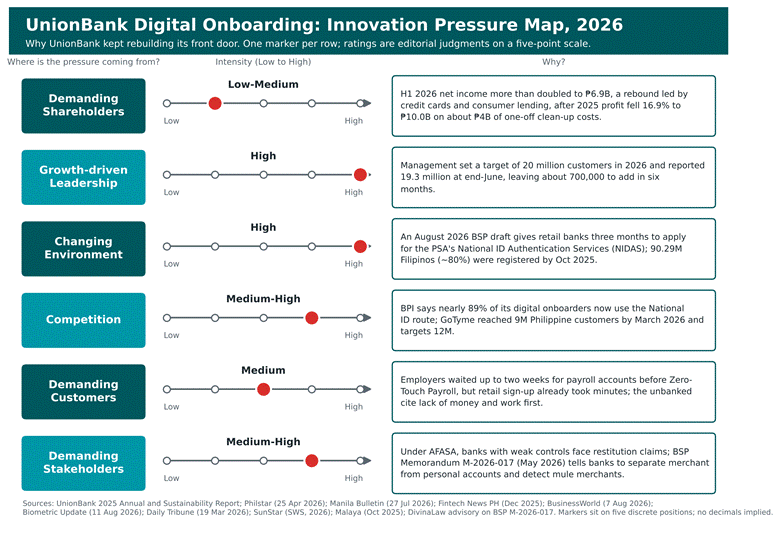
Figure 1. UnionBank Digital Onboarding: Innovation Pressure Map, 2026. Ratings are editorial judgments on a five-point scale; each marker sits on one of five discrete positions. Sources in the figure footer and References 1, 5, 9, 11, 14, 16, 21, 25, 28, 29.
Read the map from the top. The two High rows are leadership’s customer target and a regulator rewriting how identity is checked. The press materials for each onboarding launch point elsewhere. They talk about convenience, which is the Demanding Customers row, and that row sits in the middle. Retail customers were not waiting on UnionBank to get faster. The BSP’s own household data says people without accounts stay out mainly for lack of money or work. In the SWS survey the BSP cited in 2026, 58% of adults owned a financial account in the first quarter, but only 21% had a bank account.
Shareholders rate lowest, which may surprise anyone who remembers 2025. Profit did fall that year. But the rebound is already here and it is coming from cards and consumer loans, not from deposit sign-ups. Onboarding is not what investors are waiting on.
Three ratings carry real uncertainty. Changing Environment could fall a notch if the NIDAS memorandum stays in draft. We found no report that it had been finalized by mid-October 2026. Competition could rise if BPI’s National ID route keeps lifting its new-to-bank numbers, which it put at roughly 30% higher at an August forum. Shareholders could rise quickly if card credit costs turn. First-half credit costs fell 19%, but a young card book can season badly.
Four Ways to Read the Same Front Door
Each reading of UnionBank’s onboarding push predicts a different top row on the map. Only two fit the evidence, and they fit best together.
Reading one: a speed race. This is the launch-event story. UnionBank keeps shaving minutes off sign-up to beat BPI, GoTyme and the e-wallets. It predicts that Competition and Demanding Customers would top the map. They do not. Retail sign-up has been a matter of minutes since 2019. GoTyme now says it can open an account in as little as five minutes using the National ID registry. Speed has reached parity, and parity does not win customers. IdeyaHub saw the same limit in a branch setting in BDO Digitized the Queue, Not the Branch, where a faster front step left the expensive part of the visit untouched. The speed reading explains why UnionBank keeps polishing the flow. It does not explain the 2025 and 2026 launches.
Reading two: a compliance shield. On this reading, the onboarding redesign is mostly about fraud and liability. It predicts Demanding Stakeholders on top. There is real support. Money mule accounts rose as onboarding moved online. BPI’s chief digital officer has said criminals saw a chance to create digital accounts for exactly that purpose, and some accounts sold for thousands of pesos. BSP data for 2023 attributed 59.48% of cyber fraud losses to account takeover, identity theft and phishing. AFASA, signed in July 2024, made money muling a crime punishable by six to eight years in prison. UnionBank’s safeguards, from duplicate-face screening to human review, are built for this world. But the compliance reading has a hole. Zero-Touch Payroll, digital PERA and KYC-as-a-Service are growth products. A bank building a shield does not lead with three new acquisition channels. IdeyaHub’s GCash’s Face Scan Proves Who You Are. It Can’t Prove You Weren’t Tricked. traced the same limit from the wallet side: a face check confirms identity, not intent.
Reading three: let the distributor do it. Ask how a partner in the value chain would solve UnionBank’s problem of adding millions of customers cheaply and safely. An employer would say: I already know my staff. I checked their IDs when I hired them, I know their salary, and I decide which account it goes to. A government fund would say the same about its members. This reading predicts that Growth-driven Leadership tops the map, and that the bank’s best onboarding would run through sponsors. The evidence fits closely. UnionBank’s ePaycard Digital Account Opening, launched in 2021, let partner companies such as the HMO Intellicare send doctors an SMS reference code to open payout accounts in the app. Zero-Touch Payroll took that to its end point in 2025. UnionBank also builds member cards with SSS, which is one of its three principal shareholders, alongside Aboitiz Equity Ventures and Insular Life. The annual report says improved pensioner-loan journeys lifted bookings by 70%. UnionDigital’s UD Loans product is offered only to UnionBank salaried customers, by invitation. Each of these turns a sponsor’s knowledge of a customer into a bank relationship.
Reading four: the supplier becomes the utility. Now ask the supplier of identity itself, the Philippine Statistics Authority. Its answer is to make verification a public service. The PSA and the Department of Information and Communications Technology run the National ID Authentication Services, or NIDAS. A bank sends a selfie or a National ID number and gets a match against the registry. Tier 1 returns a yes or no. Tier 2 returns agreed demographic fields. A Tier 3 for sharing across institutions is still in development. This reading predicts Changing Environment at the top, and that banks will soon compete on what they do after verification, not on verification itself. That also fits. The BSP’s 2023 e-KYC amendments already recognized PhilSys-based checks. In early August 2026, the BSP released a draft memorandum requiring banks to use NIDAS in onboarding, account opening and account updates, with three months for retail banks to submit complete applications. Where a customer passes NIDAS, the authentication itself would satisfy the ID requirement. No photo of a plastic card needed.
The adjacent telco industry already ran this experiment at national scale, and it lost. The SIM Registration Act required every SIM to be tied to a person with a photo, an ID and a selfie. More than 118 million SIMs were registered by September 2023. Then senators watched a video of a police officer activating SIM cards with an ID bearing a monkey’s photo. The telecom regulator said a process built on a photo, some personal data and an ID copy may be too lax. The telcos’ industry group asked the government for one verified ID database they could check against. That is the same registry the BSP now wants banks to use. Document capture plus a selfie, at scale, invites synthetic identities. Registry checks narrow that door.
Readings three and four together explain the evidence. Identity proofing is becoming public infrastructure. The private edge moves to two places: who brings you the customer, and what you do with that customer once the account is open. The speed reading is ruled out as the main driver. The compliance reading is a real constraint, not the strategy.
Where UnionBank’s Onboarding Actually Creates Value
UnionBank Digital Onboarding: Business Opportunity Map, 2026
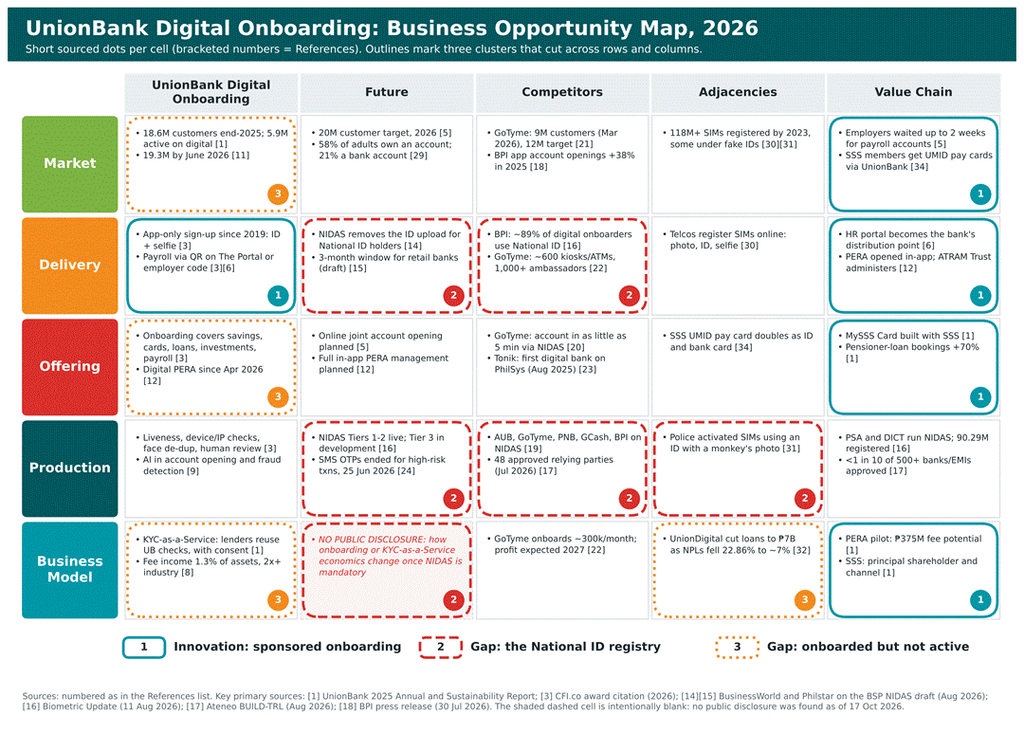
Figure 2. UnionBank Digital Onboarding: Business Opportunity Map, 2026. Bracketed numbers in each cell refer to the References list. Outlines mark Cluster 1 (sponsored onboarding), Cluster 2 (the National ID registry gap) and Cluster 3 (onboarded but not active). The shaded cell is intentionally blank.
Three clusters cut across this grid.
Cluster 1, the innovation: sponsored onboarding. It links the payroll QR and employer code (Delivery, UnionBank) to the HR portal and the two-week wait employers faced (Value Chain, Delivery and Market), and on to the MySSS Card, the 70% rise in pensioner-loan bookings and SSS’s dual role as shareholder and channel (Value Chain, Offering and Business Model). It shows that UnionBank’s real onboarding asset is not the selfie but the institutions that hand it pre-verified customers with a known income.
Get the next SEA banking case study in your inbox
Free. Unsubscribe anytime.
Cluster 2, the gap: the registry. It links NIDAS and the three-month window (Future, Delivery and Production) to BPI’s 89% and the list of banks already connected (Competitors, Delivery and Production), to the monkey-faced SIM registrations (Adjacencies, Production), and to the blank Future cell under Business Model. It reveals that the biggest change to how onboarding works has no public answer from UnionBank yet. We found no UnionBank announcement of a NIDAS integration in its releases, its annual report or press coverage through mid-October 2026, while public reports name AUB, GoTyme, PNB, GCash, Tonik and BPI.
Cluster 3, the gap: onboarded but not active. It links 5.9 million active digital users out of 18.6 million (Market, UnionBank) to the card and loan products that onboarding now feeds (Offering, UnionBank), the fee engine (Business Model, UnionBank), and UnionDigital’s bad-loan clean-up (Business Model, Adjacencies). It shows that the hard part is not opening the account. It is getting customers to use it, and lending to them well.
The threads, joined
Put product, channel, rivals and balance sheet on one page and the picture is consistent. In the first quarter of 2026, UnionBank’s customers grew 7.6% to 18.9 million. Low-cost current and savings deposits grew 7.8%. Unsecured consumer loans grew 19.2% to ₱153.1 billion, and consumer lending made up 60% of the loan book. Net interest margin widened to 6.7%, and then to 6.9% by June. The bank is not using onboarding to gather cheap deposits faster than it gathers customers. It is using onboarding to feed a lending and fee machine. Each customer is borrowing more.
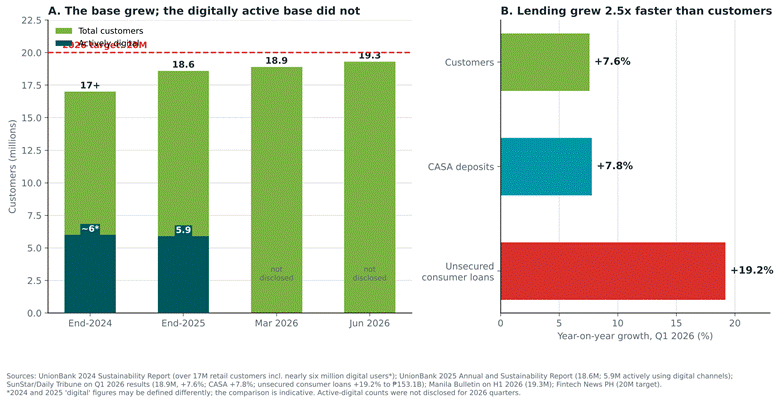
Figure 3. Customers, digital activity and lending growth. Sources: References 1, 2, 5, 10, 11. The 2024 and 2025 digital figures may be defined differently; the comparison is indicative.
Cluster 1 answers the strongest pressure on the map, Growth-driven Leadership, and answers it well. Sponsored channels are cheap. An employer or a fund does much of the verification and supplies an income signal a selfie cannot. Payroll and pension accounts also come with steady inflows, which is exactly what a card or salary-loan underwriter wants to see. Compare GoTyme, which told reporters in November 2025 that onboarding 300,000 customers a month meant spending heavily, and which does not expect profit until 2027.
Cluster 2 sits against the other High pressure, Changing Environment, and here the fit breaks. What UnionBank has built in production, its own liveness checks, face de-duplication and human review, is good. But it is a private version of a check the state is about to offer every bank. The mismatch matters most for KYC-as-a-Service, the Open Finance product UnionBank calls an industry first. It lets other lenders, with the customer’s consent, verify borrower information that UnionBank already holds. If every lender can query the PSA registry directly, the identity part of that service loses value. What remains valuable is everything beyond identity: account history, salary credits, payment behavior. UnionBank has not said publicly how it will price or position the product once NIDAS is standard. That blank cell is a finding, not an oversight in the map.
Cluster 3 sits against the Low-Medium shareholder row and the leadership row, and it is where fragility lives. UnionBank’s own digital bank shows what happens when mass-market onboarding outruns credit discipline. UnionDigital launched in July 2022, lost around ₱3 billion in 2024, and saw its NPL ratio reach 22.86% before it cut its loan book to about ₱7 billion and brought bad loans down to roughly 7% by December 2025. It now hopes to break even in 2026. The parent bank’s card book is younger than its rebound. First-half 2026 credit costs fell 19% to ₱9.4 billion, which is good news, but they are still large against ₱6.9 billion of net income.
What could break it, and what is overhyped
Three things could break the model. A finalized NIDAS rule could expose UnionBank as a late adopter in the one area where it was always early. A turn in card credit quality could reverse the profit story that onboarding now serves. And mule risk could shift into sponsored channels. A payroll account is only as clean as the employer’s hiring checks, and the BSP’s May 2026 memorandum on mule merchants shows regulators are watching how accounts are opened, not just who opens them.
What is overhyped is the speed claim. “Minutes” was a breakthrough in 2019. In 2026 it is the floor. What is underrated is Zero-Touch Payroll. It moves the bank’s acquisition cost onto a business process that employers already run, and it delivers customers with a salary attached.
A Different Answer for Each Seat at the Table
Each reader is asking UnionBank’s onboarding a different question. Each question gets the strongest case on both sides before a call.
Seat 1: The new hire or retail customer
Their question: Is easy sign-up a good reason to bank here?
| The case for | The case against |
| If your employer pays through UnionBank, Zero-Touch Payroll opens your account in under 24 hours instead of up to two weeks, with no forms, and salary can be credited the next day. | Speed is no longer rare. GoTyme says it can open an account in as little as five minutes through the National ID registry, and BPI no longer asks National ID holders for an ID photo. |
| The basic Personal Savings Account has no initial deposit or maintaining balance, and it earns interest from a ₱10,000 balance, at 0.10% a year. | That 0.10% rate is close to nothing. A fast door into a low-yield account is a convenience, not a financial reason to stay. |
Our call: Yes for payroll. Compare for everything else. Ties to the Demanding Customers row and Cluster 1.
What would change it: UnionBank connecting to the National ID registry would remove the one step where rivals are now faster.
Seat 2: UnionBank’s own strategy team
Their question: Is the onboarding engine still a competitive advantage?
| The case for | The case against |
| Sponsored onboarding works. Payroll, SSS and pensioner channels bring customers with a known income, and redesigned pensioner-loan journeys lifted bookings by 70%. | Only 5.9 million of 18.6 million customers are digitally active. A bigger base that does not use the app limits cross-selling and weakens the “digital bank” claim. |
| The growth target is on track. The bank added about 700,000 customers in the first half of 2026 and needs the same again to hit 20 million. | No public NIDAS integration was found, while BPI, GoTyme, AUB, PNB, GCash and Tonik have announced theirs. The early mover now looks late on the newest rail. |
| Lending is growing faster than the base. Unsecured consumer loans rose 19.2% in the first quarter of 2026, against customer growth of 7.6%. | KYC-as-a-Service sells verification that the state is about to offer every bank. Its identity value will shrink once NIDAS is mandatory. |
Our call: Sound channel, exposed position. Ties to the Growth-driven Leadership and Changing Environment rows, and to Clusters 2 and 3.
What would change it: Three moves would firm the call. Connect to NIDAS and announce it before the BSP deadline turns it into a compliance story. Report the share of digitally active customers every quarter. Rebuild KYC-as-a-Service around what UnionBank knows beyond identity, such as verified salary flows.
Seat 3: The regulator or outside analyst
Their question: Is this onboarding model safe at scale?
| The case for | The case against |
| UnionBank’s controls are layered: liveness checks, device and IP checks, duplicate-face screening, temporary-email blocks, watchlists and human review of anomalies. | Mule accounts are usually real people’s accounts. A face check proves identity, not intent, and AFASA can still expose banks to restitution claims when controls fall short. |
| The system is getting stronger. SMS one-time passwords ended for high-risk transactions on June 25, 2026, and the National ID registry covers 90.29 million Filipinos. | Adoption is thin. Only 48 private institutions were approved NIDAS relying parties as of late July 2026, out of more than 500 banks and e-money issuers. |
| The BSP draft would let a registry match replace a physical ID, which narrows the kind of fake-ID trick police used to activate SIMs with a monkey’s photo. | Reused KYC raises an open question. When a lender relies on another bank’s checks under Open Finance, it is not settled who carries the AFASA liability if the original check was wrong. |
Our call: Safer than before, but measure the second step. Ties to the Demanding Stakeholders row and Cluster 2.
What would change it: Published mule-account rates by onboarding channel would show whether sponsored sign-ups are actually cleaner than open ones.
The skeptic’s ledger
| Claim in this article | Why to still doubt it | What would settle it |
| Digital activity stayed flat while the base grew. | UnionBank’s 2024 “nearly six million digital users” and 2025 “5.9 million actively using” may not be defined the same way. | A consistent active-user definition in the next annual report. |
| UnionBank is late on the National ID registry. | It may have an integration it has not announced. | A statement from UnionBank or the PSA’s relying-party list. |
| National ID verification is becoming standard. | BPI’s 89% adoption figure came from one forum presentation, and the BSP rule is still a draft. | A final BSP memorandum and published adoption data from more banks. |
| Sponsored channels are safer. | No Philippine bank publishes fraud rates by onboarding channel. | Channel-level fraud and mule data, from any bank. |
Test Your Own Sign-Up Flow Before the Registry Does
Every organization that onboards customers faces a version of UnionBank’s position. The step you are proud of may be about to become free for everyone. Use the questions below on your own product or initiative.
| # | Question | Your answer |
| 1 | If a public utility did your verification tomorrow, what would still be yours? List the data, relationships and decisions that survive once identity is free. | |
| 2 | Who already knows your customer better than you do? Name the employer, fund, platform or partner that could hand you pre-verified customers, and what it would want in return. | |
| 3 | What share of the people you sign up are active 90 days later? If you cannot state the number, you are measuring the door, not the room. |
Your Innovation Pressure Map
| Where is the pressure coming from? | Intensity (Low to High) | Why? |
| Demanding Shareholders | Low ○○○○○ High | |
| Growth-driven Leadership | Low ○○○○○ High | |
| Changing Environment | Low ○○○○○ High | |
| Competition | Low ○○○○○ High | |
| Demanding Customers | Low ○○○○○ High | |
| Demanding Stakeholders | Low ○○○○○ High |
Fill in one marker per row and one sourced fact per “Why?” cell. If every row reads High, look again. At least one pressure is usually weaker than it feels.
Your Business Opportunity Map
| Your Company | Future | Competitors | Adjacencies | Value Chain | |
| Market | |||||
| Delivery | |||||
| Offering | |||||
| Production | |||||
| Business Model |
Place two to four sourced dots in each cell, then circle your strongest cluster: the one that connects at least three cells and answers your highest-rated pressure.
Tags: UnionBank, UnionBank Online, Digital Onboarding, Zero-Touch Payroll, National ID eVerify, PhilSys, KYC-as-a-Service, Banking, Fintech, AI & Data in Financial Services
IdeyaHub newsletter
Enjoyed this case study?
Get the next deep dive on Southeast Asian banks, fintechs and insurers in your inbox. One email a week.
Free. Unsubscribe anytime.
References
1. Reimagining Banking: 2025 Annual and Sustainability Report, Union Bank of the Philippines
2. UnionBank 2024 Sustainability Report, Union Bank of the Philippines
3. Union Bank of the Philippines: Digital Onboarding Excellence Champion Southeast Asia 2026, CFI.co
4. Digital Account Opening, Union Bank of the Philippines
5. UnionBank Launches Automated Payroll Tool, Targets 20 Million Customers by 2026, Fintech News Philippines
6. UnionBank launches Zero-Touch Onboarding: Setting the standard for fully digital payroll account opening, Philstar
7. Intellicare and UnionBank partnership for ePaycard Digital Account Opening (2021), BusinessWorld
8. UnionBank profit rebounds in 2H, Context.ph
9. UnionBank sees stronger earnings this year, Philstar
10. UnionBank 1Q profit soars 167%, SunStar
11. UnionBank profit jumps 113% in H1 on strength of consumer business, Manila Bulletin
12. UnionBank Launches Digital PERA Onboarding on Its Mobile App, Fintech News Philippines
13. BSP expands online access to PERA, Philstar
14. BSP wants banks to use National ID authentication in KYC processes, BusinessWorld
15. Banks, e-wallets to be required to link to national ID, says BSP, Philstar
16. Philippines pushes national ID as foundation for financial identity verification, Biometric Update
17. Ateneo BUILD-TRL working with PSA and BSP on National ID adoption, Ateneo de Manila University
18. National ID eVerify now available in the BPI app, making account opening easier, BPI
19. BPI Lets National ID Holders Open Accounts with Just a Selfie, Fintech News Philippines
20. GoTyme integrates PhilSys for digital account verification, Newsbytes.PH
21. GoTyme hits 9M users ahead of FIFA partnership, Daily Tribune
22. GoTyme Bank targets 3M more depositors in 2026, Daily Tribune
23. Leading the Way: Tonik Becomes First Digital Bank to Implement PhilSys ID Verification, PR Newswire
24. No more SMS, email OTPs for high-risk financial transactions starting June 25, GMA News
25. Under pressure: Banks urged to build AFASA-compliant anti-scam system within 1 yr, Malaya Business Insight
26. BSP Uses New Law to Probe Bank Accounts in Flood-control Corruption Case, Fintech News Philippines
27. Accounts used for money mule schemes increasing amid rise in online transactions, BusinessWorld
28. BSP Memorandum No. M-2026-017 (client advisory), DivinaLaw
29. BSP notes rise in account ownership in SWS survey, SunStar
30. Plugging loopholes in SIM card law, Inquirer
31. Philippine SIM card fiasco: Monkey photo highlights security gaps, Gulf News
32. Union Digital Bank expects to break even in 2026, Context.ph
33. UnionBank pumps P1.6 billion more into digital, Inquirer
34. SSS partners with private bank for pay cards roll-out, The Manila Times
35. BSP issues new rules on customer due diligence, e-KYC, Context.ph
36. BSP sharpens framework for probing suspicious accounts, Inquirer