
Igloo pitches Turbo, its no-code insurance core, as a way for insurers to launch products in days. Its own filings suggest the bigger customer is Igloo’s profit and loss statement.
| Turbo is less a bet on what insurers want to buy and more Igloo’s attempt to turn a labour-heavy services business into a software business before its 2026 breakeven deadline. 1. The numbers point at margin, not demand. Igloo grew revenue 49% in 2024, to US$55.46 million, but its net loss still widened 11% to US$21.8 million, and 72% of that revenue came from third-party administration work. 2. The product answers Igloo’s cost problem first. Igloo’s showcase automation result, claims first response cut from one to three days to one minute, is a saving that lands mostly inside the administration work Igloo runs for insurers. 3. The outside demand is real but thin. Igloo itself says Asia-Pacific insurers spend only 2% to 3% of gross written premium on technology, and no insurer has yet been publicly named as running its core on Turbo. To see why that matters, start with the person Turbo is supposed to help: an insurance product manager with a deadline. |
A product manager at a mid-sized general insurer in Jakarta gets a message from her distribution head on a Monday. A telco partner wants phone screen protection live inside its app before a big handset launch. The window is about a month. She knows the old route well. She writes a product specification, the actuarial team signs off on rates, and then the request joins the IT backlog behind a motor-policy change and an audit fix. Someone has to build a quote screen, a policy record, a certificate template, and a claims form, and then someone else has to wire all of it to the telco’s checkout. At her company, that cycle has never taken less than a quarter. The handset launch will come and go without her product.
Now run the same Monday through a platform like Igloo’s Turbo. She opens a drag-and-drop configurator that needs no code and starts from a template instead of a blank page. Igloo says the library holds over 200 blueprint plans spanning more than 100 products, that the platform already connects to over 40 regional and local insurers, and that working from a blueprint halves development time. She adjusts the coverage limits, the excess, and the price, checks a live preview of what the buyer will see, and pushes the same product to the telco app and to her own agents. Igloo’s pitch is that products like this can ship “in weeks or even days.”
The change reaches the end customer too. Three months later, a buyer drops his phone on a train platform and files a claim from the app. Under the old process, he might wait one to three days just for a first response. Igloo says its automated claims flow now sends a first response in one minute, and that adjudication accuracy has reached 98%.
This scene is a composite, not one verified launch. But every Turbo figure in it comes from Igloo’s own published claims about the platform and its AI modules. And that is exactly where the harder question starts. Every number in the story describes a benefit to the insurer. The numbers in Igloo’s filings describe a company that needed something else.
The problem Turbo actually solves
Igloo launched Igloo Tech Solutions on June 2, 2025. The suite bundled Turbo with three distribution tools (Igloo Agent, Igloo Consumer and Igloo Partner) plus claims, admin, AI claims and fraud modules. Every line of the announcement was aimed at insurers. Co-founder and CEO Raunak Mehta said stronger digital capability “is not optional.” The release listed early users: MSIG Vietnam on the agent tool, Kredivo and TrueMoney on the consumer tool, and Cambodian insurer BIMA, which was still implementing the partner tool.
Turbo itself is not new. In a May 2023 post on Google Cloud’s blog, Igloo’s chief actuary and chief technology officer described Turbo as the engine Igloo already used in-house. It let insurance staff with no coding skills set up products, then sold the same product through online marketplaces, sales staff in retail stores, and Ignite, Igloo’s app for intermediaries. Usage data flowed into Google’s BigQuery for analysis. What changed in 2025 was not the software. It was who Igloo decided to sell it to.
The reason becomes clear once you read the filings instead of the press release. Igloo’s accounts on file with ACRA, Singapore’s company registrar, as reported in January 2026, show revenue of US$55.46 million in 2024, up 49% from a restated US$37.14 million in 2023. That is strong growth. But the net loss also grew, from US$19.66 million to US$21.8 million. And the mix of that revenue matters more than its size. Revenue from third-party administration almost tripled, reaching US$39.72 million, or about 72% of the total.
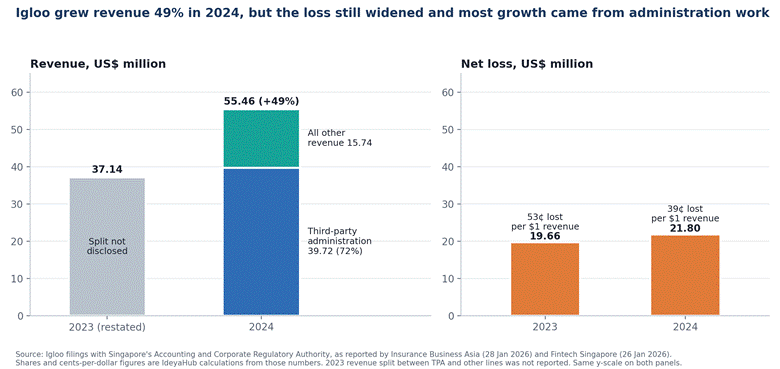
Figure 2. Igloo revenue and net loss, 2023 and 2024, US$ million. Source: Igloo filings with Singapore’s ACRA as reported by Insurance Business Asia (28 January 2026) and Fintech Singapore (26 January 2026); see References 7 and 8. Percentages and cents-per-dollar figures are IdeyaHub calculations. The 2023 split by revenue line was not reported.
Third-party administration is useful work. It means handling policy servicing, claims, and back-office tasks on behalf of insurers. It is also work that scales with people. Every extra claim needs someone, or something, to process it. A business where most revenue comes from that kind of work will struggle to reach software-style margins, no matter how fast the top line grows.
Set that against what investors were told. When Eurazeo’s insurtech fund, backed by BNP Paribas Cardif, led a US$36 million pre-Series C round in December 2023, Reinsurance News reported that Igloo expected to get closer to profitability during 2024. In dollar terms, the loss grew that year instead. In November 2025, Igloo set a firmer goal: EBITDA breakeven in 2026. That is a public deadline, and 2026 is now almost over.
That is the real problem. Turbo matters less as a new product and more as a lever: a way to turn what Igloo already does for insurers by hand into something insurers pay for as software, and to strip labour out of the parts it keeps doing itself.
Innovation Pressure Map: why Igloo turned Turbo outward
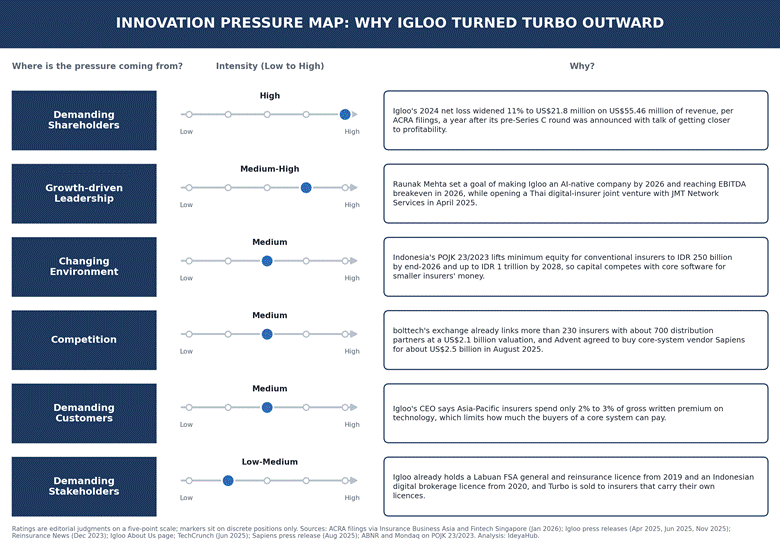
Figure 1. Innovation Pressure Map for Igloo Turbo. Ratings are editorial judgments on a five-point scale, placed on discrete positions. Sources listed beneath the graphic and in References 3, 6, 7, 8, 11, 14, 15, 16, 17, 18 and 19.
The two highest rows point inward, at Igloo’s investors and Igloo’s leadership. The press release points outward, at insurers. That gap is the story.
Some of these ratings could move. The Customers row could climb if Igloo shows that its reported 200% net dollar retention comes from partners buying Turbo rather than more embedded policies. The Environment row could climb in the other direction: if Indonesia’s equity rules push insurers to merge, merged companies will need one system instead of two, and that could become demand. The Competition row would rise quickly if bolttech moved from exchange into core administration. For now, the evidence supports the ratings as shown.
Four ways to read the Turbo launch
There is more than one plausible reason Igloo turned an internal engine into a product. Each explanation predicts a different pressure should dominate. Only one lines up with the evidence.
Reading one: insurers demanded it. If this were true, the Customers row should be the highest. The evidence is weak. At the launch, Mehta himself said Asia-Pacific insurers put only 2% to 3% of gross written premium into technology. Igloo’s November 2025 release cited research that 70% of insurance executives are exploring AI but fewer than 22% have got past the testing stage. That describes curious buyers with small budgets, not a queue of insurers begging for a new core. The early users named at launch were on distribution tools, not on Turbo as a system of record. Demand exists. It does not look strong enough to explain the timing.
Reading two: a defensive move against competitors. This reading predicts Competition should top the map. The main rivals do not overlap closely enough. bolttech is an exchange that connects insurers and distributors rather than running an insurer’s core. Sapiens, now owned by Advent, is a global core vendor with more than 600 customers in over 30 countries, and its sale was pitched around more SaaS and AI investment, not a push into Southeast Asian embedded products. Turbo targets the gap between them: mid-sized regional insurers and distributors that want fast, short-tail products without a multi-year system replacement. Competition shapes the pitch, but it did not force the launch.
Reading three: regulation made it necessary. This predicts the Environment row should dominate. It does not fit the timeline. Turbo was running inside Igloo by 2023, well before any 2026 capital deadline mattered, and Indonesia’s equity rules are about balance sheets, not software. Regulation affects how much money insurers have left for technology. It is a constraint on Turbo’s market, not the reason Turbo exists.
Reading four: Igloo needed a better margin structure. This predicts the Shareholders and Leadership rows should be highest. Here the evidence lines up. The loss widened in 2024 despite talk of moving closer to profitability. A public breakeven deadline now falls in 2026. Revenue is dominated by labour-heavy administration. And the benefits Igloo highlights for its AI modules, less manual claims handling and a first response in one minute instead of days, are savings inside the operations Igloo itself runs. The same November 2025 announcement that laid out the AI-native plan also restated the 2026 EBITDA breakeven goal. The two sit side by side for a reason.
Reading four does not make the other three false. Insurers do want speed. Competitors do exist. Regulation does shape budgets. But only the margin explanation predicts both the timing and the design.
Get the next SEA banking case study in your inbox
Free. Unsubscribe anytime.
How the pieces connect
Put the product, the market, and the balance sheet side by side, and a coherent picture forms.
Start with the product. Igloo’s product pages list what sits inside Turbo: a product configuration engine, a core policy framework, document production, an operations console, security and anti-fraud controls, claims administration, and finance and reconciliation. Insurers can also take white-label modules for quoting, underwriting, and admin, customer, and claims portals. That is not a front-end widget. It is most of the plumbing an insurer needs to run simple products end to end. And it is the same plumbing Igloo uses to run the third-party administration work that makes up most of its revenue.
That overlap is the point. Every improvement Igloo makes to Turbo for its own operations can be resold to insurers. Every insurer that licenses Turbo helps fund work Igloo needed to do anyway. In a strong version of this model, Igloo stops being mainly a services company that happens to own software and becomes a software company that also offers services.
There is early evidence the model is working. Losses grew in 2024, but more slowly than revenue. In 2023, Igloo lost roughly 53 cents for every dollar of revenue. In 2024, it lost about 39 cents. That is real operating leverage, even if it is not yet profit. Igloo also reports 200% net dollar retention, meaning existing partners roughly doubled what they spend with it. If that figure holds up under a standard definition, it is one of the better numbers in Southeast Asian insurtech.
Distribution scale gives Turbo a real edge too. In an April 2026 announcement carried by TechNode Global, Igloo said it handles more than 80 million policies a month in six Southeast Asian markets and has now passed 1.6 billion policies facilitated in total. In the Philippines alone it works with over 40 digital platforms, including GCash, Shopee, Lazada, and Smart, and has launched more than 55 products. In September 2025, it added Indonesia’s Telkomsel, putting cyber, gadget, phone screen, and travel cover inside the MyTelkomsel app for prepaid subscribers, a partnership pitched at the operator’s more than 150 million customers. Those integrations are where Turbo’s blueprint library came from. A rival vendor can copy a no-code interface. It cannot easily copy hundreds of products already tested in live channels. We made a similar argument in The Old Data Behind Southeast Asia’s New Insurtech Winners: the lasting advantage comes from data and distribution that already exist, not from the feature list.
Now the mismatch. Turbo is strongest on the products Igloo knows best: short-tail, high-volume embedded cover such as device protection, lifestyle cover, credit life, and parametric weather products. Igloo’s investors care about margin. Larger general insurers, by contrast, run core books in lines such as motor, health, and property, which need deeper underwriting, longer claims tails, and heavier integration. Turbo’s design fits the first group well. There is no public evidence yet that it runs the second. That means Turbo answers Igloo’s shareholder pressure more directly than it answers the needs of the biggest insurance buyers. This is not fatal. But a product aimed at the builder’s own problem, rather than the buyer’s largest one, carries a specific kind of fragility: it can sell well to small and mid-sized insurers while never becoming essential to the large ones that set industry standards.
The capital side adds another thread. In January 2026, Tokio Marine paid US$5 million for 493,984 new Igloo shares at US$10.12 each, a 1.65% stake. Simple arithmetic on those figures implies a post-money valuation of roughly US$300 million. For a company with US$55 million in revenue that is growing fast but still losing money, that is a moderate price, not a frothy one. Coverage of the deal linked it to Tokio Marine’s push into insurance sold through apps and online partners, with Indonesia a priority, and noted it had reportedly anchored a roughly US$5 million extension round at PasarPolis in September 2025. A strategic insurer buying a small stake is a vote of confidence. It is also a reminder that several of Igloo’s backers are insurers or insurer-backed funds, from Tokio Marine to the BNP Paribas Cardif-backed Eurazeo fund, the same kind of companies Turbo is meant to serve.
What still deserves doubt
A careful reader should hold several points loosely.
The headline figures do not always reconcile. Reinsurance News reported in 2023 that Igloo had raised US$100 million in total, and Insurance Business Asia repeated “around US$100 million” in January 2026. Writing about the same filings that month, Fintech Singapore put total equity funding since 2016 at US$79.19 million and the December 2023 round at over US$26 million, not the US$36 million announced. The gap could come from debt, convertible notes, or tranches counted at announcement. None of the coverage explains it.
Policy counts are not premium. Igloo’s policy numbers are enormous, but most are small embedded policies. Igloo told Insurance Business Asia its programmes cover more than 160 million devices and more than 11 million credit life policies. It does not publish gross written premium. A billion policies can add up to far less premium than a single mid-sized motor book.
The AI metrics are self-reported, and one is ambiguous. A 98% adjudication accuracy rate is a strong claim. Igloo’s release also says manual claims work “is reduced to 70%,” which could mean a 30% cut or, as some coverage read it, a 70% cut. Igloo has not published how it measured either figure, on which products, or over what period. They are plausible for simple, parametric-style claims such as flight delay or screen damage. They would be much harder to reach on bodily-injury motor claims.
No named core client yet. The launch named clients for Igloo’s distribution tools. As of this writing, no insurer has been publicly identified as running its core policy administration on Turbo. Until one does, Turbo’s value as a stand-alone core system is a claim, not a track record.
The deadline is close. If Igloo reaches EBITDA breakeven in 2026, Turbo will look like a well-timed pivot. If it misses, the same product will look like a way to relabel services revenue as technology revenue. The 2025 accounts, once filed with ACRA, will be the first real test.
Three verdicts for three readers
For the insurer weighing Turbo (the Customers row). Turbo is a sensible choice for a narrow job: launching short-tail embedded products quickly into partner channels. The blueprint library and existing integrations are real advantages, and they save months on work like the screen-protection launch in the opening story. It is not yet a proven replacement for a full core system across motor, health, or property. An insurer should pilot it on one embedded line, insist on clear data portability and exit terms, and ask Igloo for references from an insurer running policy administration on it, not just a distribution front end.
For Igloo’s own strategy (the Shareholders row). Productising Turbo is the right move, and it follows logically from what Igloo already built. It reuses sunk engineering, it lowers the cost of Igloo’s own administration work, and it gives insurers a reason to pay for software instead of only paying per policy. The risk is that the software line stays small next to the services line. The number to watch is the share of revenue coming from recurring licence or platform fees rather than administration. If that share does not rise in the 2025 and 2026 accounts, the breakeven target will depend on cost cuts, not a new business model.
For regulators and outside analysts (the Stakeholders row). Turbo does not need a new licence, and that is why this row rates low today. But it creates a quieter kind of exposure. If dozens of insurers across several markets run their embedded products and claims on one vendor’s platform, an outage, a data breach, or financial stress at that vendor becomes a shared risk, not a single-company problem. Igloo’s losses and its dependence on hitting a 2026 target make that worth monitoring. Analysts should treat Igloo less as an embedded-insurance distributor and more as critical outsourced infrastructure, and ask the questions they would ask of any such provider: who else could run these products if Igloo could not?
There is a parallel in banking. In PBCOM Fixed Its Core Banking System. Its App Still Gets 3.3 Stars., a modern core did not by itself change what customers felt. Turbo inverts the problem. Its benefits show up quickly at the front end, in faster launches and faster claims. Whether they show up in the builder’s own accounts is the open question.
Workshop: whose problem does your product solve first?
The Turbo case applies well beyond one Singapore insurtech. Many companies launch a product for customers that was really built to fix their own economics. That is not a flaw. It becomes a flaw only when nobody admits it, because then the product gets judged on the wrong scorecard.
Run your own product or initiative through these questions.
| # | Question | Your answer |
| 1 | If you list the three biggest benefits of your product, how many land on the customer and how many land on your own cost base? Be specific: name the metric for each. | |
| 2 | Which pressure forced your launch date: a customer asking, a competitor moving, a rule changing, or an investor deadline? What would you have built if that pressure were absent? | |
| 3 | Does your product fit the largest segment of your buyers, or the segment you already understand best? What evidence would prove it can serve the first? |
Then fill in your own pressure map. Rate each row honestly. If every row reads High, you have not yet found the real problem.
| Where is the pressure coming from? | Intensity (Low to High) | Why? |
| Demanding Shareholders | ||
| Growth-driven Leadership | ||
| Changing Environment | ||
| Competition | ||
| Demanding Customers | ||
| Demanding Stakeholders |
IdeyaHub newsletter
Enjoyed this case study?
Get the next deep dive on Southeast Asian banks, fintechs and insurers in your inbox. One email a week.
Free. Unsubscribe anytime.
References
- Turbo: Digital Insurance Core Platform, Igloo, accessed September 2026
- End-to-end Comprehensive, Customisable Insurtech Solutions (Igloo Tech Solutions), Igloo, accessed September 2026
- Igloo Launches Igloo Tech Solutions to Transform Insurance Operations in Southeast Asia, Igloo press release, June 2, 2025
- Igloo unveils Igloo Tech Solutions to transform insurance across Southeast Asia, FinTech Global, June 3, 2025
- How Igloo manages multiple insurance products across channels, Google Cloud Blog, May 29, 2023
- Igloo ushers in next era of insurtech in Southeast Asia with AI-native strategy, Igloo press release, November 6, 2025
- Tokio Marine buys minority stake in Singapore insurtech Igloo, Insurance Business Asia, January 28, 2026
- Tokio Marine Invests $5M in Igloo, Fintech Singapore, January 26, 2026
- Tokio Marine invests $5m in InsurTech Igloo, FinTech Global, January 26, 2026
- Japanese Insurer Tokio Marine Secures Minority Interest in Igloo as TPA Revenues Surge, Fintech Observer, January 27, 2026
- Insurtech Igloo closes $36m Pre-Series C funding round, Reinsurance News, December 8, 2023
- Insurtech Igloo expands Philippines strategy as insurance market hits $8.4B, TechNode Global, April 15, 2026
- Igloo and Telkomsel partner to offer embedded insurance in Indonesia, TechNode Global, September 23, 2025
- JMT Network Services and leading insurtech Igloo establish joint venture to transform insurtech solutions for Thailand, Igloo press release, April 2, 2025
- About Us, Igloo, accessed September 2026
- Singapore-based insurtech bolttech closes $147M Series C at a $2.1B valuation, TechCrunch, June 4, 2025
- Sapiens to be Acquired by Advent for $2.5 Billion, Sapiens press release, August 13, 2025
- Indonesia Ups Mandatory Capital and Equity Requirements for Insurers Amid Continuing Jitters, ABNR Counsellors at Law
- New Minimum Capital of Insurance Company in Indonesia, Mondaq
- OJK unveils strategic policies to strengthen Indonesia's insurance sector, Indonesia Business Post, May 2025