Pera Coach is free, speaks several Philippine languages, and was built with Microsoft’s support. It also lives where GCash sells investments, not where its users borrow. Six months after launch and weeks before a record IPO listing, that placement says more than the press release.
| Pera Coach is a well-built cross-sell tool wearing a financial-literacy label. It answers GCash’s pressure to turn 40 million payment users into savers and investors before its IPO, not the literacy gap its launch announcement cited. 1. The pressure comes from the cap table, not the classroom. Mynt’s revenue growth fell from 47.2% in 2025 to 14.8% year on year in the first quarter of 2026, just as existing shareholders lined up to sell 6.42 billion shares in an IPO of up to ₱92.3 billion. 2. The design follows the money, not the mistakes. GCash points users to Pera Coach from its investment section, while the weakest skill in the BSP’s own survey, interest math, matters most in the credit products used by GCash’s 7.5 million active borrowers. 3. Nothing public yet proves it works. Six months in, neither GCash’s announcements nor Mynt’s IPO disclosures give a usage, conversion, or learning-outcome figure for Pera Coach, and its own terms warn the answers may be inaccurate and are not investment advice. To see what the coach does well and what it misses, start with one store owner in Davao. |
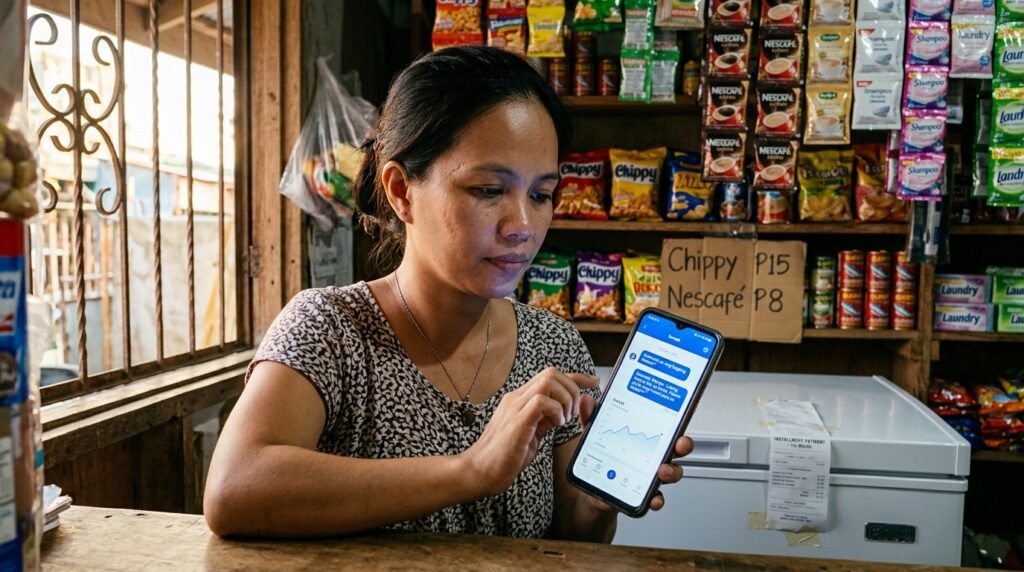
Joy runs a sari-sari store on a side street in Davao City. Most of her suppliers now take GCash, and so do half her customers. At the end of a good month she has a few thousand pesos sitting in her wallet that she does not need right away. For years her question was always the same: should that money just sit there, or should it go somewhere that earns?
Before March 2026, getting an answer meant asking a cousin, scrolling a Facebook group, or reading fund pages written in English and full of terms like risk profile and net asset value per share. Usually she gave up and left the money where it was. Nothing was wrong with that choice. It just was never really a choice.
Now she opens GCash, goes to the Invest section, and taps the Pera Coach banner. She types her question in Cebuano, one of the languages GCash listed at launch alongside English, Tagalog and Hiligaynon. The coach asks what the money is for, when she might need it, and how she would feel if its value dropped for a while. GCash says the coach tailors its replies to what a user wants to achieve, what she can afford, and how much risk she can live with. It explains the difference between a savings account and a fund in her own language, in seconds, for free.
To get there, Joy had to be a Filipino citizen, at least 18, and fully verified. GCash’s help page adds that, for now, only select users get it. Before she typed anything, the terms told her not to share personal or sensitive information, that GCash reviews conversations to improve its products, and that the coach “is not an investment adviser.”
Here is the part the launch story leaves out. The week before, Joy bought a chest freezer for the store on an installment plan inside the same app. That was the decision where the interest math actually mattered. Pera Coach was not on that screen. Joy is a composite, but every rule she ran into is GCash’s own.
The problem GCash named, and the one it filed
GCash announced Pera Coach in March 2026, billing it as “the Philippines’ first AI-powered financial coach embedded in an e-wallet” and crediting Microsoft’s support. The launch release leaned on one statistic. It came from the Bangko Sentral ng Pilipinas’ 2021 Financial Inclusion Survey, where just 2 in every 100 adults got a perfect score on six simple money questions. Microsoft Philippines country general manager Jonathan Que framed the goal as putting a personal coach in every user’s hands, “from the sari-sari owner in Davao to the OFW family in Pampanga.”
Three months later, Mynt, the company behind GCash, filed its preliminary IPO prospectus. Pera Coach appears there too, but in different company. It is listed under a plan to use generative AI “to scale customer assistance and financial literacy,” next to Gigi, the support assistant. Elsewhere, the same prospectus describes the growth plan for savings, investment and protection products in plain commercial terms. GCash can “surface these products contextually within the GCash App and cross-sell them to engaged payment and credit users.”
Both descriptions are true. The question is which one explains the design. The best way to find out is to map where the pressure on GCash actually comes from, then check whether the product answers the strongest pressure or a weaker one.
| Where is the pressure coming from? | Intensity (Low to High) | Why? |
| Demanding Shareholders | Low ○○○○● High High | Existing holders are selling 6.42 billion of the 8.03 billion firm shares in a PSE IPO of up to ₱92.3 billion, while revenue growth slowed from 47.2% in 2025 to 14.8% year on year in Q1 2026. |
| Growth-driven Leadership | Low ○○○●○ High Medium-High | Mynt’s prospectus commits to cross-selling savings, investment and protection products to engaged users, yet the app had enabled only 9.0 million users to invest in managed funds, against 40.4 million monthly active users. |
| Changing Environment | Low ○○●○○ High Medium | The BSP gave e-wallets 48 hours in August 2025 to delete online gambling links, and Globe’s equity share in Mynt needed a 120% quarter-on-quarter rebound to reach ₱1.9 billion in Q1 2026. |
| Competition | Low ○●○○○ High Low-Medium | Maya, GCash’s main e-wallet rival, reported 10.7 million bank customers and a ₱1.7 billion profit for 2025 but uses AI mainly behind the scenes in lending, payments and fraud, and BPI’s BEA Chat is a support assistant. |
| Demanding Customers | Low ○○●○○ High Medium | In the BSP’s 2021 survey, 54% of adults said they wanted financial literacy training but only 7% had attended any, and just 30% answered the interest question correctly. |
| Demanding Stakeholders | Low ○●○○○ High Low-Medium | The BSP’s AI guidance, Memorandum M-2026-031 issued in June 2026, is voluntary and non-binding, so no regulator requires an AI literacy tool or sets rules specific to one. |
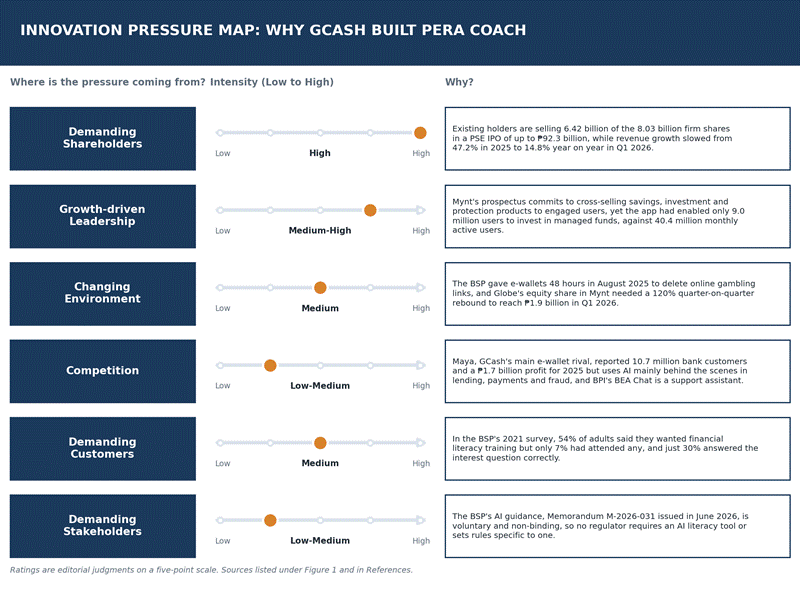
Figure 1. Pera Coach Innovation Pressure Map. Ratings are editorial judgments on a five-point scale; each marker sits on a discrete position. Sources: Mynt preliminary prospectus summary (June 29, 2026); Mynt newsroom; Globe 1Q26 results; BSP 2021 Financial Inclusion Survey; Philstar; InsiderPH; GMA News; Baker McKenzie; BPI.
The two top rows point at the same problem. GCash’s payments machine is enormous, and its growth is slowing. Mynt’s adjusted revenue rose 61.1% in 2024 and 47.2% in 2025, reaching ₱79.7 billion, with ₱17.2 billion in net income. In the first quarter of 2026, revenue grew 14.8% from a year earlier. That quarter still produced ₱5.6 billion in profit, and Globe reported a record ₱22.4 billion Mynt revenue quarter in Q2. This is not a company in trouble. It is a company whose next leg of growth has to come from somewhere other than moving money.
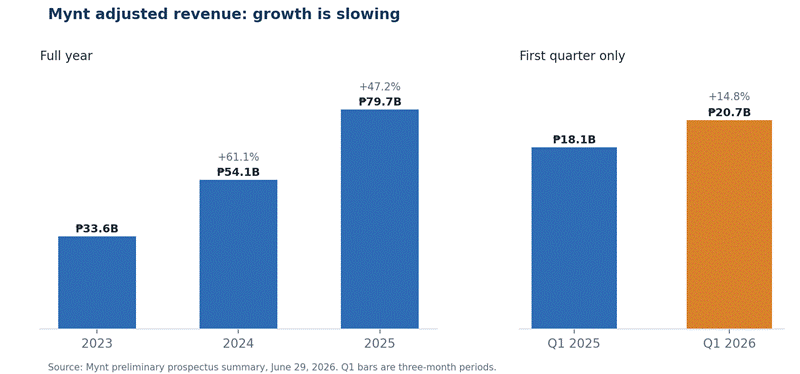
Figure 2. Mynt adjusted revenue, ₱ billions. Year-on-year growth shown above each later bar. Q1 figures are three-month periods and are not comparable in size to full-year bars. Source: Mynt preliminary prospectus summary, June 29, 2026.
That somewhere is written into the prospectus: lending and wealth. GCash reported 40.4 million monthly active users in the first quarter of 2026, almost 55% of Philippine adults. By the prospectus count, the app had enabled 9.0 million users to invest in managed funds and 1.9 million to access the stock market. The gap between those numbers is the real market Pera Coach was built for. The literacy statistic explains why the gap exists. It does not explain why GCash built this product now.
Two rows are rated low on purpose. Competition is Low-Medium because we found no Philippine rival offering a comparable money coach inside a wallet of this size. Stakeholder pressure is Low-Medium because the BSP’s June 2026 AI guidance is voluntary. Neither rating is settled. If Maya’s planned US listing goes ahead with an AI coaching feature, or if the BSP turns its STARS principles into a binding circular, both rows would move up. The Customers row is the least certain. The need is well documented. The demand for an AI coach specifically is not, because GCash has not published how many people use it.
Four ways to read Pera Coach
There are at least four honest explanations for why GCash built this product. Each one predicts a different row on the map should be highest. The evidence supports some of them far better than others.
Reading one: a literacy mission. This is the press-release version. If it were the main driver, the Customers and Stakeholders rows would carry the most weight, and the product would go wherever the literacy gap is widest. The evidence is mixed. The need is real. In 2021 only 30% of adults answered the BSP’s interest question correctly, and only 42% understood how inflation erodes purchasing power. The BSP’s 2025 Consumer Finance and Inclusion Survey, released in April 2026, found 74% getting at least half the questions right, up from 69% in 2021. But a pure literacy tool would not be gated to fully verified users, rolled out selectively, and placed behind the investment tab. This reading explains the marketing. It does not explain the placement.
Reading two: an AI story for the IPO. If this were the driver, the Shareholders row would dominate and the product would be timed to the listing. The timing fits. Pera Coach launched in March. Mynt filed its registration statement on June 27. More than 20 cornerstone investors, including BlackRock and the International Finance Corporation, committed in September. The prospectus uses Pera Coach as evidence of an AI capability. Still, a product built only for the roadshow would not need four languages and a working risk-profile conversation. This reading explains the timing, not the substance.
Reading three: a contextual cross-sell engine. If this were the driver, Leadership and Shareholders would both be high, and the product would sit exactly where users are one tap from buying. That is where it sits. The help page tells users to find Pera Coach under GInvest. Mynt’s own launch post names the Invest tab, and the wire version adds Save. The conversation it runs, about goals, affordability and tolerance for loss, is the same sequence any investment platform runs before it suggests a product. The prospectus uses the word “contextually” for exactly this. Of the four readings, this one matches the most evidence.
Reading four: a competitive response or a cost play. If Pera Coach were a reaction to rivals, the Competition row would be high. It is not. Maya, which booked its first full-year profit in 2025, describes its AI as plumbing for lending decisions, payments, savings and fraud detection, not as a customer-facing money coach. BPI’s BEA Chat, updated in August 2025, is a support tool that also answers questions on investments and remittances. Neither is a close copy. The cost-saving version also fails. GCash already has Gigi for support, which the prospectus says handled more than two million inquiries in Q1 2026 with a 91% fully automated resolution rate. Pera Coach is not the cost tool. That reading is ruled out.
So the best-supported answer is a blend of readings two and three. Pera Coach is a cross-sell engine built to widen the wealth funnel, launched at a moment when the shareholder story needed that funnel to look wide. Literacy is the language it speaks, not the pressure it answers.
Where the coach sits, and where the mistakes happen
The funnel view makes the design choice visible. Every count in the chart comes from the same prospectus. Users can hold several products, so the bars overlap rather than stack.
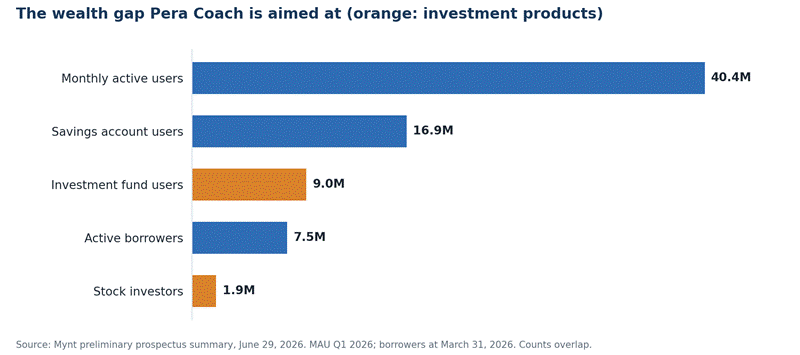
Figure 3. GCash users by product, millions. Monthly active users are for Q1 2026 and active borrowers are as of March 31, 2026; savings, fund and stock counts are users the app has enabled, as reported in the prospectus. Counts overlap. Source: Mynt preliminary prospectus summary, June 29, 2026.
Look at where the money decisions carry the most risk. GCash counted 7.5 million active borrowers at March 31, 2026. Its lending book grew at a 71.3% compound annual rate from 2023 to 2025. The non-performing loan ratio stood at 5.1%. Net interest margin after losses was 23.4%. That is a profitable book, and it is profitable in part because borrowing is where small misunderstandings about interest become expensive. The BSP’s 2021 survey found interest calculation was the single weakest literacy skill.
Get the next SEA banking case study in your inbox
Free. Unsubscribe anytime.
Pera Coach, as published, is not in that flow. GCash’s launch materials and help page route users through its investment section, and in one version its savings section too. GCash’s September messaging did move toward everyday decisions. One example question it promoted was whether to check out a purchase or check your balance first. But the published entry point is still the wealth section. A user who only ever pays bills, sends money and takes a loan may never see the banner.
This is the core fragility. The strongest pressures on the map are growth and the IPO, and the product answers them well. It meets users who are already curious about investing and walks them toward a decision. The literacy pressure GCash advertised is weaker on the map, and the product answers it only for people who were already heading to the right tab. A coach built for literacy would sit where the costliest mistakes happen. This one sits where the next product sale happens.
That is not unique to GCash. The same tension showed up in our look at how Sun Life removed the medical exam but kept the sales call: a genuine convenience for the customer, placed exactly at the point of purchase. Education and distribution are hard to separate in financial services. The honest move is to say which one comes first.
The IPO math the coach has to support
The offer terms show why the wealth funnel matters so much right now. The deal tops out at ₱10 a share. At that price, 8.03 billion firm shares plus an overallotment of 1.2 billion more would raise as much as ₱92.3 billion. Of the firm shares, 6.42 billion, or 80%, are secondary shares sold by existing holders. Only 1.61 billion are new shares. Most of the money goes to current owners, not into GCash.
At the ₱10 ceiling, the 66.9 billion shares outstanding after the offer would value Mynt at about ₱669 billion. That is roughly 39 times 2025 net income. Pricing is set for October 1. Retail and institutional orders close on October 12, and the stock is slated to debut on October 20. Every peso below the ceiling lowers that multiple. But at any price near the top of the range, buyers are paying for growth that payments alone no longer deliver at the 2025 pace.
There is also a feedback loop worth noticing. PSE president Ramon Monzon has said he expects a significant jump in new retail investors, and GCash users can order the shares through GStocks without leaving the app. GCash is about to ask millions of users to consider buying a stock, possibly for the first time, through the same app where its AI coach explains risk appetite. The terms say the coach is not an investment adviser. The context will make that line matter more than usual.
Regulation adds a softer edge. The BSP ordered e-wallets in August 2025 to delete links to online gambling platforms within 48 hours. Globe’s equity share in Mynt was weak enough in the fourth quarter that its ₱1.9 billion in Q1 2026 counted as a 120% quarter-on-quarter rebound. Whatever the exact cause, that episode showed how fast a revenue line can close on a regulator’s word. Wealth and lending products are the lines GCash controls more directly. Pera Coach feeds them.
What is working, and what is overhyped
Credit where it is due. Pera Coach gets several things right that most bank chatbots in the region do not.
Language is a real advantage. Supporting Cebuano and Hiligaynon, not just English and Tagalog, fits a user base where 78% live outside Metro Manila and 92% belong to lower-income groups, according to Mynt. A fund page in English was a barrier. A conversation in Bisaya is not.
The framing is honest about limits. The terms say the coach may be inaccurate, is not an investment adviser, and should not receive sensitive personal information. Those are the right warnings. They also shift the risk onto the user, which is worth noting.
The distribution is unmatched. No other Philippine provider can put an AI coach in front of 40 million monthly active users. The prospectus says GCash has four times the active users of its nearest competitor.
Now the overhyped parts. “First AI-powered financial coach embedded in an e-wallet” is a claim about packaging, not capability. A conversational layer on a foundation model is the easier kind of AI to copy. We made the same point about Malaysia’s Ryt AI: a chat interface is a good product, not a moat. GCash’s real moat is the data underneath, the GScore credit engine and the transaction history of 40 million users. Pera Coach sits on top of that moat. It is not the moat.
The literacy claim is also stretched. The launch leaned on a 2021 figure, 2% answering all six questions. A month later the BSP released its 2025 survey, which showed improvement. More importantly, a literacy tool should be measured by what users learn or do differently. GCash has not published a single outcome number. Not users, not conversations, not how many went on to open a fund. Until it does, “advances financial literacy” is a headline, not a finding.
A skeptical reader should still doubt two things. First, whether the coach treats third-party products and GCash’s own products evenly when it explains options. Nothing public says either way. Second, whether conversations reviewed “to improve products and services” will also train sales targeting. The terms allow product improvement. They do not describe limits on marketing use.
Three readers, three answers
For the customer: use it to understand, not to decide. This verdict ties to the Demanding Customers row, rated Medium. The need is real and the tool is free. Ask it what a term means, how a fund differs from a savings account, or what risk appetite means for your timeline. Do not treat its answers as a recommendation, because GCash says plainly they are not. Before any loan or installment plan, work out the total cost yourself. The coach is not in that screen yet.
For GCash’s strategy: good engine, wrong claim. This verdict ties to the Shareholders and Leadership rows, rated High and Medium-High. As a cross-sell engine, Pera Coach is well aimed. It meets curious users at the right moment and speaks their language. The risk is reputational. If the product is sold as literacy and later judged as sales, the gap becomes the story. The fix is cheap. Put the coach in the credit flows too, and publish outcome data. A version that explains a GGives installment before checkout would earn the literacy label.
For the regulator or analyst: ask for the numbers. This verdict ties to the Demanding Stakeholders row, rated Low-Medium. That rating is low only because the rules are voluntary today. Memorandum M-2026-031 sets principles of sustainability, transparency, accountability, responsibility and security. Circular 1160, which implements the Financial Products and Services Consumer Protection Act, already requires fair treatment, disclosure and data protection. The questions write themselves. How many users? How many went from a coach conversation to a product purchase? How does the coach present in-house products versus third-party ones? For an analyst pricing the IPO, the same questions apply. Pera Coach is described as a growth asset. It has no disclosed growth metric.
The pressure map also says where to look next. If Q3 results show wealth-product users climbing faster than monthly active users, the cross-sell reading is confirmed and the coach is doing its job. If the BSP converts its AI principles into a binding rule, the Stakeholders row moves up and GCash will have to show the outcome data it has not shared.
Workshop: find the tab your product really lives in
Pera Coach is a clean example of a common pattern. A product is announced for one pressure and placed for another. Run these three questions on your own product, feature, or initiative. Then fill in the blank map, with at least one low rating.
| # | Question | Ask yourself |
| 1 | Where does the user actually meet it? | List the exact screens or moments where your product appears. Is that where the costliest customer mistake happens, or where the next sale happens? Your answer: |
| 2 | Which pressure row is highest, and does your launch message name it? | Compare your top-rated pressure with the problem your announcement claims to solve. Write down the gap in one sentence. Your answer: |
| 3 | What number would prove it works? | Pick one outcome metric you would publish, such as users, behavior change, or conversion. If you would not publish it, ask why. Your answer: |
Your Innovation Pressure Map
| Where is the pressure coming from? | Intensity (Low to High) | Why? |
| Demanding Shareholders | Low ○○○○○ High | |
| Growth-driven Leadership | Low ○○○○○ High | |
| Changing Environment | Low ○○○○○ High | |
| Competition | Low ○○○○○ High | |
| Demanding Customers | Low ○○○○○ High | |
| Demanding Stakeholders | Low ○○○○○ High |
If your highest-rated row does not match the problem your launch message names, that is not automatically a failure. It is a signal to say so out loud, before a customer, regulator, or investor says it for you.
IdeyaHub newsletter
Enjoyed this case study?
Get the next deep dive on Southeast Asian banks, fintechs and insurers in your inbox. One email a week.
Free. Unsubscribe anytime.
References
- GCash launches “Pera Coach”, Philippines’ first AI-powered financial coach embedded in an e-wallet to strengthen financial literacy, Mynt Newsroom
- Ph fintech GCash launches country’s first AI financial coach embedded in e-wallet to strengthen financial literacy, PR Newswire APAC
- What is Pera Coach?, GCash Help Center
- Pera Coach Terms and Conditions, GCash
- GCash advances financial literacy through in-app AI-powered ‘Pera Coach’, GMA News Online
- Mynt Preliminary Prospectus, Summary (June 29, 2026), Mynt Inc.
- GCash parent Mynt submits SEC registration statement, PSE listing application for proposed IPO, Mynt Newsroom
- GCash parent Mynt secures commitments from global and local cornerstone investors for proposed IPO, Mynt Newsroom
- All set for P92-B GCash IPO in Oct, Inquirer Business
- Globe 1Q 2026 Financial and Operating Results, press release, Globe Telecom
- Globe 2Q 2026 Financial and Operating Results, press release, Globe Telecom
- 2021 Financial Inclusion Survey, Topline Report, Bangko Sentral ng Pilipinas
- BSP survey shows gains in youth and women’s financial access, formal lending, financial literacy, Philippine Information Agency
- BSP orders e-wallets to remove online gambling links, Philstar.com
- BSP lays down rules on AI use to guide banks, financial institutions, GMA News Online
- Philippines: BSP releases AI governance framework, Baker McKenzie
- Bangko Sentral amends regulations on financial consumer protection, ACCRALAW
- Maya posts P1.7 billion profit in 2025, Philstar.com
- Maya showcases how AI-first banking drives wider financial access, InsiderPH
- Philippine “Revolut” Maya eyes up to $1 billion US listing, Finance Magnates
- BPI enhances BEA Chat with smarter, AI-powered features for customer support, BPI