
Singapore savers could already buy gold on a banking app at any hour, from a third of a gram. DBS’s new token is less about opening that door and more about what sits behind it: a wealth ladder, a fee engine, and a set of blockchain rails that need retail traffic.
| DBS’s Physical Gold Token solves an access problem Singapore had largely solved already, which makes it a weak retail breakthrough and a sharp, quiet bet on DBS’s own wealth ladder and tokenisation rails. 1. The door was already open. OCBC has let app users buy gold around the clock from 0.01 ounce since October 2021, and its gold and silver investors grew 2.5 times in 2025, so “broadening access” describes a market that was already accessible. 2. The pressure that built it sits inside DBS’s income statement. In the first half of 2026, DBS’s net interest income fell 3% while fee income climbed 20% to a record SGD 2.94 billion, and a product that turns retail savers into holders of an in-house wealth asset fits that shift exactly. 3. The weak points are the ones DBS has not disclosed. The June 2026 announcement named no spread, fee or minimum, while the closest precedent, HSBC’s Hong Kong gold token, charges margins of up to 2% in trading hours and up to 5% outside them and never lets holders take delivery. To see why the gap between the pitch and the purpose matters, start with one saver and one gram. |
Wei Ling is 31, a physiotherapist in Tampines, and she wants to put about S$200 a month into gold. In 2025 her choices at Singapore’s big banks looked like this. UOB’s Gold Savings Account wanted 5 grams to start, roughly S$1,000 at mid-2026 prices, and traded only on weekdays from 8am to 11pm. If she ever wanted metal in her hand, she would book an appointment at UOB’s main branch at 80 Raffles Place and convert in 100-gram cast bars, paying a S$100 fee per 100-gram bar. OCBC’s app let her start with 0.01 ounce, about 0.31 grams, at any hour. But what she bought was paper gold. OCBC’s own terms say plainly that she would never hold physical metal.
Now imagine her in late 2026 with DBS digibank, the app her salary already lands in. She opens it on a Sunday night. She buys a fraction of a DBS Physical Gold Token. Behind every whole token sits one gram of gold, stored in a vault DBS keeps for this purpose in Singapore. The trade settles almost instantly. If she ever wants the metal, the token can be redeemed for it. She did not open a new account, book an appointment or wait for Monday.
That is a real improvement in one specific way. She gets allocated, redeemable gold in a small size, at any hour, inside an app she already uses. What she still cannot see is the price of the trade itself. DBS has not published the spread. And the gold she is buying was trading near USD 4,491 an ounce in early September 2026, about 20% below the USD 5,600 peak DBS cited when it announced the product in June.
The problem DBS actually had
DBS announced the token on 11 June 2026 as a way to “broaden access” to gold, an asset it had offered only to wealth clients since 2013. The release billed it as a Singapore first: one platform where customers can buy, keep and sell gold that has been tokenised. That claim holds, but only because of the word “tokenised.” Access to gold on a phone was not the missing piece.
OCBC started digital gold and silver trading on its app in October 2021. In 2025 alone, the number of OCBC customers putting money into gold and silver there rose 2.5 times. UOB runs a Gold Savings Account on its TMRW app. Singapore’s retail saver already had cheap, small, app-based gold. What she lacked was a bank-issued token tied to specific bars in a Singapore vault with a redemption right. That is a narrower gap, and it is not obviously the one retail savers were asking to close.
So what was DBS solving for? Its own numbers point somewhere else. Rates fell, and the bank’s core engine slowed. Group net interest income dropped 3% to SGD 7.08 billion in the first half of 2026, and the margin lost 20 basis points, ending at 1.88%. Over the same six months, fee income climbed 20% to SGD 2.94 billion, and wealth management fees hit a record SGD 1.83 billion. In the second quarter alone, wealth fees grew 42% to SGD 919 million. Wealth assets under management rose to SGD 516 billion.
The bank’s growth story has moved from lending spread to wealth fees. The gold token fits that story better than it fits the access story. It gives a mass-market customer a first wealth product that is simple, tangible, and fully built and held by DBS.
DBS Physical Gold Token: Innovation Pressure Map
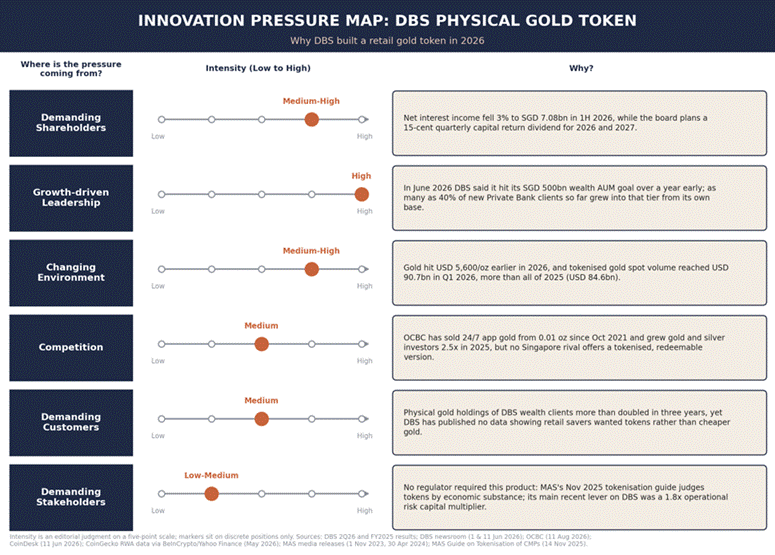
Figure 1. Innovation Pressure Map for the DBS Physical Gold Token.
Source: DBS 2Q26 results press statement; DBS FY2025 results release (9 Feb 2026); DBS newsroom releases of 1 Jun 2026 and 11 Jun 2026; OCBC media release, 11 Aug 2026; CoinDesk, 11 Jun 2026; CoinGecko RWA data reported by BeInCrypto via Yahoo Finance, May 2026; MAS media releases of 1 Nov 2023 and 30 Apr 2024; MAS Guide on the Tokenisation of Capital Markets Products (published 14 Nov 2025). Intensity ratings are editorial judgments on a five-point scale.
Two of these ratings are soft. Demanding Customers could move up to Medium-High if DBS publishes early uptake figures that show retail demand for the token specifically, not for gold in general. Changing Environment could move down if gold keeps sliding from its peak, since the price boom was part of the case for launching now. The top of the map is firmer. Leadership and shareholder pressure both rest on audited, published numbers.
The ranking matters. The press release speaks to customers. The map says the heaviest pressure came from inside the building.
Three ways to read a gold token
There are three credible readings of why DBS built this. Each one predicts a different row at the top of the map.
Reading one: DBS is democratising gold. This is the press release reading. If it were the main driver, Demanding Customers should be the highest pressure, with visible unmet demand from ordinary savers. The evidence does not support that. The ordinary saver already had OCBC from 0.31 grams, around the clock, since 2021. The growth DBS cites, gold holdings more than doubling, came from wealth clients who already had access. Democratisation is a benefit of the product. It is not a convincing reason for it.
Reading two: DBS is riding the gold boom. Here the prediction is that Changing Environment and Shareholders sit on top. The price case was strong in June. Gold had hit USD 5,600 earlier in the year, and tokenised gold had just logged a single quarter of trading larger than all of 2025. DBS also has a clear appetite for trading income: its Markets unit grew trading income 12%, to SGD 469 million, in the second quarter of 2026 as volatility picked up. But a pure boom play would have launched fast and simply. DBS instead chose the slowest, most capital-heavy route: its own vault, its own tokenisation, its own custody, its own distribution. It also launches months after the peak. Boom-chasing explains the timing of the announcement. It does not explain the architecture.
Reading three: DBS is building a ladder and a rail. This reading predicts Growth-driven Leadership on top, which is where the evidence puts it. Three facts line up. First, DBS says as many as 40% of its new Private Bank clients so far were existing customers who grew into that tier, and it is opening 18 new wealth centres across six markets by the end of 2027. A gram-sized, app-based gold token is a bottom rung on that ladder. Second, the token is built end to end in-house. Li Zhen, who heads FX, precious metals and digital assets at DBS, framed the launch around the bank’s “fully in-sourced, end-to-end” capability. Third, DBS is already exploring a listing of the same token on DBS Digital Exchange for accredited and institutional investors. One asset, issued once, would then serve a retail saver in digibank and an institution on an exchange.
The third reading survives because it explains both the design and the timing. The first reading describes who benefits. The second explains the headline. The third explains why DBS built it this way.
What the token plugs into
The product only makes full sense when three threads are pulled together: the mechanics, the competitive field and the income statement.
The mechanics. One gram of physical gold, held in Singapore by DBS, sits behind each token. Holders can buy fractions. Trading runs 24/7 with atomic settlement, meaning the token and the cash move in the same instant. The token can be redeemed for physical gold. DBS handles vaulting, tokenisation, issuance, custody and distribution itself. None of that is new to DBS in isolation. It has held physical gold for wealth clients since 2013. In 2025 it issued a tokenised structured note on the public Ethereum blockchain and listed Franklin Templeton’s sgBENJI token and Ripple’s RLUSD stablecoin. The gold token joins these pieces into one retail product.
The competitive field. Put the four closest bank products side by side and DBS’s real differentiator becomes clear.
Get the next SEA banking case study in your inbox
Free. Unsubscribe anytime.
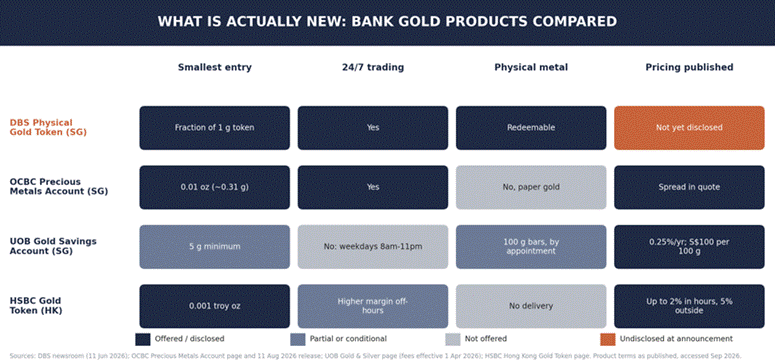
Figure 2. Bank gold products compared on the four features DBS leads with.
Source: DBS newsroom, 11 Jun 2026; OCBC Precious Metals Account product page and OCBC media release, 11 Aug 2026; UOB Gold & Silver product page (service charge effective 1 Apr 2026); HSBC Hong Kong Gold Token product page. DBS pricing had not been published at announcement. Terms as published, accessed September 2026.
Speed and small size are not unique to DBS. OCBC already matches both. Redemption into metal, in small units, inside a mass-market app, is the true differentiator. It is also the most expensive feature to run, because it needs real bars, a real vault and real logistics. HSBC, whose gold token was Hong Kong’s first retail product built on distributed ledger technology, chose not to offer it at all.
This is a pattern IdeyaHub has tracked before. In Visa Doesn’t Want Your Business. It Wants to Be Underneath It., the product that mattered was the shared settlement layer, not the consumer-facing feature. DBS is running a version of the same play inside one bank. The token is the visible feature. The in-house tokenisation stack is the layer underneath. That stack is also moving on other fronts. On 5 September 2026 DBS and Citi executed a weekend cross-border USD payment with tokenised deposits on Swift’s ledger. On 10 September, DBS, OCBC and UOB announced Singapore’s first live interbank SGD transactions using tokenised deposits on the same ledger.
The income statement. Here is where the threads meet. DBS earned SGD 11.0 billion in 2025, down 3%, as its margin compressed to 2.01%. Wealth management fees were the bright spot, up 29% to SGD 2.81 billion. The 2026 pattern is sharper. Second-quarter net interest income fell 2% while wealth fees rose 42%. For a bank whose board plans a 15-cent capital return dividend every quarter through 2027, fees are no longer a side line. They are how the dividend stays funded while rates fall.
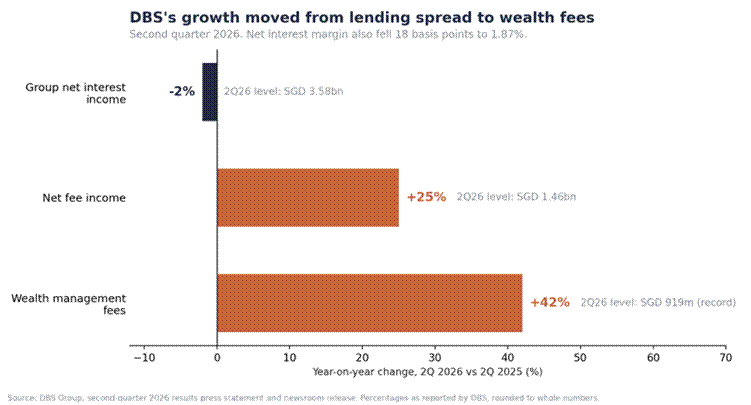
Figure 3. DBS second-quarter 2026 income lines, year-on-year change.
Source: DBS Group, second-quarter 2026 results press statement and newsroom release (‘DBS second-quarter net profit up 9% to record SGD 3.08 billion’). Growth rates are as reported by DBS in whole percentages; no values were estimated.
A retail gold token will not move those numbers on its own. First-half wealth fees were SGD 1.83 billion. Even a popular gold product at retail ticket sizes of a few hundred dollars would be a small slice of that. The value is not in the token’s own spread. It is in what the token does to the customer. A saver who holds DBS gold is now a DBS investment customer, with a holding the bank custodies, prices and can later offer more products around. That is the bottom rung of the ladder that has delivered up to 40% of DBS’s new Private Bank clients.
So does the design answer the strongest pressure on the map? Mostly, yes. The in-house build, the exchange listing plan and the digibank distribution all serve leadership’s wealth-ladder and platform goals. The weaker match is on the customer row. The feature DBS leads with, 24/7 fractional trading, is one customers already had. The feature that is new, physical redemption, is the one DBS has said least about: no minimum redemption size, no fee, no timeline.
Where the model could crack
A skeptical reader should hold five doubts until DBS publishes more.
Pricing is the whole product, and it is missing. The June announcement disclosed no spread, fee or minimum. That matters because a closed-loop token is only as cheap as the issuer decides. HSBC’s gold token caps its margin at 2% during London and Hong Kong trading hours and 5% outside them. On a S$1,000 purchase, a 2% margin is S$20 gone before the gold price moves at all. At 5%, it is S$50. If DBS prices its weekend and overnight trades the way HSBC does, “24/7” may mean “available at a worse price.”
A token that cannot leave is a deposit with extra steps. DBS has not said whether holders can transfer tokens to other banks, wallets or platforms. If they cannot, the blockchain adds little that a well-built ledger entry would not. The holder’s exit is to sell back to DBS or redeem for metal. Open tokens show the alternative: CoinGecko data reported in May 2026 put the market value of tokenised commodities at USD 5.55 billion, with spot trading of tokenised gold concentrated in PAX Gold and Tether Gold. DBS’s token is a different animal. That is safer for retail, but it weakens the case that tokenisation itself is the benefit.
Always-on trading runs into a resilience record. MAS imposed a 1.8x multiplier on DBS’s operational risk-weighted assets after disruptions in March and May 2023. In November 2023 it went further and paused DBS’s non-essential IT changes and new business ventures for six months. MAS let the pause lapse on 30 April 2024 but said the multiplier would stay until DBS showed it could hold service availability. On 19 March 2026, digibank, POSB digibank and PayLah! went down again before recovering by 1:19pm. A product sold on round-the-clock access to a volatile asset raises the cost of every outage. IdeyaHub’s case on PBCOM Fixed Its Core Banking System. Its App Still Gets 3.3 Stars. made the same point from the other direction: back-end upgrades do not count for much if the front door fails at the moment a customer needs it.
The launch arrives after the peak. DBS pointed to gold’s USD 5,600 high when it announced the token. By early September gold traded near USD 4,491. A retail saver’s first experience of a new product is often the price chart since she bought. If early buyers are underwater, the ladder stalls at the first rung.
The regulatory frame is unstated. MAS’s Guide on the Tokenisation of Capital Markets Products, published on 14 November 2025, classifies tokens by the rights they carry, not the technology they use. A token that represents allocated physical gold may sit outside the capital markets product regime altogether. DBS has not said which consumer protections apply to holders. For a product aimed at first-time investors, that silence is a gap worth closing before launch.
What is working deserves equal weight. Allocated, redeemable gold in gram-sized units inside a mass-market app is a real product improvement over paper gold. DBS has the balance sheet, the vault and the custody record to run it without a partner, which removes a layer of counterparty risk. Its first-half return on equity of 17.5% and a non-performing loan ratio of 1.0% mean the bank can fund a slow-burn platform bet without stress. And its digital assets track record is not theoretical: Euromoney reports that trading volumes by DBS’s wealthy clients in digital assets were up fivefold in 2025 compared with 2023.
One token, three answers
For the retail saver, the verdict is a conditional yes. Buy it for the right reason. The token’s clear advantage over OCBC’s paper gold is redemption into metal. Its clear advantage over UOB’s account is small size and round-the-clock trading. Neither advantage is worth much if the spread is wide. Wait for the published price schedule, compare it with OCBC’s live quote on the same trade, and check whether weekend pricing differs from weekday pricing. This verdict ties to the Demanding Customers row, which is only Medium for a reason: the product answers some customer needs, not a pent-up demand.
For DBS’s own strategy, the verdict is positive, with a caveat. The token answers the High-rated leadership pressure well. It adds a low-ticket rung to a wealth ladder that has fed up to 40% of new Private Bank clients, and it proves an in-house tokenisation stack on a retail product before listing the same asset on DDEx. The caveat is that the proof depends on retail traffic. If pricing is steep or the first buyers lose money, the rung sits empty and the rail carries little. The bank should measure success by how many token holders buy a second DBS wealth product within a year, not by token volume.
For MAS and outside analysts, the verdict is watchful. The Demanding Stakeholders row is Low-Medium because nobody asked DBS for this. That means the protections around it are whatever DBS chooses to disclose. Analysts should ask for three numbers once the product is live: token holders, redemption requests, and average effective spread. Regulators should ask which rulebook covers a retail gold token that trades 24/7 and redeems into metal. They should also ask how DBS keeps pricing fair on the weekend, when outside benchmark prices are thin.
Before you tokenise anything
The DBS case shows a pattern that repeats across banks and fintechs. A launch is sold on the customer row of the map. The real driver sits higher up. Use the questions below on your own product, feature or initiative before it goes out the door.
| # | Question | Your answer |
| 1 | What can your customer do with this product that they could not already do with the best rival option? Write only the difference, not the full feature list. | |
| 2 | Which pressure row is really rated highest for your organisation, and does the feature you are leading with answer that row or a weaker one? | |
| 3 | What single number, once published, would prove or disprove your launch story, and are you willing to publish it? |
Then rate your own pressures. Leave at least one row low if the evidence says so.
Your Innovation Pressure Map
| Where is the pressure coming from? | Intensity (Low to High) | Why? |
| Demanding Shareholders | ||
| Growth-driven Leadership | ||
| Changing Environment | ||
| Competition | ||
| Demanding Customers | ||
| Demanding Stakeholders |
If your top-rated row and your launch headline point at different people, you are not in trouble. You just need to be clear inside the building about who the product is really for.
IdeyaHub newsletter
Enjoyed this case study?
Get the next deep dive on Southeast Asian banks, fintechs and insurers in your inbox. One email a week.
Free. Unsubscribe anytime.
References
- DBS expands gold offerings with market-first tokenised physical gold for customers in Singapore, DBS
- Singapore bank DBS to offer tokenized gold to retail customers, CoinDesk
- DBS to launch tokenized physical gold for Singapore retail investors, Ledger Insights
- DBS brings tokenised physical gold to the mass market in Singapore, Private Banker International
- DBS second-quarter net profit up 9% to record SGD 3.08 billion as quarterly total income crosses SGD 6 billion for first time, DBS
- DBS Second-quarter 2026 results press statement, DBS
- Full-year profit before tax at record SGD 13.1 billion, net profit at SGD 11.0 billion with ROE at 16.2%, DBS
- DBS to launch 18 new wealth centres across the region by 2027 as affluent clients seek closer relationships, DBS
- OCBC Precious Metals Account, OCBC
- Platinum and palladium now on the OCBC app, OCBC
- Gold & Silver: UOB Gold Savings Account, UOB
- HSBC Gold Token, HSBC Hong Kong
- HSBC’s Gold Token Goes Live for Retail Investors in Hong Kong, CoinDesk
- Tokenized Gold Crosses 2025’s Full-Year Volume in Just 1 Quarter, BeInCrypto via Yahoo Finance (CoinGecko RWA data)
- Current price of gold: September 3, 2026, Fortune
- MAS Imposes Six-Month Pause on DBS Bank’s Non-Essential Activities as Bank Restores System Resilience, Monetary Authority of Singapore
- MAS Will Not Extend Six-Month Pause on DBS Bank’s Non-Essential Activities, Monetary Authority of Singapore
- DBS Restores Digital Banking Services After First Outage of 2026, Fintech News Singapore
- Singapore: MAS publishes guide on tokenisation, Baker McKenzie
- Guide on the Tokenisation of Capital Markets Products, Monetary Authority of Singapore
- DBS and Citi partner to enable instant 24/7 cross-border USD payments with tokenised deposits, DBS
- DBS, OCBC and UOB complete first live blockchain-enabled SGD transactions on Swift’s ledger, DBS
- The world’s best for digital assets 2026: DBS Private Bank, Euromoney