Its new business app digitizes checks instead of killing them. That’s a sharper read of its own customers than most digital banks manage — and a bet against where the rest of the country’s payments are headed.
| Chinabank’s new business banking platform isn’t a niche bank discovering a market. It’s a 106-year-old niche bank finally building the digital plumbing its original customer already needed. 1. A market it never had to find. Chinabank was built in 1920 to lend against the trustworthiness of Manila’s Chinese-Filipino trading community rather than collateral, a model still visible in the ₱28 billion net income and ₱1.1 trillion loan book it posted for 2025, well ahead of any digital-only challenger bank in the country. 2. A product built around how that customer actually pays. My CBC Business, launched in August 2026, digitizes check issuance and post-dated check warehousing instead of retiring them, a bet that a payment habit still governed by a 1979 anti-bouncing-check law hasn’t disappeared just because InstaPay exists. 3. A moat the software itself doesn’t supply. The platform runs on technology licensed from a vendor that already serves other Philippine banks, launches months after the central bank reported PESONet overtaking check payments nationwide for the first time, and comes with no disclosed numbers on how many of Chinabank’s own business clients have actually moved onto it. Whether that adds up to a defensible bet on a specific, well-understood customer, or a century-old bank digitizing a habit the rest of the market is quitting, depends on a history most coverage of niche banking skips entirely. |
A textile importer in Binondo needs to pay four suppliers before Friday. Two want a post-dated check for next month, the way they’ve always been paid. One wants same-day pesos through InstaPay. One is owed a foreign-currency wire for a shipment clearing customs in Xiamen. Under the old way of doing this, that’s four separate errands, a signature stamp, a trip to the bank or a call to a relationship manager, and a checkbook that has to be reordered before it runs out. Under the way Chinabank is now selling it, all four happen from one login, on a phone, without anyone leaving the office.
That small scene is the entire argument behind My CBC Business, the digital cash management platform China Banking Corporation rolled out in August 2026 for its small business and corporate clients. It’s easy to read that launch as one more Philippine bank playing catch-up on features that GCash, Maya, and the digital-only challenger banks normalized years ago. That reading misses what actually makes this launch worth examining. Chinabank isn’t a digital bank trying to find a niche. It’s a 106-year-old niche bank finally digitizing the one it has always had. Understanding the difference between those two things is the whole point of this issue, and it’s the difference between judging My CBC Business as a feature update and judging it as a company protecting the only asset that actually matters to it.
The bank built for one customer, before “niche” was a category
Every niche digital bank this newsletter has covered so far picked its customer on purpose, recently. GXS Bank looked at Grab’s driver data and noticed a credit gap. Tonik looked at the roughly 90% of Filipinos without formal credit access and built two lending channels to reach them. Bank Jago noticed that one in five GoPay users had no bank account behind their digital life. Each of those is a company doing market research in the 2020s and finding a gap.
China Banking Corporation didn’t do market research. It was founded on August 16, 1920, in Binondo, Manila, by Dee C. Chuan and a group of Chinese-Filipino businessmen, for one explicit purpose: to serve a trading and merchant community that Manila’s existing Spanish- and American-run banks weren’t built to serve, and mostly didn’t want to. That’s not a mission statement written after the fact. It’s the reason the bank exists at all, more than a century before anyone started using the word “niche” to describe a fintech strategy.
The mechanism behind that niche is worth naming precisely, because it explains everything that follows. Chinese-Filipino trading families historically extended and received credit based on a concept usually rendered in English as reputation or trustworthiness, and known in the Fujianese-Hokkien dialect most of these families spoke as pinsin. A trader’s word, backed by a network of relationships built over years, functioned as collateral in a community where formal land titles and audited balance sheets weren’t always the currency of trust. Chinabank built its early lending book on exactly that currency. The cleanest illustration of it is also the most famous: in 1949, a 25-year-old shoe trader named Henry Sy received an unsecured ₱1 million loan from Chinabank, an enormous sum for the time, with nothing backing it except the bank’s judgment of his standing inside that trading network. Sy would go on to build SM into the largest retail and property conglomerate in the Philippines. His son Hans Sy now chairs Chinabank’s board. That loan wasn’t philanthropy. It was underwriting, just underwriting built on relationship data a generic collateral-based lender couldn’t see or price, which is precisely the argument GXS Bank makes about Grab’s ride-hailing data seventy-six years later, minus the app.
The point isn’t nostalgia. It’s that “underwrite the customer a mainstream bank’s paperwork can’t see, using a data source specific to one named community” is not a 2020s digital-banking invention. Chinabank was doing a version of it before the Philippines had a stock exchange building taller than four stories. What changed is the data source, not the underlying bet.
That original niche is also, on the numbers, still the bank’s core business. Chinabank closed 2025 with a record ₱28 billion in net income, up 13% year-on-year, on gross loans that crossed ₱1 trillion for the first time, up 13%, and total deposits of ₱1.4 trillion, up 9%. Return on equity came in at 15.6%, return on assets at 1.6%, with a cost-to-income ratio of 45% and a non-performing loan ratio of 1.6%, unchanged from the year before despite the faster loan growth. By 2023, independent measures already put Chinabank as the fourth-largest private universal bank in the country by assets. None of that scale or profitability is typical of a “niche” institution the way the term gets used for GXS Bank or Tonik, both of which are still working toward, or only just reached, sustained profitability on loan books measured in the low hundreds of millions of dollars. Chinabank’s niche has had a century to compound. That’s the asset My CBC Business exists to protect, not the market it’s trying to break into.
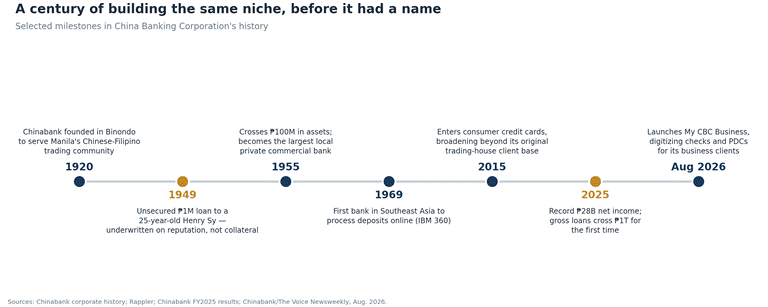
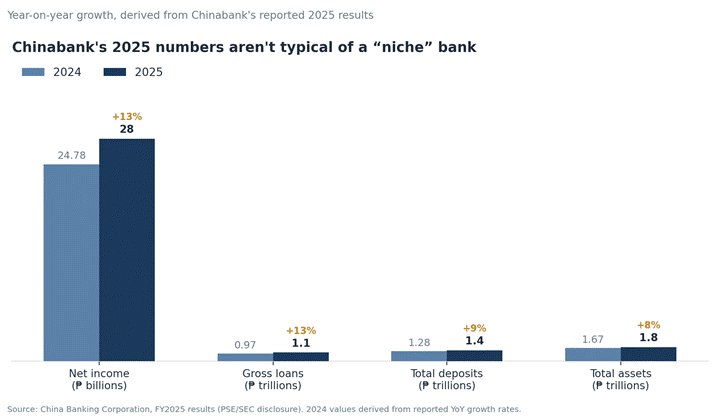
Figure 1. Chinabank’s 2025 results, and what they looked like a year earlier.
What My CBC Business actually does, and who it was actually built for
Strip away the launch language and My CBC Business is a fairly conventional corporate cash management platform, the same category BPI’s BizLink and BDO’s business cash management suite already occupy. It handles receivables and payables end-to-end, automates payroll, runs auto-debit and auto-credit arrangements, offers on-demand foreign currency trading for a business paying an overseas supplier, and moves domestic funds instantly through InstaPay and PESONet. Solutions Exchange Inc., a Manila-based fintech vendor that has built banking software for Philippine banks for more than two decades, supplied the underlying platform. Domingo Dayro Jr., who heads Chinabank’s Cash Management Services and Operations Group, framed the goal in the launch material as making “digital banking frictionless for our clients” so they can focus on expanding their businesses instead of managing the paperwork behind them. The platform replaces an older system, Chinabank Online Corporate, which is being phased out entirely once existing clients finish migrating.
None of that is where the interesting decision sits. The interesting decision is what Chinabank chose to build deeper into the platform rather than quietly retire: check services. My CBC Business includes self-service and outsourced check issuance, post-dated check warehousing, digital stop-payment orders, and online checkbook reordering. In a country where the central bank has spent years pushing businesses toward instant electronic transfers, building a more capable, more automated way to issue and store paper checks looks, on the surface, like investing in the wrong technology at the wrong moment.
It isn’t, and the reason it isn’t tells you more about who Chinabank actually serves than any press release does. Post-dated checks remain a genuinely widespread mechanism for extending short-term trade credit in Philippine commerce, not a habit clinging on by inertia. The practice is significant enough that it sits inside its own body of law: the 1909 Negotiable Instruments Law provides the underlying legal framework, and Batas Pambansa Blg. 22, passed in 1979, makes issuing a check that later bounces a criminal offense, specifically because post-dated checks function as a form of payment security in ordinary business dealings. A Filipino importer settling a 30-, 60-, or 90-day trade credit arrangement with a supplier by handing over a stack of post-dated checks isn’t doing something outdated. He’s doing something the country’s commercial legal code still takes seriously enough to criminalize getting wrong. Digitizing the issuance and warehousing of that instrument, rather than trying to talk a Binondo trading family out of decades of supplier relationships built around it, is a bet on how Chinabank’s actual customer transacts today, not on how a digital-native, urban, English-speaking fintech user in Manila or Cebu transacts.
Figure 2. What a Chinabank business client gets versus what its two largest competitors already offer.
| Capability | Chinabank (My CBC Business) | BPI BizLink | BDO cash management |
| Instant domestic transfers (InstaPay/PESONet) | Yes | Yes, PESONet free to non-BPI banks | Yes |
| Automated payroll processing | Yes | Not a headline feature | Available as a separate module |
| Foreign currency trading, on demand | Yes | Multi-currency support | Available, relationship-managed |
| Digital check issuance and stop-payment | Yes, self-service and outsourced | Mobile check deposit only | Not advertised as self-service |
| Post-dated check warehousing | Yes | Not offered | Not advertised |
| Liquidity sweep across accounts | Yes (Sure Sweep) | Not a headline feature | Available as a treasury service |
Read that table honestly and two things are true at once. On the modern treasury features, mobile-first InstaPay and PESONet transfers, FX trading, automated payroll, Chinabank isn’t ahead of BPI or BDO. It’s arriving at feature parity with two competitors that already had digital cash management platforms in the market. That’s a real and fair criticism: this is a bank catching up on basic table stakes, not leapfrogging the category. But on the specific instrument that matters most to Chinabank’s own historical customer base, checks and post-dated checks, it’s the only one of the three actually investing in making that instrument more capable rather than treating it as a shrinking legacy channel to be tolerated. That’s not innovation in the sense the word usually gets used for a fintech launch. It’s segmentation done correctly: building the feature your specific customer needs more of, even when the rest of the market has stopped building it at all.
The part the launch material leaves out
Here is where the story needs a harder look, because the positive read above is only half of it.
Start with the technology itself. Solutions Exchange Inc., the vendor behind My CBC Business, describes itself as a trusted partner to “some of the largest banks in the Philippines” for more than twenty years, building digital banking platforms and open banking APIs for corporate, SME, and retail segments across the industry, not exclusively for Chinabank. That matters because it means the software layer underneath “next-gen” isn’t proprietary and isn’t hard to copy. A competitor bank with a checkbook and the same vendor relationship could plausibly stand up a similar feature set inside a comparable timeframe. Whatever moat Chinabank has here isn’t the platform. It’s everything the platform sits on top of: a century of relationships, a brand a Chinese-Filipino trading family already trusts with the next generation of its business, and a checkbook-and-warehousing workflow built around a payment habit Chinabank understands better than a newer bank would think to ask about. That’s a real and durable advantage. It’s also not a technological one, and a reader should be skeptical of any coverage that frames My CBC Business’s feature list itself as the differentiator.
Then there’s timing. Chinabank launched deeper investment in check-based tooling in August 2026, the same month the Bangko Sentral ng Pilipinas reported that digital payments had reached 64.7% of total retail transaction volume in the Philippines for 2025, up from 57.4% the year before, moving the country to the edge of its own 70% target under the national Digital Payments Transformation Roadmap. In that same report, the BSP said transactions through PESONet, its batch electronic transfer scheme built specifically as the digital alternative to paper checks, surpassed check payments nationwide for the first time. QR Ph, the country’s interoperable QR standard, overtook debit and credit cards in transaction volume in the same year, processing 2.47 billion transactions worth ₱1.16 trillion. Every trend line the central bank is tracking points the same direction, and it’s not toward checks.
That doesn’t make Chinabank’s bet wrong. A national average masks enormous variation by customer segment, and a large import-export trading family running 60-day supplier terms is not the same customer as a sari-sari store owner scanning a QR code for a ₱50 purchase; national retail payment statistics say very little about how a specific wholesale trading relationship settles its books. But it does mean Chinabank is investing real engineering effort into making a shrinking payment behavior more convenient, at the exact moment the rest of the country’s payment infrastructure is organizing itself around making that same behavior unnecessary. If Chinabank’s own Filipino-Chinese business clients follow the national curve even a few years behind it, and there’s no public reason to assume they won’t eventually, the bank will have spent 2026 building sophisticated tooling for a workflow it will need to actively wean its own customers off of by the early 2030s. A bank that reads its niche well enough to build the check tooling in the first place should, in principle, be well positioned to manage that transition when it comes. Nothing in the public record yet shows Chinabank saying so, or laying out what that transition path looks like.
The third gap is the one that should matter most to a reader trying to judge whether this launch is actually working. Chinabank’s record 2025 results, the ₱28 billion net income, the ₱1.1 trillion loan book, don’t break out SME or trade-finance-specific performance from the bank’s total numbers. There’s no disclosed figure for how many business clients have migrated from the old Chinabank Online Corporate platform to My CBC Business, no adoption rate, no deposit or fee-income contribution specific to the new platform, and no public data on whether the outsourced check-issuance and PDC warehousing features are being used at meaningful volume or sitting mostly unused next to the InstaPay button everyone actually taps. A launch with genuinely well-targeted product decisions can still be a commercial disappointment if the target customer doesn’t migrate, and there is currently no way for an outside reader to tell which of those two things is happening. That absence of disclosure is worth flagging on its own, independent of whether the underlying product thesis is sound.
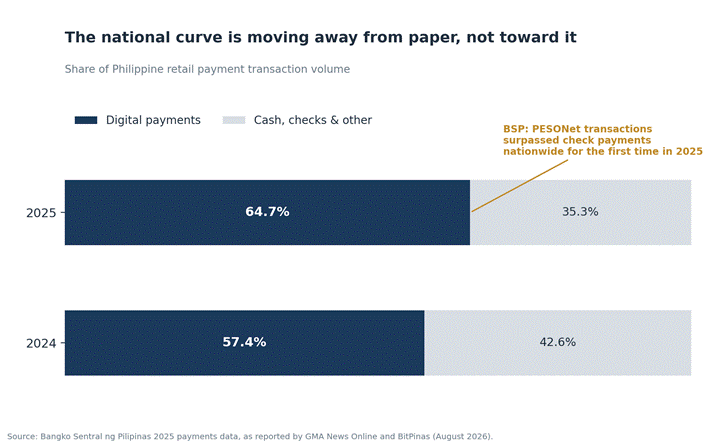
Figure 3. The direction of national payment behavior Chinabank is betting its own customers will lag.
What holds up, and what a skeptical reader should still doubt
Put the pieces together and Chinabank comes out as a bank that read its own customer correctly on the product decision that mattered most, sitting on top of a financial position most challenger banks in this region would trade for immediately, while overselling a launch that is mostly feature parity dressed up as innovation and leaving the actual adoption numbers a mystery.
The part that holds up: this is genuinely not the same move as a digital bank discovering an underserved segment for the first time. Chinabank’s customer, the Chinese-Filipino trading and merchant community, and the underwriting logic built around trust rather than pure collateral, predate the Bangko Sentral’s entire digital banking license framework by seventy years. The decision to digitize checks instead of eliminating them is a specific, well-evidenced read of how that customer still runs trade credit, backed by a legal framework still being enforced, not a legacy feature nobody had the nerve to cut. And the balance sheet behind the bet is real: a bank posting 15.6% return on equity and crossing ₱1 trillion in loans for the first time has the capital and the patience to make a multi-year product transition without betting the institution on it, which is more than can be said for several of the more heavily covered digital-only banks in this region still working toward their first profitable year.
The part that should make a reader pause: the technology itself is rented from a vendor available to Chinabank’s competitors, the specific payment behavior the new platform doubles down on is one the national payments data says the country is actively moving away from, and there’s no public evidence yet that the bet is paying off in adoption, fee income, or deposit growth specific to the new platform. A century-old customer relationship is a real moat. A digital front end licensed from a common vendor is not one, and coverage that treats “next-gen digital banking” as the headline, rather than the relationship it’s built to defend, is telling only half the story Chinabank itself would probably rather you read.
Workshop: is your “niche” actually yours, or just a feature list?
Whether you’re evaluating your own product’s target customer, a company you’re assessing as an investor, or a partnership pitch that leans on the word “niche,” run it through the same three questions this issue just applied to Chinabank.
| # | Question | Your answer |
| 1 | How old is this niche, really? Did you discover this customer recently through data or research, or have you actually served them for years, in a way a newer competitor would need years to replicate? A niche you’ve held for a decade behaves differently than one you found in a spreadsheet last quarter. | |
| 2 | Does the product match how the customer already behaves, or how you wish they behaved? Name the one feature that looks outdated to an outsider but is actually correct for your specific customer. If you can’t name one, you may be building for a generic customer and calling it a niche. | |
| 3 | If a competitor licensed the same technology tomorrow, what would still be yours? Separate what the software does from what the relationship, the history, or the trust does. If the honest answer is “not much,” the moat is thinner than the product launch suggests. |
Hit reply with what you found. A future issue will feature one submission, anonymized on request, with a real breakdown of where the niche is real and where it’s just a good feature list.
Tags: Chinabank, China Banking Corporation, Niche Banking, Philippine Business Banking, My CBC Business, Post-Dated Checks, PESONet, BPI BizLink, BDO, SME Banking Philippines
References
1. Chinabank hits record P28 billion net income in 2025 — China Banking Corporation (chinabank.ph)
2. China Banking Corporation history — Chinabank (chinabank.ph/china-bank-history)
3. About China Bank — Chinabank (chinabank.ph/about-chinabank)
4. Why Chinabank is special to Henry Sy’s family – and what we can learn from it — Rappler
5. Chinabank unveils Next-Gen Digital Banking — The Voice Newsweekly
6. Trade Financing — Chinabank (chinabank.ph/trade-financing)
7. BizLink — BPI (bpi.com.ph)
8. Corporate Cash Management Services — BDO Unibank
9. Solutions Exchange Inc. company profile — BossJob
10. Collecting Payment Through Post-Dated Checks in the Philippines — Respicio & Co.
11. Cheaper Transfers and QR Ph Scans Push Nearly 65% of PH Payments Online — BSP — BitPinas
12. Digital payments accounted for 64.7% of total payments in 2025, says BSP — GMA News Online
13. InstaPay, PESONet transactions topped P24T in 2025 — Philippine Daily Inquirer