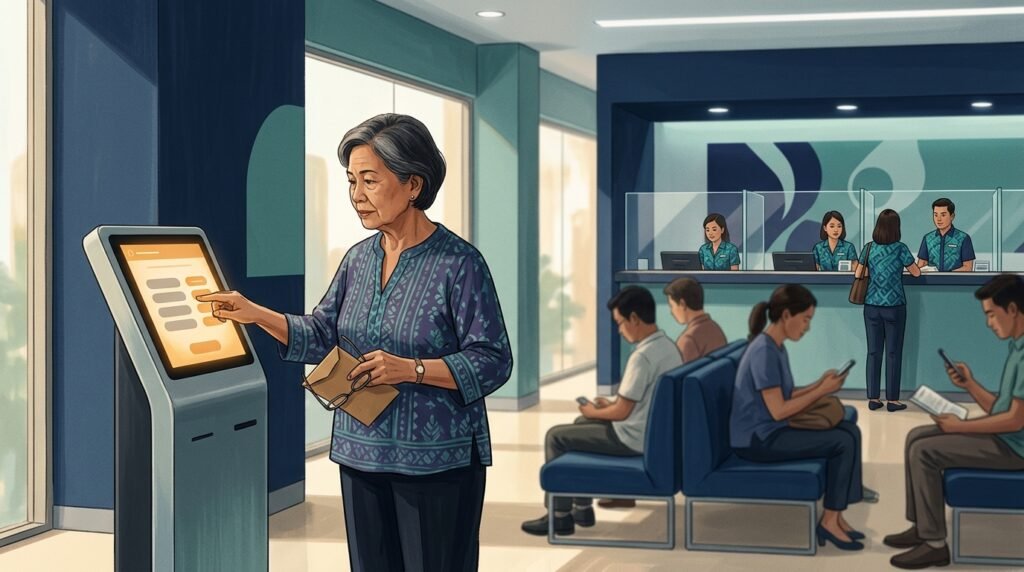
The Service Assist Machine took the paper slip out of the country’s biggest branch network. It did not take out the teller, the cost, or the bet that branches still pay for themselves.
| BDO’s Service Assist Machine is a throughput tool built to keep a fast-growing branch network moving, not a cost-cutting or digital-migration play, and its value now rests on branch economics that got more expensive in 2025. 1. It removes the paper, not the counter. SAM lets a client key in a transaction and get a queue number, but the transaction still ends at a teller, which is why BDO’s own 2025 annual report calls it “an enhanced queue management system.” 2. It was built to support expansion, not to replace people. BDO opened 106 new branches and offices in 2025 and grew its workforce 7% to 47,117, the opposite of what an automation play would show. 3. The branch math behind it is getting harder. Consolidated cost-to-income rose from 55.5% to 57.4% in 2025, while the CASA ratio, the cheap funding branches exist to collect, slipped from 71% to 68%. A retired teacher depositing her pension shows where the gain is real, and where it stops. |
Imagine Nanay Lorna, a retired public school teacher, walking into a BDO branch in a provincial town a few years ago. She pulls a deposit slip from the rack by the door. She writes her account number, her name, the amount, and a breakdown of the bills by denomination. The guard hands her a paper queue number. When her turn comes, the teller spots a smudged digit and slides the slip back. She rewrites it at the counter while the line behind her grows.
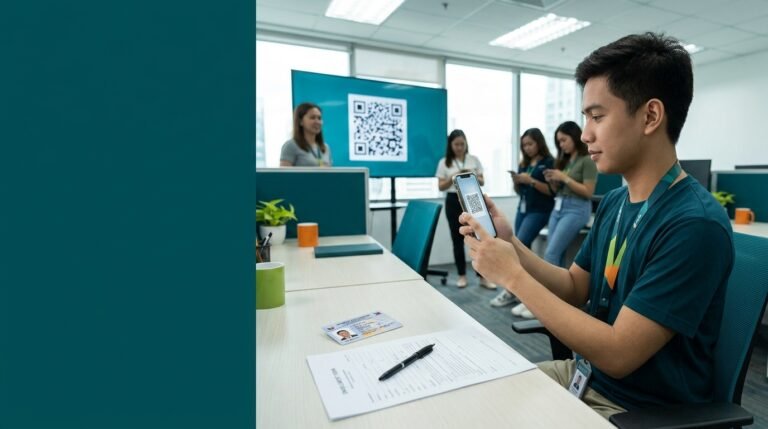
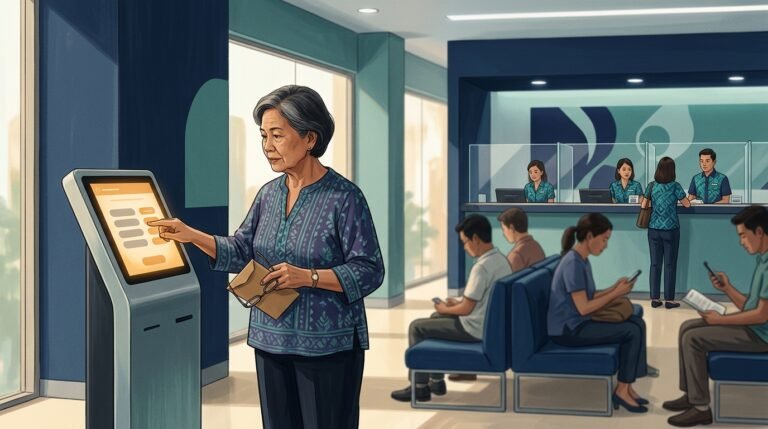
Now picture the same errand on a weekday in 2026. The night before, her daughter books the visit for her on BDO’s website and forwards the QR code to her phone. At the branch, Nanay Lorna scans the code at a touchscreen kiosk, taps her transaction type, and keys in her details. The machine routes her to the priority lane for senior clients and prints her number. There is no slip to fill out and nothing to rewrite. When she reaches the counter, she has nothing to hand over but her ID and her cash, because her details were keyed in at the kiosk.
That is the Service Assist Machine, or SAM. The change is real. The handwritten slip, and the risk of having to rewrite it, is gone from that step. But look at what stayed. She still traveled to a branch. She still waited for a person. A teller still finished the job. SAM made the line smarter. It did not make the line shorter by design, and it did not remove the counter at the end of it. That distinction decides almost everything about whether this product is a breakthrough or simply good housekeeping.
A Kiosk That Calls Itself a Queue
BDO markets SAM as part of a “phygital” branch, a blend of physical and digital service. Coverage in 2024 and 2025 describes it in similar terms: key in your transaction details instead of filling out a form, get a queue number, use priority queuing, and scan a QR code from an online booking. BDO began adding self-service kiosks to branches in 2022, was promoting SAM nationwide by July 2024, and in its 2025 annual report, published in 2026, says it “continued the rollout” of the machine. The bank sits SAM alongside three other tools: the Account Assist Kiosk for paperless account opening, the Universal Teller Machine for cash and check deposits and passbook updates, and BDO Connect, a video link to product specialists.
The most revealing phrase is BDO’s own. The annual report calls SAM “an enhanced queue management system.” That is accurate, and it is modest. A queue system does not complete a transaction. It organizes demand for people who do.
So the real question is not whether SAM is convenient. It plainly is, for the step it covers. The question is why the country’s largest bank keeps investing in a better waiting line at all, six years after its own chief executive said branch needs would be “adjusted” as people moved to digital. In June 2020, BDO President Nestor Tan said the shift to digital would change how many branches the bank needed, starting in crowded metro areas. At the time, BDO reported 1,390 domestic operating branches and offices as of September 2019, plus two full-service branches overseas. By the end of 2025 it reported 1,996 branches and banking offices, including two foreign branches. The two counts are defined slightly differently, so the gap is approximate. The direction is not. BDO did not shrink its branch network. It grew it by several hundred locations.
The pressures behind that choice explain SAM better than any press release.
BDO’s Branch Pressure Map, 2026
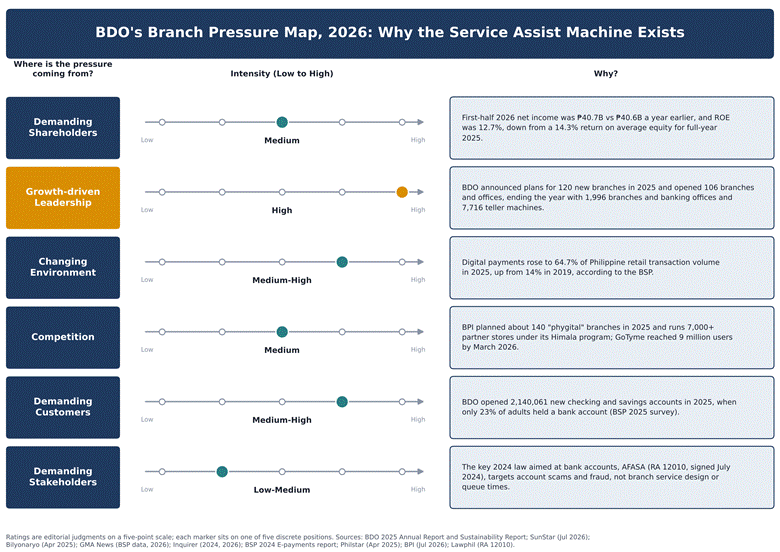
Figure 1. BDO’s Branch Pressure Map, 2026. Ratings are editorial judgments on a five-point scale. Sources listed in the figure footer and References 1, 2, 4, 15, 16, 18, 19, 20, 23, 26 and 27.
| Where is the pressure coming from? | Intensity (Low to High) | Why? |
| Demanding Shareholders | Medium | First-half 2026 net income was ₱40.7 billion against ₱40.6 billion a year earlier, and return on equity was 12.7%, down from a 14.3% return on average equity for full-year 2025. |
| Growth-driven Leadership | High | BDO announced plans for 120 new branches in 2025 and opened 106 branches and offices, ending the year with 1,996 branches and banking offices and 7,716 teller machines. |
| Changing Environment | Medium-High | Digital payments rose to 64.7% of Philippine retail transaction volume in 2025, up from 14% in 2019, according to the BSP. |
| Competition | Medium | BPI planned to reach about 140 “phygital” branches in 2025 and now runs a partner-store network of more than 7,000 outlets under its Himala program, while GoTyme reached 9 million users by March 2026. |
| Demanding Customers | Medium-High | BDO opened 2,140,061 new checking and savings accounts in 2025, in a country where only 23% of adults held a bank account in the BSP’s 2025 survey. |
| Demanding Stakeholders | Low-Medium | The key 2024 law aimed at bank accounts, the Anti-Financial Account Scamming Act (RA 12010, signed July 2024), targets account scams and fraud, not branch service design or queue times. |
Sources: BDO 2025 Annual Report and Sustainability Report; SunStar; Bilyonaryo; GMA News; Philstar; BPI; Inquirer; Lawphil. Ratings are editorial judgments on a five-point scale.
Read the map from the top two rows down. The strongest pressure is not customers or regulators. It is leadership’s own expansion plan, backed by a shareholder case that has gone flat. Customers matter, but mostly through sheer volume: more than two million new checking and savings accounts in 2025, flowing into a network whose new branches are mostly in rural and provincial areas. Regulators barely register. We found no Philippine banking rule that requires a bank to digitize its waiting line.
Two ratings carry real uncertainty. Competition could be rated higher. BPI’s agent network brings account opening to neighborhood stores, which attacks the reason to visit a branch at all. If BPI’s partner-store network keeps scaling past the more than one million new depositors it has already onboarded, that row moves up. Demanding Customers could be rated lower. BDO publishes no wait-time data, no SAM usage figures, and no satisfaction scores tied to the machine. The volume of new accounts is a fact. Whether those customers were frustrated by queues is an inference.
Four Reasons BDO Could Have Built It
There are four reasonable readings of why SAM exists. Each predicts a different top row on the map. Only one fits the numbers.
Reading one: customer convenience. This is the press release story. It predicts that Demanding Customers should be the dominant pressure, and that BDO would publish proof: shorter waits, fewer rejected slips, better satisfaction scores. The evidence is thin. In every public source reviewed, BDO describes benefits in general terms such as saving time and enhancing convenience. It discloses no number of SAM units, no transaction count, and no before-and-after wait time. Convenience is real at the level of a single visit. It is not demonstrated at the level of the network.
Reading two: cost-cutting through automation. This is the reading many analysts apply to any bank kiosk. It predicts Demanding Shareholders on top, and it predicts falling headcount and a falling cost-to-income ratio as machines absorb work. The 2025 numbers rule this out. Consolidated operating expenses rose 13% to ₱165.1 billion. Net interest income rose 9%. The cost-to-income ratio climbed from 55.5% to 57.4%, and at the parent bank from 53.9% to 55.9%. Headcount rose from 44,044 to 47,117. A bank using kiosks to replace staff would not add more than 3,000 people in a year. SAM may save a teller a few keystrokes per client. It is not shrinking the payroll.
Reading three: a funnel into digital. On this reading, SAM teaches branch visitors to use screens so they eventually stop visiting. It predicts Changing Environment as the top pressure, and a branch count that flattens or falls as the funnel works. Tan’s 2020 comment fits this reading. The bank’s behavior since then does not. Branches kept rising, and 2025 openings were concentrated in rural and provincial areas where BDO has argued that physical branches build trust and serve places with weak internet. There is a nuance worth keeping. In an October 2024 promoted article on FinanceAsia, BDO said more than 90% of its new CASA accounts were being opened digitally. BDO did not say how many of those were opened on in-branch kiosks, so “digital” and “in the branch” may overlap. The funnel exists, but it runs through the branch rather than around it.
Reading four: a throughput tool for a branch-led growth plan. This reading predicts Growth-driven Leadership as the dominant pressure, with customer volume close behind. It expects SAM to roll out alongside new branches, in a network that keeps growing, with costs rising as the network grows. That matches every number above. SAM helps each new branch handle more people with fewer errors and fewer handwritten forms. It makes expansion smoother. It does not make expansion cheaper.
The fourth reading wins, with a piece of the third attached. SAM is the front door of a strategy that bets on branches, not a hedge against them.
The Branch Is the Product
Once SAM is read as infrastructure for expansion, the useful question shifts. Does the branch strategy it serves still pay? Three threads answer that: what the machine does, what rivals are doing instead, and what the balance sheet says.
What the machine actually covers
SAM handles the front end of a visit: capturing details, sorting clients, and sending priority customers to the right lane. Its siblings go further. The Universal Teller Machine completes cash and check deposits, bill payments, and passbook updates without a teller, and supports cardless use through QR codes or biometrics. The Account Assist Kiosk pre-fills account-opening forms. Across the network, BDO counts 7,716 teller machines of all types, including ATMs, cash accept machines, and Universal Teller Machines.
Get the next SEA banking case study in your inbox
Free. Unsubscribe anytime.
That split matters. The machines that remove work from tellers are the UTMs and deposit machines. SAM’s job is coordination. It is the cheapest part of the self-service stack to deploy and the least able to change unit costs on its own. If BDO wanted to cut cost per transaction, the lever is moving routine work to UTMs and apps. SAM makes the remaining counter work tidier.
What rivals bet on instead
BDO’s peers are not ignoring branches either. In April 2025, BPI reported 59 phygital, nine prime phygital, and three flagship branches, and planned 70 more hybrid branches that year, with a goal of modernizing its entire branch network within five years. Its larger bet is outside the branch. BPI’s partner-store program, brought under the Himala name in July 2026, turns neighborhood stores into small banking points. BPI says the network has more than 7,000 partner stores, 1,369 of them handle cash deposits and withdrawals, and more than one million new depositors have been onboarded since the program began. GoTyme took a third path, with self-service account-opening kiosks in select Robinsons stores and an app-led model that reached 9 million Philippine users by March 2026.
Set side by side, the three strategies answer the same question differently. BDO says: bring people to a better branch. BPI says: bring the branch to where people already are. GoTyme says: you may never need the branch. SAM is BDO’s answer to how to make “come to us” less painful. It does not answer BPI’s challenge, which is that a sari-sari store down the street may beat any branch line, however smart.
The branch has one defense the others lack, and 2026 supplied a live example. In mid-June 2026, BPI’s app and online banking went down for an extended stretch, which the bank first acknowledged in an advisory on the night of June 14. BPI told customers its branches were open and staff could assist them while it restored digital access. Physical capacity proved its value as a fallback. That is a real argument for BDO’s network. It is also an argument for keeping branches staffed, not for making them leaner.
What the balance sheet says
The financial case for a big branch network rests on one thing above all: cheap deposits. Current and savings accounts, or CASA, pay far less interest than time deposits. A bank with a high CASA ratio funds its loans more cheaply than its rivals. That is the payoff branches are supposed to deliver.
BDO’s payoff is still large but no longer widening. Its CASA ratio was 71% at the end of 2024 and 68% at the end of 2025. In the first half of 2026, total deposits grew 13% while CASA deposits grew only 4%. When total deposits outgrow CASA by that margin, CASA’s share of the funding base keeps falling. The pattern looks a lot like the one IdeyaHub traced at a much smaller lender in PBCOM Fixed Its Core Banking System. Its App Still Gets 3.3 Stars., where the CASA ratio slid and growth had to be funded with costlier time deposits. BDO’s scale and starting point are far stronger. The direction is the same.
Meanwhile, the cost of the network rose faster than revenue in 2025. Operating expenses grew 13%. Net interest income and non-interest income each grew 9%. Net income grew about 6% to a record ₱87.2 billion. In the first half of 2026, the gap closed somewhat. Cost growth slowed to single digits and pre-provision operating profit rose 12%. But net income was essentially flat at ₱40.7 billion, so the operating gain did not reach the bottom line, and return on equity was 12.7%, against a 14.3% return on average equity for full-year 2025.
Put the threads together. BDO is spending more to run a bigger network. That network is bringing in more deposits, but a smaller share of them are the cheap kind. SAM makes each branch visit smoother. It does nothing direct about either problem. The product answers a Medium-High pressure, customer volume, well. It answers the High pressure, leadership’s expansion, only indirectly by making new branches easier to run. It does not touch the shareholder pressure at all. That is not a failure of the machine. It is a sign that the machine was never the strategy. The branch is.
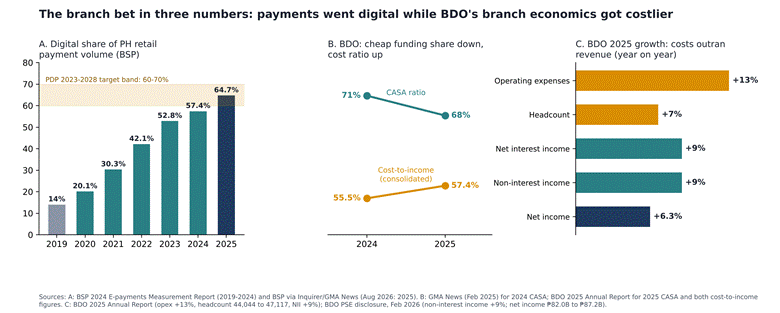
Figure 2. Payments went digital while BDO’s branch economics got costlier. Panel A: BSP 2024 E-payments Measurement Report (2019 to 2024) and BSP via Inquirer and GMA News (2025). Panel B: GMA News (2024 CASA ratio) and BDO 2025 Annual Report. Panel C: BDO 2025 Annual Report and BDO PSE disclosure, February 2026. See References 1, 3, 6, 16, 25 and 26.
Where the model is fragile
Three things could break the logic. First, if CASA keeps slipping, the main financial reason for a branch-heavy model weakens year by year, and a smarter queue cannot fix funding costs. Second, if agent networks like BPI’s Himala prove they can open accounts and handle cash at a fraction of a branch’s cost, every new BDO branch looks expensive by comparison. Third, the trend in payments runs one way. Digital payments went from 42.1% of retail volume in 2022 to 52.8% in 2023, 57.4% in 2024, and 64.7% in 2025. The government’s development plan targets 60% to 70%. Each point of that shift is a reason one fewer person stands in a branch line.
What would make the model stronger is also clear. Branches in rural and provincial areas, where BDO is opening most new sites, may be the places where digital adoption lags and trust in a physical bank still decides where people put their money. If BDO’s two million-plus new accounts in 2025 came mostly from those areas, and if those accounts become low-cost savings over time, the branch bet pays. BDO does not publish that split. Until it does, a skeptical reader should treat the payoff as plausible but unproven.
Three Readers, Three Answers
For the customer, the verdict is positive, with a limit. This answer ties to the Demanding Customers row. If you must visit a branch, SAM removes the most annoying part of the old process. No handwritten slip, no rejected form, a clear priority lane for seniors, and the option to book ahead. For a first-time account holder or an older client, that is a meaningful improvement. But SAM does not shorten the time you wait for a person, and BDO publishes nothing to show it does. If your goal is to avoid the line entirely, the better tools are the Universal Teller Machine, BDO Online, and BDO Pay, not the kiosk at the door.
For BDO’s strategy, the verdict is sound but incomplete. This answer ties to the Growth-driven Leadership and Demanding Shareholders rows. SAM is a sensible, low-risk part of making a growing network work. It removes handwritten forms, standardizes the front of every branch, and gives new rural branches a modern feel from day one. The weakness is not the machine. It is that the branch strategy behind it cost more in 2025 while delivering a smaller share of cheap deposits. Return on equity was 14.3% for 2025 and 12.7% in the first half of 2026. If BDO wants SAM to count as more than housekeeping, the next step is to connect the kiosk to cost: route routine requests from SAM straight to UTMs, measure counter time saved, and publish it.
For regulators and analysts, the verdict is to watch the right numbers. This answer ties to the Demanding Stakeholders and Changing Environment rows. Nothing about SAM raises a regulatory concern. It does, however, illustrate a gap in how Philippine banks report branch innovation. Banks disclose machine types and branch counts. They rarely disclose usage, wait times, or cost per transaction by channel. As digital payments pass two-thirds of retail volume, the more useful questions for an analyst are about the branch itself: what share of BDO’s new accounts come from first-time bank users, how much of that becomes stable CASA, and what each branch costs to run against what it gathers. Those numbers will say more about BDO’s next five years than any kiosk.
What a skeptical reader should still doubt: that SAM has measurably cut waiting times anywhere, because no data has been published; that the “over 90% digital” account-opening figure means clients are leaving branches, because BDO has not said whether in-branch kiosks count as digital; and that rural expansion will produce cheap deposits at the rate the network needs, because the 2025 and first-half 2026 CASA trend points the other way.
Before You Digitize Your Own Front Door
Most organizations face a version of BDO’s choice. A front-of-house step is slow and paper-heavy, and a screen can fix it. The fix is easy. The harder question is whether it answers the pressure that actually matters. Use the questions below on your own product or initiative before you build. If the trade-offs of reconnecting existing tools interest you, IdeyaHub’s earlier piece Philippine Banks Aren’t Inventing New Products. They’re Reconnecting Old Ones. shows the same pattern across ten Philippine institutions.
| # | Question | Your answer |
| 1 | Which step does this remove, and which step does it leave? Write down the last human action in the process. If your new tool ends before that action, you have improved coordination, not capacity. | |
| 2 | Which pressure does the product answer, and is it the strongest one? Rate your pressures first, then check whether the product addresses the top-rated row or a weaker one. | |
| 3 | What number would prove it worked, and will you publish it? Name one metric, such as wait time, cost per transaction, or error rate, that would change if the product succeeds. If you cannot name it, you cannot defend the product. |
Your Innovation Pressure Map
| Where is the pressure coming from? | Intensity (Low to High) | Why? |
| Demanding Shareholders | Low ○○○○○ High | |
| Growth-driven Leadership | Low ○○○○○ High | |
| Changing Environment | Low ○○○○○ High | |
| Competition | Low ○○○○○ High | |
| Demanding Customers | Low ○○○○○ High | |
| Demanding Stakeholders | Low ○○○○○ High |
Fill in one marker per row and one sourced fact per “Why?” cell. If every row reads High, go back and look harder. At least one pressure is usually weaker than it feels.
Tags: BDO Unibank, Service Assist Machine, BDO SAM, Phygital Banking, Branch Banking Philippines, Philippine Banking 2026, Banking, Fintech, AI & Data in Financial Services, Financial Inclusion
IdeyaHub newsletter
Enjoyed this case study?
Get the next deep dive on Southeast Asian banks, fintechs and insurers in your inbox. One email a week.
Free. Unsubscribe anytime.
References
1. BDO Unibank 2025 Annual Report, BDO Unibank
2. BDO Unibank 2025 Sustainability Report, BDO Unibank
3. BDO recorded ₱87.2 billion net income in 2025 (PSE disclosure), Philippine Stock Exchange
4. BDO Posts ₱40.7 Billion Net Income in First Half of 2026, SunStar
5. BDO Unibank H1 2026 net income rises to ₱40.7 billion on strong core operations, Context.ph
6. BDO nets P82B in 2024, GMA News
7. BDO introduces nationwide self-service machines, Manila Bulletin
8. BDO branches provide phygital banking solutions, SunStar
9. Easier, simpler branch experience awaits at BDO, Philstar
10. Banking made easy: Alden Richards shows how BDO delivers convenience, Context.ph
11. From counter to clicks: Alden Richards explores BDO’s branch innovations, Mindanao Times
12. BDO integrates benefits of digital to branch banking via self-service technology, Romblon News Network
13. BDO Unibank keeps customers first with commitment to excellence and innovation (promoted content), FinanceAsia
14. BDO to scale down network expansion in metropolis, boost shift to digital, GMA News
15. No bank nearby? Not for long, says BDO’s Nestor Tan: 120 new branches coming in 2025, Bilyonaryo
16. Digital payments accounted for 64.7% of total retail payments in 2025, says BSP, GMA News
17. Over half of retail payments went digital in 2023, beating BSP goal, Inquirer
18. BSP: Filipino account ownership down to 50% in 2025, household access up to 85%, GMA News
19. BPI ramps up ‘phygital’ transformation, Philstar
20. “Himala”: BPI transforms everyday stores into full-service banking hubs, BPI
21. BPI online banking unavailable for nearly two days, bank confirms, Manila Bulletin
22. BPI restores key digital banking services, Inquirer
23. GoTyme hits 9M users as of March 2026, profitability still on track, Inquirer
24. What are GoTyme Bank kiosks?, GoTyme Bank
25. Philippines hits digital payments goal: BSP, Inquirer
26. From Surge to Stability: Digital Payments Driving a Steady Transition (2024 Report on E-payments Measurement), Bangko Sentral ng Pilipinas
27. Republic Act No. 12010 (Anti-Financial Account Scamming Act), Lawphil